When true friendship effects change…

In June Dale Kuehne wrote a blog post “Change that believes in me” that speaks to the journey of taking a teaching position at Saint Anslem College (Manchester, NH) which is run by the Benedictine monks of the Abbey there. He doesn’t say it this way, but I do believe he points to something deeper than mere colleagueship: friendship. Perhaps all of us need to think more deeply what our friendships mean and how seriously we engage in them. I recommend this Dale Kuehne’s post….

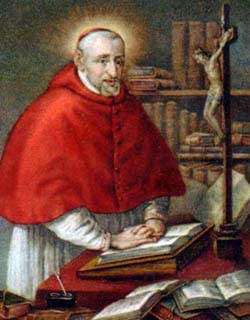
Saint Robert Bellarmine

San Roberto Bellarmino.jpg

Today’s saint is special to me for many personal reasons, one of which is the fact that he gave himself to the Lord for his total and unreserved use. One can claim to like Bellarmine for his intellect, or the way he worked with controversial Catholic preachers and theologians and Protestants, or with Galileo, or his service to several popes, but what about his capacity to love the Lord and his neighbor, and what about his ability to know his limitations and his gifts, or his capacity to live the Beatitudes? 

Each time I am in Rome I make a path to St Ignatius’s Church where Bellarmine is buried in the third chapel on the right as you face the main altar, near to his dear friend, Saint Aloyius Gonzaga, to pray for several intentions, among them are: theologians, the pope, the Jesuits, +Avery Robert Dulles and of course, myself.


The Roman Martyrology (2005) has this entry for Robert Bellarmine (1542-1621): 

The feast of St. Robert Bellarmine, from the Society of Jesus, Doctor of the Church and bishop, who was outstanding at arguing the theological controversies of his day. He resigned his red hat, then gave himself wholeheartedly both to pastoral ministry in Capua, with great success, and took up very many challenges in defense of the doctrine of the faith at the Holy See in Rome.

Traces magazine: there’s an app for it on iPad

Traces.jpg

Great news with you: Traces is now available for iPad users and users of Apple’s latest OS, Lion. All that is necessary is to go to the App Store and enter “Traces” and you will find it.   


There are many, pretty obvious, advantages to this new form, including receiving Traces as soon as it’s published, paying less for a subscription and the ability to easily tell friends who have an iPad.


I hope all of you Apple and iPad users will sign up, immediately, and tell your friends! 

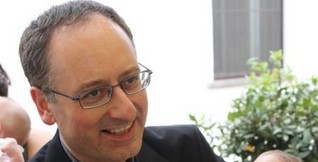
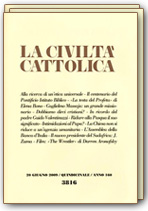
La Civiltà Cattolica has new leadership with Antonio Spadaro

Antonio Spadaro.jpgLa Civiltà Cattolica, THE prestigious journal of opinion in Italy, and perhaps in very many ecclesial circles, has new leadership in Jesuit Father Antonio Spadaro. La Civiltà Cattolica has been at the service of the Church 162 years.

Father Antonio, 45, takes the helm from Father GianPaolo Salvini, 75, who’s been the head of La Civiltà Cattolica since 1985, an apostolate of the Italian Jesuits in Rome.
While not an official organ of communication of the Holy See, La Civiltà Cattolica is reviewed by a ranking –though competent– official of the Secretariat of State. It is said that the Papal Palace, that is, the Pope himself, reviewed the pre-publicaiton draft of the journal; Pope Paul VI changed the process.

 La Civiltà Cattolica cover.jpg

The new director, Father Antonio, also the superior of the House of Writers (near to the Porta Pinciana) is trained in literary criticism and has been at the journal for a time since 1994. He’s from Messina and was ordained in 1996. All of his training was in Italy but he completed his Jesuit formation, tertianship, in Ohio. He earned a doctorate from the Gregorian University under the direction of the Australian Jesuit Gerald O’Collins. The new director has published some 15 books and he’s interested in the new social communications.
Don Antonio hosts two blogs: “Antonio Spadaro” and “Cyberteologia.”
He got a difficult road ahead of him: bringing La Civiltà Cattolica further into the new millennium with the use of English, social media and greater visibility. The voice of  La Civiltà Cattolica needs to be heard. A new broom sweeps clean.
May God grant Father Antonio many and rich blessings as he begins his new ministry.

Our Lady of Sorrows

Why the Sorrowful Mother?  Why do Catholics honor Mary, the Mother of God with the title of “Sorrows”? Is it an honor to be called such? Some good questions, I think. Mark Miravalle answers the question this way:

Our Lady of Sorrows icon.jpeg

We could just as well ask St. Paul why he instructs all Christians to “make up what is lacking in the sufferings of Christ for the sake of his body, which is the Church” (Colossians 1:24).

We Christians, too, will suffer and do suffer. Our suffering has the capacity to release a portion of the infinite graces merited by Jesus at Calvary, what theologians call “objective redemption.” But as these redemptive graces of Jesus must be personally received by the human heart, every Christian has a role in this mysterious release and reception of grace which theologians call “subjective redemption.”

Mary alone, as the “New Eve” with Jesus the “New Adam,” participates in both objective and subjective redemption: both in the historic acquisition of redemptive grace and in the providential release of redemptive grace. Blessed John Paul would teach of his mother and ours that Mary’s intensity of suffering at Calvary was a “contribution to the redemption of all” (Salvifici Doloris, 25).

Continue reading Our Lady of Sorrows

Pope to new bishops: balance your Christian life, be open to the laity

Newly ordained bishops are invited to Rome for a baby bishops’ camp each year. This year more than 100 new bishops came together for a series of workshops sponsored by the Congregations for Bishops and Eastern Churches on the theme of the Holy Spirit in the life of the bishop and the Church. The pope addressed the new bishops today. He exhorted them to live a balanced Christian life of prayer, study, work and rest. Moreover, he reminded the bishops that they are pastors of souls –not CEOs– and have to be concerned for the eternal destiny of those they are called to serve asking them at the same time to welcome the gifts the laity bring to the life of the Church. Every baptized person is brought into the inner life of the Trinity. In other words, the Pope told the bishops don’t act arbitrarily and be human: clericalism has no place in pastoral leadership.

Watch the video presentation of the event.

Vatican cardinal meets SSPX superior general

Card Wm J Levada.jpgThe Vatican office organizing the “talks” between the Holy See and the Society of Saint Pius X issued a press release going over some of the areas of concern between the two. William Cardinal Levada, Prefect of the Congregation for the Doctrine of the Faith met today for two hours with Bishop Bernard Fellay. Among the issues presented and discussed was the set of principles called the “Doctrinal Preamble” which is outlining the ecclesial solution of bringing the SSPX into full communion with the Catholic Church. Some are thinking that the pastoral solution might be akin to that of a personal prelature like what the Opus Dei is in the Church.

Bernard Fellay.jpeg

The Doctrinal Preamble gives canonical and ecclesiological guidance for life in the Church, including principles for interpreting Church teaching since the Second Vatican Council, namely ecumenism, interreligious dialogue, religious freedom and the sacred Liturgy. This is understood in the saying: thinking (feeling) with the Church” (sentire cum ecclesiae).

No deadline was given but it is understood that a period of a two to three months is given to understand and pray about the issues at hand. It has been 21 years since the SSPX broke with Catholic Church.

Read the Vatican Radio’s announcement about the meeting.
Cindy Wooden of CNS covered the story.

SSPX insulting Pope Benedict?

I raise the question of the Society of Saint Pius X insulting Pope Benedict with a degree of seriousness. Why? Because when I read the article that was written by Father Regis de Cacqueray and published with the approval of the SSPX Superior General Bishop Bernard Fellay, I thought while many of the ideas need to be understood better and are worthy of further investigation, de Cacqueray’s seeming intentions and tone are really offensive and unbecoming of a priest.

As Pope Benedict has said and indicated many times, no one is above scrutiny. Charity requires the teaching of truth; the first item of justice ought to be charitable discourse to correct error. I do, however, think Father Regis de Cacqueray’s rhetoric is rather inflamatory.

The National Review had an opinion piece on the issue, too.
AND all this around the days of serious conversation between the Holy See and the SSPX!!!
What do you think?

Exaltation of the Holy Cross

Exaltation of the Cross Pdella Francesca.jpg

Consummatum est. It is completed — it has come to a full end. The mystery of God’s love toward us is accomplished. The price is paid, and we are redeemed. The Eternal Father determined not to pardon us without a price, in order to show us especial favor. He condescended to make us valuable to Him. What we buy we put a value on. He might have saved us without a price –by the mere fiat of His will. But to show His love for us He took a price, which, if there was to be a price set upon us at all, if there was any ransom at all to be taken for the guilt of our sins, could be nothing short of the death of His Son in our nature. O my God and Father, Thou hast valued us so much as to pay the highest of all possible prices for our sinful souls– and shall we not love and choose Thee above all things as the one necessary and one only good?


Blessed John Henry Newman

Meditation on the 12th Station