Poverty Eradication and Intergenerational Justice: Stewardship, Solidarity and Subsidiarity

This coming year Pope Benedict is going to spend time teaching matters of Justice. In fact, he’s called for a new emphasis on Justice several times in the past year. St John’s University is a college operated by the Congregation of the Mission (the Vincentians), the religious order founded by the great Saint Vincent de Paul who had a special love for the poor and marginalized but also taught that one can’t effectively serve the poor without an intimate relationship with Jesus Christ. For Saint Vincent de Paul, in order to walk with the poor one had to first first walk with the Lord. To that end, the Vincentian Fathers, Brothers and laity organized the Vincentian Center for Church and Society.


Next week, there is the 7th Biennial Vincentian Chair of Social Justice at St. John’s University (Queens, NY Campus) on “Poverty Eradication and Intergenerational Justice: Stewardship, Solidarity and Subsidiarity” to take place on October 22, 2011. 

More information can be found here: Poverty Eradication and Intergenerational Justice.pdf

“New Evangelizers for the New Evangelization – The Word of God grows and spreads” in a spirit of joy

Fisichella.png

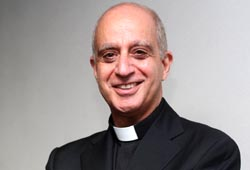
How does one evangelize? Why does one evangelize? Or not? Tomorrow in Rome, Archbishop Rino Fisichella, President of the Pontifical Council for Promoting the New Evangelization,  will host a meeting entitled “New Evangelizers for the New Evangelization : The Word of God Grows and Spreads.” In a recent interview, Fisichella said: 

“For new evangelization, this [the issue of immigration] is certainly a factor to be taken seriously, because we have millions of Christians on the move in different countries, bringing with them not only the richness of their Christian experience, but who also come to meet the challenges which Europe in particular but also the United States present, with regards to secularization”.

“… we want to reinforce that evangelisation is the very mission of the Church and it has been going on for over two thousand years, but it needs to find a new language, a new lifestyle one that is respectful but has a deeply rooted identity”, evangelisers “who have a profound sense of belonging to the Church and the Christian community but at the same time who are open to others. And also a good dose of joy and enthusiasm, which is never a bad thing!”

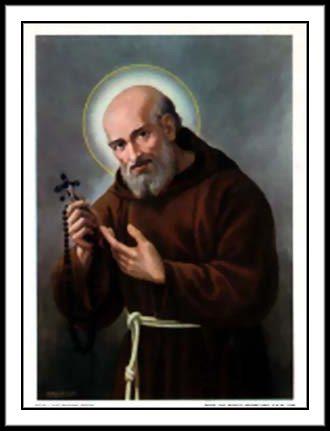
Saint Seraphin of Montegranaro

St Seraphin of Montegranaro.jpg

More of the simple lay friars were made saints than the Capuchin priest friars. I wonder why? But a snippet from a biography on Saint Seraphin may be helpful to get a sense of the man:


In 1556, Felix repeated his request to the provincial minister who admitted him to the novitiate at Jesi, where Felix received the name, Seraphin. Upon his reception into the Order, Seraphin remarked, “I have nothing‹just a crucifix and a rosary‹but with these I hope to benefit the friars and become a saint.”

Although he was not totally illiterate, Seraphin could speak about God more eloquently than any theologian. Even the bishop of Ascoli, the eminent theologian, Cardinal Bernerio, sought Seraphin’s advice in especially difficult cases. 

With himself, Seraphin was austere. Only once in his life did he accept a new habit, and then, only out of obedience. For 40 continuous years, all he ate was soup or salad. In keeping with the spirituality prevalent at the time, Seraphin had a personal devotion of serving as many eucharistic liturgies as possible.

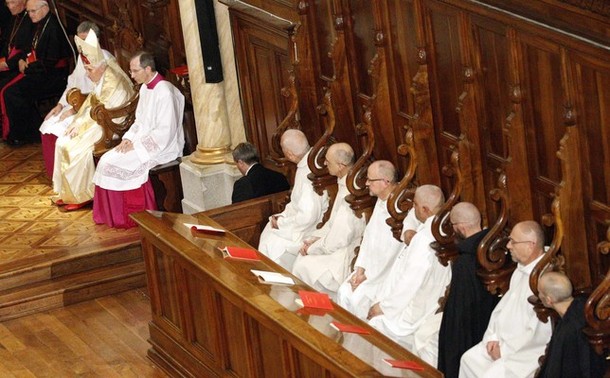
Pope Benedict throws light on the value of the monastic life


Pope and Carthusians 2011.jpgIn speaking at a Charterhouse on October 9, Pope
Benedict contrasted modern life and the monastic life saying that society
“throws light on the specific charism of the Carthusian monastery as a
precious gift for the Church and for the world, a gift which contains a
profound message for our lives and for all humanity. I would summarise it in
these terms: by withdrawing in silence and solitude man, so to speak, ‘exposes’
himself to the truth of his nakedness, he exposes himself to that apparent
‘void’ I mentioned earlier. But in doing so he experiences fullness, the
presence of God, of the most real Reality that exists. … Monks, by leaving
everything, … expose themselves to solitude and silence so as to live only
from what is essential; and precisely in living from the essential they
discover a profound communion with their brothers and sisters, with all
mankind”.
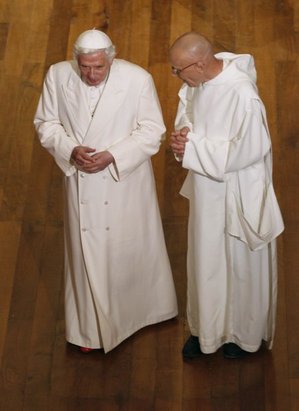

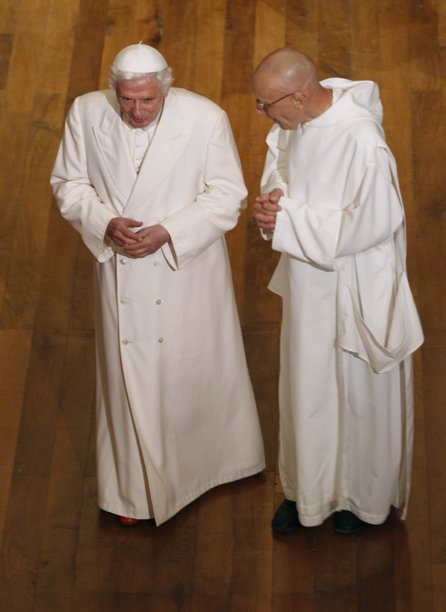
Pope and Carthusian Prior 2011.jpg

This vocation, the Pope went on, “finds its response in a
journey, a lifelong search. … Becoming a monk requires time, exercise,
patience. … The beauty of each vocation in the Church lies in giving time to
God to work with His Spirit, and in giving time to one’s own humanity to form,
to grow in a particular state of life according to the measure of maturity in
Christ. In Christ there is everything, fullness. However we need time to
possess one of the dimensions of His mystery. … At times, in the eyes of the
world, it seems impossible that someone should spend his entire life in a
monastery, but in reality a lifetime is hardly sufficient to enter into this
union with God, into the essential and profound Reality which is Jesus
Christ”.

“The Church needs you and you need the Church”, the
Holy Father told the monks at the end of his homily. “You, who live in
voluntary isolation, are in fact at the heart of the Church; you ensure that
the pure blood of contemplation and of God’s love flows in her veins”.
Saint Louis Bertrand

St Louis Bertrand2.jpg

O God, through mortification of the body and preaching of the faith, you raised the blessed Louis, your confessor, to the glory of the saints; grant that what we profess by faith we may ever fulfill by works of piety.


The preaching one hears from a member of the Order of Preachers ought to lead each person to a deeper relationship with God. Saint Louis Bertrand said, “If because of your preaching men lay aside enmities, forgive injuries, avoid occasions of sin and scandals, and reform their conduct, you may say that the seed has fallen on good ground.  But to God alone give all the glory and acknowledge yourselves ever unprofitable servants.”


~Saint Louis Bertrand to the young Dominican students


Let us pray through Saint Louis Bertrand’s intercession for the Church in the Americas and the Islands.

14 countries deny religious freedom, says a US agency

The annual report on religious freedom lists 14 countries which deny religious freedom to their citizens. The United States Commission on International Religious Freedom (www.uscirf.gov) is a bi-partisan US Federal commission, appointed by the US President to advise him and Congress on matters pertaining to the freedom of religion.

Visit the above link for the report and other interesting information.

Of particular concern are: Burma, China, Egypt, Eritrea, Iran, Iraq, Nigeria, North Korea, Pakistan, Saudi Arabia, Sudan, Turkmenistan, Uzbekistan and Viet Nam.
Rome Reports gives the story.

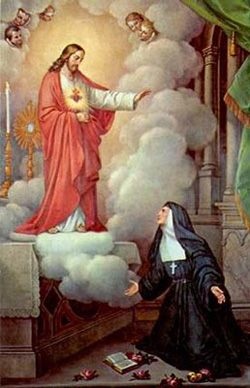
Our Lady of the Rosary

OLR and St Dominic.jpgThe rosary is essential to the spiritual life of Christians. We ought to live the rosary.

The rosary is a practical study of sacred Scripture in the we remain faithful to the call to be close to Christ through constant a memory of the life, death, resurrection and ascension of the Lord. Theologically, we call this the Paschal Mystery.

The rosary, popularly seen as a Marian prayer (i.e., connected to the Blessed Virgin Mary), but really it is a Christological prayer.

The supreme victory promised by God through the intercession of Mary is none other than being generated by love and the grace of conversion. Praying the rosary keeps us in touch with Christ, the Savior, the Good Shepherd.

Read more in the John Paul II teaching found in his apostolic letter, Rosary of the Virgin Mary, and a more of the feast today given by CNA.

Catholic bishops and religious freedom

Amy Sullivan of Time magazine wrote a piece today, “Why Catholic Bishops are Targeting Obama on Religious Freedom.” I don’t particularly think Sullivan’s article is not all that informative, in fact, I think she needs to review it again and republish it. She does, however, indirectly say that Catholics –indeed all people of faith– better wake up today and get with the program: the current presidential administration of the US government is narrowing an understanding and practice of religious freedom. Catholics, unlike the Jews or the Muslims are too often slow to know the horizons of the debate. Catholics don’t often go up to Mount Nebo to survey the geography or their own history. Whether recent events are the most egregious in 30 years is a matter of opinion, but the trampling (or reduction) of religious freedom harms everybody, atheist and the Legion of Mary member alike.

It’s time to get fluent in the terms of religious freedom, pun intended.
This is not a Catholic issue. This is an issue for all people who live a life of faith.

Pope encourages sustained inter-religious dialogue

Every 5 years a bishop is to make a visit to the Eternal City first to pray at the tombs of Saints Peter and Paul and secondly to make a report to the Pope (and his curia). The church-term for such a meeting is called the “ad limina” — to the threshold of the apostles, the Church, the heartbeat of our faith. It is not a meeting of checking-in with the CEO, CFO and the COO of the company. For a bishop is not a branch manager. This is a gesture of communion between two people who are in love with Christ and His sacrament, the Church; it is a meeting of one pastor meeting the Supreme Pastor, Christ, through the ministry of the See of Peter. It is a time to verify the good being done and to get feedback about what more needs to be done for the good of the faithful. With Benedict’s age I think the 5-year meeting is now about every 7 years. 

In recent weeks, Benedict has been meeting with Indonesian bishops. Part of his concluding address to the latest group has an encouragement to advocate inter-religious dialogue. As you can tell, Pope Benedict XVI is a pope of dialogue. The relevant paragraph follows:

Continue reading Pope encourages sustained inter-religious dialogue