Saint Elizabeth Ann Seton

Behold a wise woman who has built her house. She feared the Lord and walked the right path. (the Entrance verse at Mass)

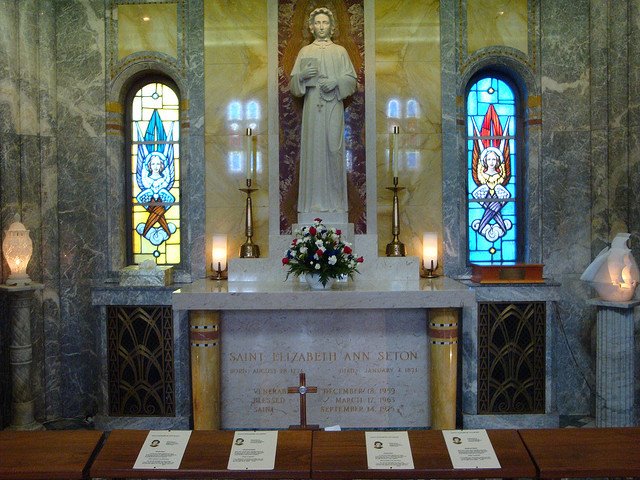
Elizabeth Ann Seton tomb.jpgThe first United States native to be canonized by the Catholic Church is Elizabeth Ann Seton (August 28, 1774 – January 4, 1821). She is the famous American convert, wife, mother and founder of a religious congregation of women (The Sisters of Charity) revolutionized the work of the Church in the US. Seton’s motto, “Hazard yet forward” is a indication of her deep conviction that Christ indeed is our Savior and everything we do ought to be done for Him. Our “hazard” is being bold in proclaiming the Good News of Salvation, in proposing to live this Good News so that our lives are truly different and all people may see the face of Christ in our own.

Let us call upon Saint Elizabeth Ann Seton for her intercession with the Lord to help us hazard yet go forward in doing all things for Christ and His sacrament, the Church for our own salvation and the salvation of others.
The Church prays
O God, who crowned with the gift of true faith Saint Elizabeth Ann Seton’s burning zeal to find you, grant by her intercession and example that we may always seek you with diligent love and find you in daily service with sincere faith.

Pope Benedict XVI’s monthly prayer intentions for January 2012

Pope Benedictus XVI

Image via Wikipedia

One of the ministries of this blog is to pray with the Pope for the Church. Benedict XVI’s prayer intentions that are published through the Apostles of Prayer focus our attention. In 2012, pray with me for …

The general intention
That the victims of natural disasters may receive the spiritual and material comfort they need to rebuild their lives.
The missionary intention
That the dedication of Christians to peace may bear witness to the name of Christ before all men and women of good will.
Enhanced by Zemanta

Our Dayspring

Decorated capital SGheraducci.jpg


Our Savior, the Dayspring from the east,
has visited us from on high, and
we who were in darkness and shadow 
have
found the truth,
 for
the Lord is born of the Virgin!

 
Let
us, the faithful, run and give our praising,

Hymns
for the Incarnate God let us be raising!

Holy Family


Holy Family JdeBray.jpg

O
God, who were pleased to give us the shining example of the Holy Family,
graciously grant that we may imitate them in practicing the virtues of family
life and in the bonds of charity, and so, in the joy of your house, delight one
day in eternal rewards.

Today is a fitting day to follow the Fourth Commandment: Honor your father and mother. Of course, this applies to our living and deceased parents.

The consistent teaching of the Church, based on sacred Scripture and Tradition, tells us that the family is an irreplaceable contribution to the good of society. In an eminent
way the family, through responsible motherhood and fatherhood, and the spouses’ unique and singular participation in God’s work of co-creation. Pope Benedict XVI reminds that us that “the
natural family, as an intimate of life and love, based on marriage between a
man and a woman, constitutes ‘the primary place of humanization for the person
and society,’ and ‘a cradle of life and love'” (Message for the Celebration
of the World Day of Peace 2008).

Holy Innocents

holy-innocents11.jpg

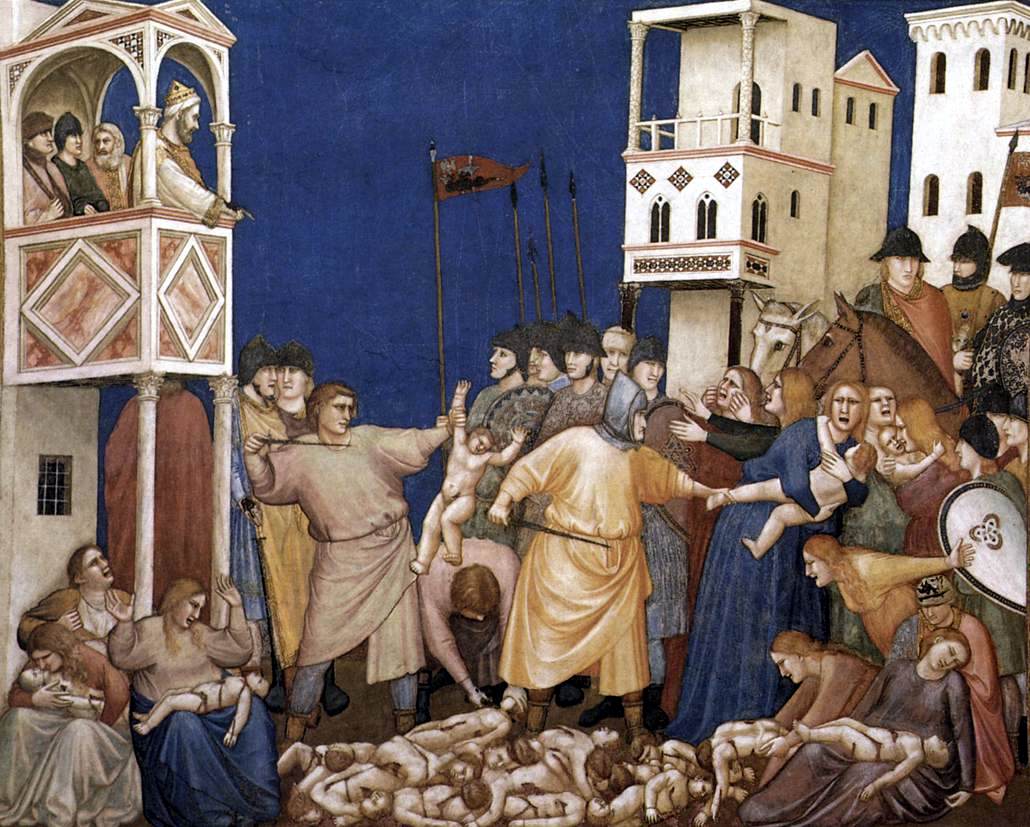
At the king’s command these innocent babes and little Children were put to death. They
died for Christ, and now in the glory of heaven as they follow Him, the
spotless Lamb, they sing for ever: Glory to You, O Lord!


O God, whom the Holy Innocents confessed and proclaimed on this day, not speaking but by dying, grant we pray, that the faith in you which we confess with our lips may also speak through our manner of living.


Pay close attention to the sentiments of this prayer: confession of the reality of God not by words but by actions, by the way we live. How appropriate to keep this in mind these days.

Saint John the Evangelist

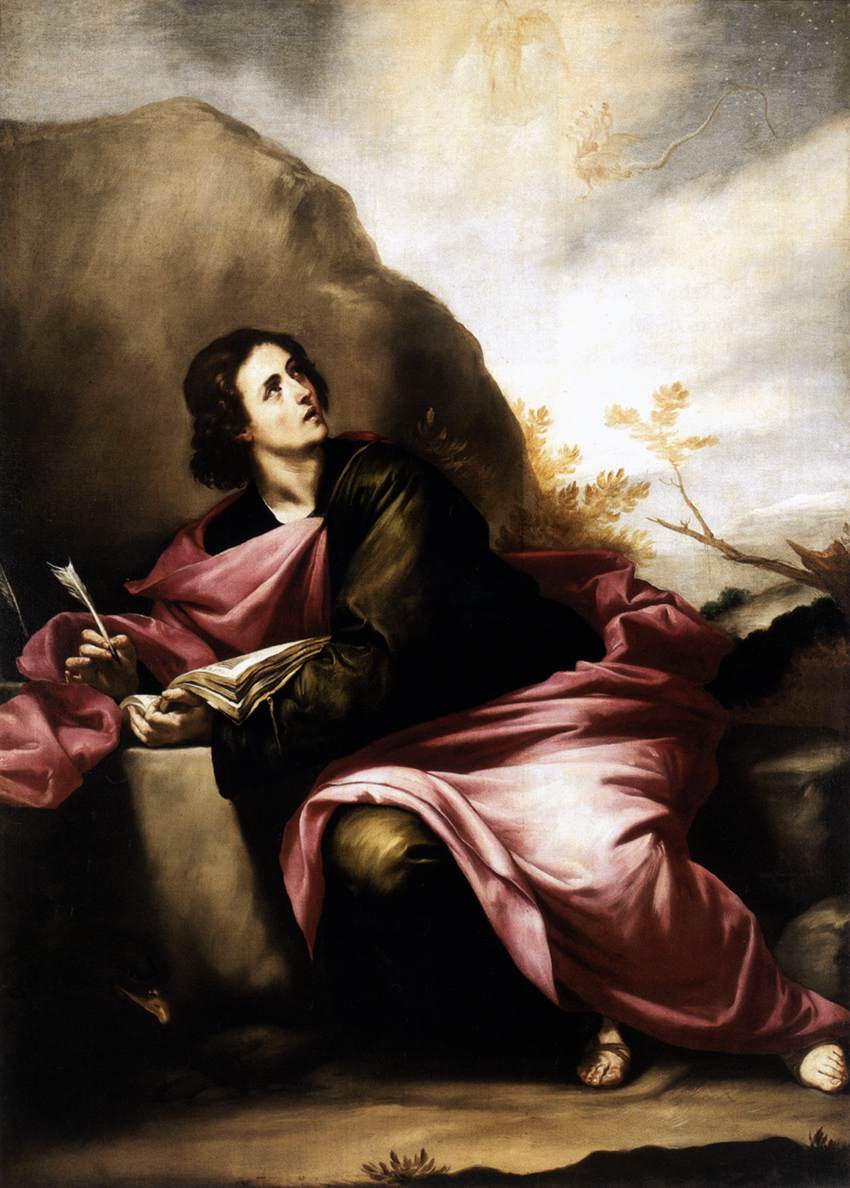
St John on Pathmos ACano.jpgToday, the Church celebrates the liturgical memorial of the Beloved disciple, Saint John the Evangelist. As you know, John is the great theologian, perhaps you might say after Saint Paul, of Jesus. His Gospel is a superb love story.

At dinner tonight Abbot Caedmon of Portsmouth Abbey blessed wine. It was a wonderful experience to hear the prayers used and a churchman pointing to a significant Catholic sacramentality that’s not often seen today.

Saint Stephen

St Stephen Fra Angelico.jpg

You are the chief in the choir of Martyrs, like unto an angel; who pleaded with God for those that stoned him.  O blessed Stephen, intercede for us with the Lord.

 (A Sarum text)

Grant, Lord, we pray, that we may imitate what we worship, and a learn to love even our enemies,  for we celebrate the heavenly birthday of a man who knew how to pray even for his persecutors.

Catholic priest at the South Pole for Christmas

Steve Rossetti at the South Pole Christmas 2011.jpgFather Steve Rossetti, a priest of the Diocese of Syracuse (NY) and a professor of Theology at the Catholic University of America, is spending the Christmas holiday at the South Pole. 

How many people do you know who would opt for a holiday at the South Pole where on a good day it is 24 degrees? On a bad day, you could just be stuck there…. Honestly, I dot know many people who would go on this type of adventure. Father Rossetti’s at the South Pole because of friendship, first with God, then with the workers and with himself. Friendship that says I am a part of something greater than myself.
To me, Father Rossetti is giving us an example of what it means to be self-giving, a gesture of true charity which shows Christ’s concern for others. Going to the South Pole is more than a charitable work. It is a way of being, a way of standing in awe at the Divine Majesty. Why is this important to me? Because it reminds me (the act educates me) to the fact of the Incarnation as a given to human history: we are given.

The story is here.

Anton Baumstark: On the Historical Development of the Liturgy

The decision to publish this book in English is exceptional. Anton Baumstark is a pivotal figure in 20th century liturgical studies and widely considered a genius. He set the world on fire for his keen understanding of the sacred Liturgy, both of the East and the West as he offers a lens –a method– for understanding historical (organic) development in the Tradition of the Church. Baumstark keeps the reader grounded in asking the questions which keep us close to the theologia prima, the sacred Liturgy. The serious student in liturgical studies will pay close attention to On the Historical Development of the Liturgy and Comparative Liturgy.

The Forward is written by Archimandrite Robert F. Taft, SJ, from whom I was first introduced to Anton Baumstark.


From the publisher, Liturgical Press:


Baumstark Cover.png

Anton Baumstark’s On the Historical Development of the Liturgy (1923) complements his classic work, Comparative Liturgy. Together they lay out his liturgical methodology. Comparative Liturgy presents his method; On the Historical Development of the Liturgy offers his model.


This book was written for one audience and valued by another. Written to lead adherents of the nascent German liturgical movement to a deeper religious appreciation of Catholic worship, its methodology and scope have won the appreciation of liturgical specialists for nearly a century. In describing the organic growth of the liturgy, its shaping and distortion, Baumstark’s reach extends from India to Ireland, Moscow to Axum, Carthage to Xi’an. He discusses the influences of language, literature, doctrine, piety, politics, and culture. While his audacity can be breathtaking and his hypotheses grandiose, his approach is nevertheless stimulating. In this annotated edition, Fritz West provides the first English translation of this work by Anton Baumstark.


Trained in classical and oriental philology, Anton Baumstark (1872-1948) was prodigious as a scholar studying the literature, art, and liturgy of the whole church–Oriental, Eastern, and Western. Comparative liturgy, his method for studying the historical development of the liturgy as an organism, has had a lasting influence, notably on the liturgical study of the Christian East. Fritz West, a liturgical scholar ordained in the United Church of Christ, has written numerous articles on liturgical methodology, the three-year lectionary, and worship in his Reformed tradition. He has published two books, The Comparative Liturgy of Anton Baumstark and Scripture and Memory: The Ecumenical Hermeneutic of the Three-Year Lectionaries.

Benedict XVI reviews 2011: our encounter with Jesus Christ, inflaming our love for God and for others

The review of the proclamation of the Gospel in 2011 by the Pope is a stunning reminder that not all is complete if not rooted and grounded in Christ. His questions are good points for self-examination. Be careful to read the emphasis added to the text.


Benedict with Roman Curia Christmas 2011.jpg

The occasion that brings us together today is always particularly moving. The holy feast of Christmas is almost upon us and it prompts the great family of the Roman Curia to come together for a gracious exchange of greetings, as we wish one another a joyful and spiritually fruitful celebration of this feast of the God who became flesh and established his dwelling in our midst (cf. Jn 1:14). For me, this is an occasion not only to offer you my personal good wishes, but also to express my gratitude and that of the Church to each one of you for your generous service; I ask you to convey this to all the co-workers of our extended family. I offer particular thanks to the Dean of the College, Cardinal Angelo Sodano, who has given voice to the sentiments of all present and of all who work in the various offices of the Curia and the Governorate, including those whose apostolate is carried out in the Pontifical Representations throughout the world. All of us are committed to spreading throughout the world the resounding message that the angels proclaimed that night in Bethlehem, “Glory to God in the highest and on earth peace to people of good will” (Lk 2:14), so as to bring joy and hope to our world.

As this year draws to a close, Europe is undergoing an economic and financial crisis, which is ultimately based on the ethical crisis looming over the Old Continent. Even if such values as solidarity, commitment to one’s neighbour and responsibility towards the poor and suffering are largely uncontroversial, still the motivation is often lacking for individuals and large sectors of society to practise renunciation and make sacrifices. Perception and will do not necessarily go hand in hand. In defending personal interests, the will obscures perception, and perception thus weakened is unable to stiffen the will. In this sense, some quite fundamental questions emerge from this crisis: where is the light that is capable of illuminating our perception not merely with general ideas, but with concrete imperatives? Where is the force that draws the will upwards? These are questions that must be answered by our proclamation of the Gospel, by the new evangelization, so that message may become event, so that proclamation may lead to life.

Continue reading Benedict XVI reviews 2011: our encounter with Jesus Christ, inflaming our love for God and for others