To a disciple who was forever complaining about others the Master said, “If it is peace you want, seek to change yourself, not other people. It is easier to protect your feet with slippers than to carpet the whole of the earth.”
Author: Paul Zalonski
“The Sea Within”, a Kindly Light production
Catholic TV will premiere “The Sea Within” Friday, July 27 at 9:30pm and Saturday, July 28 at 1pm. “The Sea Within” explores the spirituality of surfing as shared by Dr. Peter Kreeft, professor of philosophy at Boston College.
The project is based on his three books on the subject: I Surf Therefore I Am, If Einstein Had Been a Surfer, and The Sea Within. It was produced by Kindly Light, the media division of the Dominican Fathers Province of Saint Joseph. Donations to Kindly Light are tax-deductible and your gift is one way to actively participate in our media projects for the new evangelization.
Send a DVD to someone you know by ordering it here.
“The main task for us all is that of a new evangelization aimed at helping younger generations to rediscover the true face of God, who is Love.” -Pope Benedict XVI.
Saint Camillus de Lellis: patron saint of nurses, the sick and hospitals
In the US, the Church liturgically remembers the patron saint of nurses, the sick and hospitals, Saint Camillus de Lellis. We the Church we pray for all those who dedicate their lives to the care of sick.
O God, who adorned the Priest Saint Camillus with a singular grace of charity towards the sick, pour out upon us, by his merits, a spirit of love for you, so that, serving you in our neighbor, we may, at the hour of death, pass safely over to you.
The Church proposes today Saint Camillus de Lellis (1550-1614), a man with a weighty past who gave his life to Christ and served the sick and the dying. He was influenced by the great Saint Philip Neri. The witness of Saint Camillus is one that we ought to pay attention to: Christ is present to us in those are sick.
More of Saint Camillus’ life can be read here.
From Butler’s Lives of the Saints 1894:

THE early years of Camillus gave no sign of sanctity. At the age of nineteen he took service with his father, an Italian noble, against the Turks, and after four years’ hard campaigning found himself, through his violent temper, reckless habits, and inveterate passion for gambling, a discharged soldier, and in such straitened circumstances that he was obliged to work as a laborer on a Capuchin convent which was then building. A few words from a Capuchin friar brought about his conversion, and he resolved to become a religious. Thrice he entered the Capuchin novitiate, but each time an obstinate wound in his leg forced him to leave. He repaired to Rome for medical treatment, and there took St. Philip as his confessor, and entered the hospital of St. Giacomo, of which he became in time the superintendent. The carelessness of the paid chaplains and nurses towards the suffering patients now inspired him with the thought of founding a congregation to minister to their wants. With this end he was ordained priest, and in 1586 his community of the Servants of the Sick was confirmed by the Pope. Its usefulness was soon felt, not only in hospitals, but in private houses. Summoned at every hour of the day and night, the devotion of Camillus never grew cold. With a woman’s tenderness he attended to the needs of his patients. He wept with them, consoled them, and prayed with them. He knew miraculously the state of their souls; and St. Philip saw angels whispering to two Servants of the Sick who were consoling a dying person. One day a sick man said to the Saint, “Father, may I beg you to make up my bed? it is very hard.” Camillus replied, “God forgive you, brother! You beg me! Don’t you know yet that you are to command me, for I am your servant and slave.” “Would to God,” he would cry, “that in the hour of my death one sigh or one blessing of these poor creatures might fall upon me!” His prayer was heard. He was granted the same consolations in his last hour which he had so often procured for others.
In the year 1614 he died with the full use of his faculties, after two weeks’ saintly preparation, as the priest was reciting the words of the ritual, “May Jesus Christ appear to thee with a mild and joyful countenance!”
Church thinking about social communication
How theologians might reflect on communication and information technologies and the new culture that they create formed the basis of a symposium sponsored by the Pontifical Council on Social Communication, held at the Jesuit-sponsored Santa Clara University in California (USA) in late June. The PCCS, along with the United States Conference of Catholic Bishops’ Committee on Communications and the University’s Communication Department, convened a gathering of 25 theologians to begin a process of sustained theological reflection. The group focused on three general areas: ecclesiology, approaches from historical theology, and a theological understanding of digital culture, in each area considering the challenges that contemporary communication poses to the church’s theological understanding.
Communication, whether the mass media or the Internet, has changed the environment in which people live, raising questions about church structure, personal identity, parish life, religious self-understanding, and religious formation and participation. For example, people take their identity from popular culture more than from the Church’s catechetics or even from the Gospel. The same mass media also promote a vertical model of the Church in which the local community, the parish, and the diocese disappear, so that only “the Catholic Church” headed by the Pope matters. Each of these poses a serious ecclesiological challenge, as each redefines the nature of the Church.
To read the whole article, see the text here.
Gerald Ryan, no ordinary parish priest in the Bronx
The NY Times published a story, “In Graying Priesthood, New York’s Grayest Keeps Faith in Bronx,” on Monsignor Gerald Ryan, 92, pastor of Saint Luke’s Church (in the Mott Haven section of the Bronx, NYC). Monsignor’s the oldest serving Catholic priest serving the Church in New York. A terrific story on man who’s given his all for Christ and the Church.
Read the story and be sure to view the pictures.
Saint John Vianney, pray for us.
Blessed Teresa of St Augustine and Companions, the Martyrs of Compiègne

Unless you are clued-in on the Carmelite martyrs, Blessed Teresa of St Augustine and Companions — (d. 1794), also known as the Martyrs of Compiegne, are commemorated today as Virgins and Martyrs. These nuns are the subjects of the opera by François Poulenc, Dialogues of the Carmelites, for which Georges Bernanos provided the libretto.
The 1790 a decree of the new French Republic suppressed all religious communities, except for those engaged in teaching and nursing. You had show the government you were a utilitarian entity that did something for the common good.
July 1794 saw sixteen nuns were arrested on the charge of continuing their illicit way of life. The nuns were “enemies of the people by conspiring against its sovereign rule.” On July 17, 1794, the nuns were taken to the place of execution, all the while singing the Salve Regina and the Te Deum and reciting the prayers for the dying.
Mother Teresa of St. Augustine and companions were beatified in 1906, the first martyrs of the French revolution. The believed what they said: “We are the victims of the age, and we ought to sacrifice ourselves to obtain its return to God.”
It’s important to give the names of the martyrs so as not to forget their history:
Madeleine-Claudine Ledoine (Mother Teresa of St. Augustine), prioress, born in Paris, September 22, 1752, professed 16 or May 17, 1775;
Marie-Anne (or Antoinette) Brideau (Mother St. Louis), sub-prioress, born at Belfort, December 7, 1752, professed September 3, 1771;
Marie-Anne Piedcourt (Sister of Jesus Crucified), choir-nun, born 1715, professed 1737; on mounting the scaffold she said “I forgive you as heartily as I wish God to forgive me”;
Anne-Marie-Madeleine Thouret (Sister Charlotte of the Resurrection), sacristan, born at Mouy, September 16, 1715, professed August 19, 1740, twice sub-prioress in 1764 and 1778. Her portrait is reproduced opposite p. 2 of Miss Willson’s work cited below;
Marie-Antoniette or Anne Hanisset (Sister Teresa of the Holy Heart of Mary), born at Rheims in 1740 or 1742, professed in 1764;
Marie-Francoise Gabrielle de Croissy (Mother Henriette of Jesus), born in Paris, June 18, 1745, professed February 22, 1764, prioress from 1779 to 1785;
Marie-Gabrielle Trezel (Sister Teresa of St. Ignatius), choir-nun, born at Compiegne, April 4, 1743, professed December 12, 1771;
Rose-Chretien de la Neuville (Sister Julia Louisa of Jesus), widow, choir-nun born at Loreau (or Evreux), in 1741, professed probably in 1777;
Anne Petras (Sister Mary Henrietta of Providence), choir-nun, born at Cajarc (Lot), June 17, 1760, professed October 22, 1786.
Concerning Sister Euphrasia of the Immaculate Conception accounts vary. Miss Willson says that her name was Marie Claude Cyprienne Brard, and that she was born May 12, 1736;
Pierre, that her name was Catherine Charlotte Brard, and that she was born September 7, 1736. She was born at Bourth, and professed in 1757;
Marie-Genevieve Meunier (Sister Constance), novice, born May 28, 1765, or 1766, at St. Denis, received the habit December 16, 1788. She mounted the scaffold singing “Laudate Dominum.”
In addition to the above, three lay sisters suffered and two tourieres.
The lay sisters are:
Angelique Roussel (Sister Mary of the Holy Ghost), lay sister, born at Fresnes, August 4, 1742, professed May 14, 1769;
Marie Dufour (Sister St. Martha), lay sister, born at Beaune, 1 or October 2, 1742, entered the community in 1772;
Julie or Juliette Vero-lot (Sister St. Francis Xavier), lay sister, born at Laignes or Lignieres, January 11, 1764, professed January 12, 1789. The two tourieres, who were not Carmelites at all, but merely servants of the nunnery were:
Catherine and Teresa Soiron, born respectively on February 2, 1742 and January 23, 1748 at Compiegne, both of whom had been in the service of the community since 1772.
The miracles proved during the process of beatification were:
The cure of Sister Clare of St. Joseph, a Carmelite lay sister of New Orleans, when on the point of death from cancer, in June, 1897;
The cure of the Abbe Roussarie, of the seminary at Brive, when at the point of death, March 7, 1897;
The cure of Sister St. Martha of St. Joseph, a Carmelite lay sister of Vans, of tuberculosis and an abcess in the right leg, December 1, 1897;
The cure of Sister St. Michael, a Franciscan of Montmorillon, April 9, 1898.
The work of the Theologian to the Papal Household
The life of the Church is very interesting. Even such obscure things, seemingly that is, like that of the Papal Theologian, piques my wonder and awe at what is expected in our communal pursuit of Truth. And that’s what the Papal Theologian helps us to do: seek the face of God. Perhaps in your seeking Truth, Beauty and Goodness you are genuinely curious about how the Church works and the people behind the work being done?
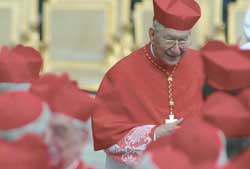
The Papal Theologian emeritus of the Papal Household, Georges Cardinal Cottier, OP, gave an interview to Jose Antonio Varela Vidal at Zenit (11 July 2012) about Blessed Pope John Paul II, with whom he worked intimately: “…he was a man of hope. When he said: ‘Do not be afraid,’ he certainly said it for the countries occupied by Communism, but he also said it because he saw that there was a certain decadence in the West. I would say he awakened the Church everywhere. Then, his love of life, this was fantastic and he witnessed this love of life in a life profoundly marked by illness, and young people understood him.”
Continue reading The work of the Theologian to the Papal Household
Bit-by-bit getting to the Carmelite charism with Father Reginald Foster
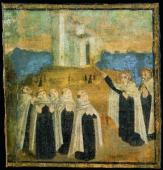 Today’s feast of Our Lady of Mount Carmel begs us to open the door to more of what it means to follow the life of a Carmelite vocation, in other words. At this point in life I know little of what the Carmelite charism is about and its place in the Schools of Spirituality. However, Veronica Scarisbrick of Vatican Radio speaks with Father Reginald Foster, an American Discalced Carmelite priest now living back in the USA after decades of service to the Church working as a Latinist. Foster was chiefly responsible for the Holy Father’s Latin works. At one time, Father Reginald, with a few others, had to make sure papal documentation
was published in Latin was correct. Father Reginald was also very famous for his Latin classes in Rome. If you graduated from his classes, then you spoke and read Latin well.
For me, the interesting points of this interview (on the audio clip) are the one dealing with the Carmelite differences and Elijiah as the spiritual Father of the founder of the Order; Foster explains the concept of “duplex spiritum.”

Our Lady of Mount Carmel
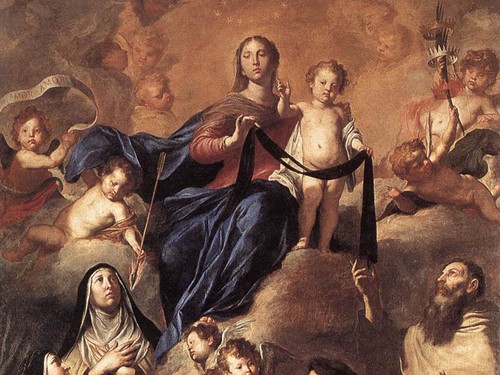
May the venerable intercession of the glorious Virgin Mary come to our aid, we pray, O Lord, so that, fortified by her protection, we may reach the mountain which is Christ.
Our Lady of Mount Carmel, pray for us.
The Blessed Virgin Mary never fails. She always kept her promise; always go to Mary. Saint Simon Stock the English Carmelite friar received this promise from the Virgin herself and he passed it on to the Church.
The Virgin Mary gave to Saint Simon the brown scapular, saying “Take this Scapular, it shall be a sign of salvation, protection in danger and a pledge of peace. Whosoever dies wearing this scapular shall not suffer eternal fire.” The soul wearing the scapular would be in heaven on the first Saturday of the month following death.
Thus, wearing the brown scapular is not required; it is a helpful sacramental to remind us that we are not alone and that God through Mary’s assistance keeps us close to the Mystery. Originally only worn by those of the Carmelite Order, it was soon adopted by the lay faithful. To this day, the brown scapular, is one of the most popular of all Catholic sacramentals.
Liberal Christianity on the decline
The NY Times op-ed columnist and author Ross Douthat writes about the decline of “liberal Christianity.” I found Douthat’s “Can Liberal Christianity Be Saved?” a good article to ponder, even good enough to take to prayer, because Ross asks what within the tradition of modern Christianity is worth saving and what definitely needs to be jettisoned. Douthat, for me, reminds me of days not long ago when a prominent religious order of men adopted a form of liberal Christian thinking on all maters but the truth, even to the point of a several members saying they relished being post-Christian. Gone are the days –at least one hopes the days are gone– when we are theologically shallow, lacking the biblical narrative and true theology.
Ross Douthat recently published the provocative Bad Religion: How We Became a Nation of Heretics (Free Press, 2012).