Luigi Giusanni had gift for deciphering signs of the times, Ignacio Carbajosa Pérez tells Rimini


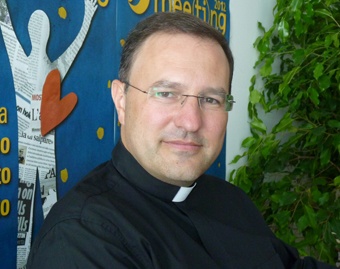
Ignacio Carbajosa Prez.jpgWe continually need to get to the heart of who our influences are as people. That is true of Father Luigi Giussani who is being spoken of not only as the founder of the ecclesial movement of Communion and Liberation but also because his cause for canonization is now being studied. Father Ignacio Carbajosa Pérez, 45, said of Father Luigi
Giussani, “For me the most striking thing was to hear this man with this love
for my humanity, finally, to find someone who knew very well what is my
humanity and then looked upon it in a sympathetic way.” (Read more of what Father Ignacio told David Kerr here at The Rimini Meeting 2012.)


Father Ignacio, a Madrid native and currently an Old Testament professor at Madrid’s San Damaso Institute, was part presentation at The Rimini meeting 2012 on “Education, Identity and Dialogue.” Perhaps the text will be available soon.

Rimini Meeting 2012

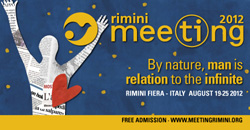
Rimini 2012.jpgTHE most significant cultural and religious meeting in the world is held in the late August: “Rimini Meeting” in the seaside town of Rimini (Italy). From 19-25 August, The Meeting coordinated by members of Communion and Liberation attracts numerous speakers and more than 800K.

What is the Rimini Meeting, you ask? The answer is here
The work of the Meeting has been in progress since the late 1970s and it debuted on the world stage in 1980… and counting…generating a culture of dialogue and understanding among people.

This year’s theme is “By Nature Man is Relationship to the Infinite.”
Pope Benedict XVIs August 10th letter to The Meeting can be read here. (Must read!)

August 20 kick off review video presentation
Several video clips from the week’s Meeting can be viewed here. It’s really essential to spend the time listening to what’s happened (and happens to people).

One of the reviews of the Rimini week is seen here, produced by Rome Reports who has been ably following the progress of the Meeting.
The coverage of The Meeting is the best thus far in English followed at the link above, however, there is some information that is old and needs updating. Staying current in other languages is a challenge for the CL movement, one that is still somewhat an Achilles’ heel. But instead of swimming the River Styx we’ve moved to the banks. Media coverage in English is getting better (though our American works need help!)
An American equivalent of The Rimini Meeting is the New York Encounter held yearly in January. In 2013, the NYE will run 18-20 January.

Pope Benedict writes to The Meeting 2012


The Holy Father, Pope Benedict closely follows The Meeting. He was in attendance several years ago, as was John Paul II in 1982. Picking up from Father Luigi Giussani’s thinking of “life as a vocation”, the Pope reminds us that everything is answered in relationship to the Infinite. On July 11, 2012 I posted a piece called “The Vocation to Life” which is essential reading if you want to know more of what the Pope, Giussani and Christianity is all about.

The Pope’s letter for the 2012 Meeting follows (emphasis mine).

To the Venerable
Brother Monsignor Francesco Lambiasi,

Benedict XVI.jpg

 Bishop of Rimini 

I wish to extend my
cordial greetings to you, to the organizers and to all the participants in the
Meeting for Friendship among Peoples, now in its XXXIII year. The theme chosen
this year – “The nature of man is a relationship with the infinite” – is
particularly significant in view of the approaching start of the Year of Faith,
which I have willed to proclaim to mark the 50th anniversary of the opening of
the Second Vatican Ecumenical Council.

To speak of man and of his yearning for
the infinite means, first and foremost, to recognize his constitutive
relationship with the Creator
. Man is a creature of God. Today this word –
creature – seems almost passé: we prefer to think of man as a self-fulfilled
being and master of his own destiny. The consideration of man as a creature
seems “uncomfortable,” because it implies an essential reference to something
else, or better, to Someone else – whom man cannot control – who enters in
order to define his identity in an essential way; a relational identity, whose
first element is the original and ontological dependence on He who wanted us
and created us. Yet this dependence, from which modern and contemporary man
attempts to break free, not only does not hide or diminish, but luminously
reveals the greatness and supreme dignity of man, who is called into life in
order to enter into relationship with Life itself, with God.

Enhanced by Zemanta

Continue reading Pope Benedict writes to The Meeting 2012

Saint Monica

saint-monica.jpgEveryone ought to have a “Saint Monica” figure in their lives. The sainted mother of Saint Augustine is the patron of spiritual maternity. Even though Monica was the biological mother of Augustine, she worked hard in the spiritual realm to get her son to give himself to Christ and his plan rather than his own plan of self-destructive behavior. Her constant prayer, fasting and good works all contributed to Augustine’s conversion. The collect for today’s Mass speaks volumes.

The Church prays
O God, who console the sorrowful and who mercifully accepted the motherly tears of Saint Monica for the conversion of her son Augustine, grant us, through the intercession of them both, that we may bitterly regret our sins and find the grace of your pardon.
 

Enhanced by Zemanta

Pope John Paul I, elected 34 years ago today

John Paul I.JPGToday is the 34th anniversary of papal election of Albino Luciani as Pope John Paul I. He’s remembered for being the smiling pope and the pope who reigned for 33 days. In some way, Divine Providence gave us this gift and then opened the door for yet another. John Paul’s cause for canonization is being studied.

O God, faithful rewarder of souls, grant that your departed servant Pope John Paul I, whom you made successor of Peter and shepherd of your Church, may happily enjoy for ever in your presence in heaven the mysteries of your grace and compassion, which he faithfully ministered on earth.

George Weigel gives his reflections here.

Latria ought to be paid to the Eucharist


B16 with Eucharist.jpg


Among a certain crowd of priests, religious and laity
you will hear that Adoration and Benediction of the Blessed Sacrament is no
longer an appropriate method of prayer: “Vatican II changed all that…” or
they’ll say “That’s ol’time religion.” One priest even told me that Adoration of the Blessed Sacrament is cookie worship. Really? Giving praise to God is
outdated? Adoration of the Holy Name is no longer in vogue? The God who created
you is not worship and made known? None of this reflects my Catholic faith!

I am somewhat certain that those who claim Adoration and Benediction of the Blessed Sacrament neither know the Commandments (to worship God), the Tradition of the Church, the documents of the Second Vatican Council nor the post Conciliar work of Popes Paul, John Paul and Benedict. It is safe to say that these people who reject the the practice of a Holy Hour are the same who who haven’t had a good formation in the faith or the Lex Orandi tradition.

Perhaps we all should recall what the Servant of God Pope Paul VI said in Mysterium
Fidei

The Catholic Church has always displayed and still
displays
this latria that ought to be paid to the Sacrament of the Eucharist,
both during Mass and outside of it, by taking the greatest possible care of
consecrated Hosts, by exposing them to the solemn veneration of the faithful,
and by carrying them about in processions to the joy of great numbers of the
people (56).

‘American dream’ fulfilled in Jesus

The Catholic News Agency carried a story by David Kerr on Chris Bacich the US leader of Communion and Liberation (CL) this week at the Rimini Meeting in Italy.
Notable in Chris’ interview is that Chris puts his finger on the reality of Christian faith today when he speaks of those who find in CL a “real willingness to grapple with the real life, everyday culture in which [they] live, while showing no fear” because they “recognize that the encounter with Christ, and his presence in our life, is the answer to this desire for a life that is better, that is great, that is worthwhile and fruitful.”

As point of clarification, CL is not a “lay ecclesial movement”; it is technically improper to call the ecclesial movements “lay ecclesial movements” because the movements are not limited to the lay faithful, but are open to the ordained as well. Many of the movements have ardent followers who are deacons, priests and bishops in the movements. Therefore, not “lay ecclesial.”

Enhanced by Zemanta

A walk to Defeat ALS in New Haven, September 16


T-Shirt_Logo.jpgMy friend Father David Bornio sent me this note asking to kindly to get the word out. If you live in the New Haven area, please consider walking to Defeat ALS.

A walk to Defeat ALS will
be held Sunday, September 16, 2012 at Lighthouse Point Park New Haven, CT
06512. 


Registration at the park will begin at 10 and the walk at 11. To
register now, visit  or call 203-874-505.

Proceeds from the walk
to Defeat ALS fund vital services for Connecticut patients and families living
with ALS, also known as Lou Gehrig‘s disease, and support research to find a
cure. Volunteers and donations would be greatly appreciated. 


The ALS
Association
Connecticut Chapter is located at 4 Oxford Rd., unit D4 Milford, CT
06460. Please direct donations to (heavens hopefuls). 

Presently, Sister Marie
Elise, Deacon Horace Harmor, Father David Borino and many of our New Haven friends are living with this illness. 

Lou Gehrig, the famous baseball player walked
1508 times for his team. How about walking once for ours? 
Enhanced by Zemanta

Saint Louis

St Louis IX, MO.jpgSaints come from all walks of life. We’ve got every group represented in the group of canonized. Today is the feast of a saint of a rare group –a king. The Church honors King Saint Louis IX.

The Church prays
O God, who brought Saint Louis from the cares of earthly rule to the glory of a heavenly realm, grant, we pray, through his intercession, that, by fulling our duties on earth, we may seek out your eternal Kingdom.
Please keep in your prayers the Connecticut native who made his solemn profession of vows as a Benedictine monk of the Abbey of Saint Mary and Saint Louis today.
 
Dom Dunstan Holms is now a permanent member of Saint Louis Abbey; Abbot Thomas has assigned him the work of being the chair of the classics department; he’s a well respected Latin teacher at the Priory School. May God richly bless Dom Dunstan as he moves more and more toward the Paschal Mystery.
Likewise, say a prayer for the Archdiocese of Saint Louis on their feast day.

Saint Bartholomew

St Bartholomew MdiGiovanni.jpgNathanael was one of Christ’s first converts, yet his name does not occur again till the last chapter of St. John’s Gospel, where he is mentioned in company with certain of the Apostles, to whom Christ appeared after His resurrection. Now, why should the call of Nathanael have been recorded in the opening of the Gospel, among the acts of Christ in the beginning of His Ministry, unless he was an Apostle? Philip, Peter, and Andrew, who are mentioned at the same time, were all Apostles; and Nathanael’s name is introduced without preface, as if familiar to a Christian reader. At the end of the Gospel it appears again, and there too among Apostles. Besides, the Apostles were the special witnesses of Christ, when He was risen.  He manifested Himself, “not to all the people,” says Peter, “but unto witnesses chosen before of God, even to us, who did eat and drink with Him after He rose from the dead.” [Acts x. 41.] Now, the occasion on which Nathanael is mentioned, was one of these manifestations. “This is now the third time,” says the Evangelist, “that Jesus was manifested to His disciples, after that He was risen from the dead.” It was in the presence of Nathanael, that He gave St. Peter his commission, and foretold his martyrdom, and the prolonged life of St. John. All this leads us to conjecture that Nathanael is one of the Apostles under another name. Now, he is not Andrew, Peter, or Philip, for they are mentioned in connexion with him in the first chapter of the Gospel; nor Thomas, James, or John, in whose company he is found in the last chapter; nor Jude (as it would seem), because the name of Jude occurs in St. John’s fourteenth chapter. Four Apostles remain, who are not named in his Gospel,–St. James the Less, St. Matthew, St. Simon, and St. Bartholomew; of whom St. Matthew’s second name is known to have been Levi, while St. James, being related, was not at any time a stranger to our Lord, which Nathanael evidently was. If then Nathanael were an Apostle, he was either Simon or Bartholomew. Now it is observable, that, according to St. John, Philip brought Nathanael to Christ; therefore Nathanael and Philip were friends: while in the other Gospels, in the list of Apostles, Philip is associated with Bartholomew; “Simon and Andrew, James and John, Philip and Bartholomew.” [Matt. x. 3.] This is some evidence that  Bartholomew and not Simon is the Nathanael of St. John. On the other hand, Matthias has been suggested instead of either, his name meaning nearly the same as Nathanael in the original language. However, since writers of some date decide in favour of Bartholomew, I shall do the like in what follows.

What then do we learn from his recorded character and history? It affords us an instructive lesson. When Philip told him that he had found the long-expected Messiah of whom Moses wrote, Nathanael (that is, Bartholomew) at first doubted. He was well read in the Scriptures, and knew the Christ was to be born in Bethlehem; whereas Jesus dwelt at Nazareth, which Nathanael supposed in consequence to be the place of His birth,–and he knew of no particular promises attached to that city, which was a place of evil report, and he thought no good could come out of it.

Philip told him to come and see; and he went to see, as a humble single-minded man sincerely desirous to get at the truth. In consequence, he was vouchsafed an interview with our Saviour, and was converted.

Blessed John Henry Newman
Plain and Parochial Sermons