Just about a week ago did Mother Placid Dempsey, nun of the Abbey of Regina Laudis, make her way to the Lord. Her final act of earthly love to the One whom she committed herself to in this life, and lived in communio with for 85 years, accepted the invitation of the Lord for life eternal. Mother Placid was the first Benedictine nun of Regina Laudis that I met; we were introduced by a mutual friend, Palma. And boy was she helpful in a time of my life that needed reassurance.
It’s amazing to read all the things one does in life when one dies; her obit shines but a little light on a person many only aspire to be. Mother Placid was a unique woman of faith. I am grateful for the times we’ve met in her lucid years. Her diminishment was hard to watch. The last time I saw her in person a few years ago following Mass it was as though we met for the first time. The illness bore her mind away but her smile was all I needed. I think it was she behind the grill at the abbey church that walked with help in and out choir. I offered my prayer for Mother.
Someone characterized Mother Placid perfectly: “Wise, impish, witty, given to sharp spiritual insights and equally pointed….” All of which was true to my experience and for which I am grateful.
With the Church, let us pray,
Grant, we pray, almighty God, that the soul of your servant Mother Placid, who for love of Christ walked the way of perfect charity, may rejoice in the coming of your glory and together with her sisters may delight in the everlasting happiness of your Kingdom.
The obit posted by the Abbey follows.
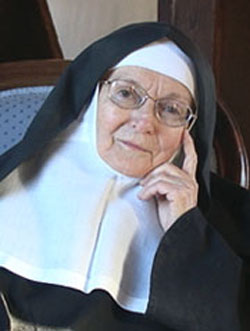 Reverend Mother Placid (Patricia Ann) Dempsey, 85, consecrated nun of the Abbey of Regina Laudis, died September 27, 2012 at the Abbey after a long illness. Described as a tiny giant, Mother Placid–artist, poet, and guest mistress for over 50 years–touched the lives of thousands of people.
Patricia Ann Dempsey was the youngest of four children of William Ambrose Dempsey, New York City trial lawyer, and Kathleen
Costello Dempsey, teacher and housewife. The Dempseys migrated to America at the time of the great famine in Ireland and settled in Pennsylvania where Mother Placid’s grandmother ran a saloon in the mountain mining town of White Haven. The Costellos were metal craftsmen for centuries in Ireland. Her maternal grandfather was instrumental in bringing the Knights of Columbus to Brooklyn.
Patricia grew up in Brooklyn, and described the atmosphere of her
home as “…warm and intellectually stimulating with discussions of cultural matters, philosophical questions, and legal matters”. After graduating from St. Angela Hall Academy High School, she received her Bachelor’s Degree in Art from Marymount College (Tarrytown NY) in 1949. In both high school and college she was awarded honors for her art. She was active in all aspects of drama, especially scenery design and construction. She also participated in many cultural and charitable activities, including social activities for the blind, infirm and pre-school children.
While at Marymount, Patricia attended a talk given by Mother Mary Aline, co-foundress of the newly-established Benedictine Monastery Regina Laudis. Her curiosity aroused, she came to Bethlehem with a friend in 1947, arriving in the midst of a blizzard. She described what she found: “It was so cultured, so simple…There was a freshness here, a mystery–like going into some huge stillness, going into God.”
 Patricia Dempsey entered the monastery as a Postulant on August 18th, 1949, one of the first American postulants and the only one of that group to persevere in the monastery. As a novice she received the name Sister Placid, after the faithful disciple of St. Benedict. She was perpetually professed and consecrated on the Feast of the Ascension, June 3rd, 1954. Besides her work as artist, teacher and guest mistress, Mother Placid was a Council member and Postulant Mistress for a number of years, as well as Mistress of Ceremonies. She helped write and present in Rome the Abbey’s first Constitutions.
Her extensive work as monastic artist included painting, graphics, vestment design, enamel, wood, stone and concrete sculpture, and book illustrations, notably the covers of several of the “Classics of Western Spirituality” series. Her work has been exhibited in galleries in this country and Europe, especially in New York City and Paris. Her well-known “Stations of the Cross”, hand-carved out of a neighbor’s cherry tree, grace the walls of the lower monastery chapel at the Abbey and continue to be a source of prayer and inspiration for visitors. Mother Placid designed scenery for several Abbey plays as well as buildings used for the Abbey fair. She was instrumental in the development of monastic crafts and supervised the renovation of the Monastic Art Shop to include an art gallery and display space.
In the Abbey, Mother Placid taught classes in monastic history and spirituality, philosophy and the Rule of St. Benedict. She was much influenced in her early life by the writings of Jacques and Raissa Maritain whom she later met when they visited Regina Laudis in 1949. She maintained scholarly and spiritual friendships with psychiatrist and author Dr. Karl A. Menninger, and with Caryll Houselander, the English Catholic author. Among her most cherished relationships was the one with renowned children’s book illustrator Tomie dePaola, who first came to Regina Laudis as an art student. They became colleagues and fast friends, each enriching the other’s work and life.
Always faithful to the vision of Lady Abbess Benedict, foundress of the Abbey, Mother Placid’s unique and transformative contribution to Regina Laudis was her ability to translate monastic values into contemporary language. She was instrumental in receiving the many young people who were drawn to the monastery in the 60’s and 70’s, and helping them to see their own lives and process of seeking as valuable and “of God.” Her deep sense of culture and breadth of education, and her frank love of people were supreme assets in this work. Moreover, she brought a depth of wisdom and understanding, in her inimitably playful way, to the work of forming communities of laypersons desiring to give themselves to Christ, through their professions.
Religious life is generally misunderstood, mostly by people who never get to know what it’s about. Entering is like the first day of creation for you. You come to find out what God has put you here for. You walk in, and this place will set off all the light and dark places in you. It’s a pressure cooker. You will walk into all the trials you need to clean up your act and learn to love. Mother Placid Dempsey
Besides her monastic Community, Mother Placid is survived by her numerous nieces and nephews, including Mother Praxedes Baxter, OSB, also of Regina Laudis, and by great-nieces and nephews.
Prayer of the Faithful offered by Mother Prioress Dolores Hart at the Requiem Mass for Mother Placid, September 29, 2012, Feast of St. Michael the Archangel.
“For all who have come together, joined in our union of unspoken blessing of death, having been touched in the mystery of Mother Placid’s life: allow me to share now her own words written in her own hand unknowingly for this day over 54 years ago: Now we must walk past our winters, Beyond the edge of what we were; This is the time when tears well up, In the corners of the autumn morning; The sad ecstatic time of joy trying to break up on the hills, And yet, release would be betrayed; The heart must break instead
from the sheer wild love that only restraint can know in the silver light, the cool delineated air of mellow violence.
FREEDOM IS LOVE IN FULL CAPTIVITY.
Dear Mother Placid, -for the grace of your continued gift of Love.”