I hate Jesuitism. Perhaps you do too. We stand in good company with Nietzsche and of course with Jesuit Father James Schall.
Author: Paul Zalonski
Dorothy Day’s 32nd anniversary of death
Today is the 32nd anniversary of death of the Servant of God Dorothy Day. The Benedictine Oblate from Brooklyn Heights, NY, who is remembered for her conversion to Christ and His Church and with Peter Maurin founded The Catholic Worker Movement.
In recent days we’ve learned that the bishops of the USA are standing behind Day’s cause for canonization advancing it to the next canonical stage. While the process may be protracted for some, it is a good and substantial process to ascertain the claim of sanctity of the person in question. As an editorial, I tend to think 30 years is a good amount of time between the death of a person and the study process commencing; in my humble opinion I think it was far too short of time for Mother Teresa and Pope John Paul II beatifications; both are saints in my opinion, but I think the process can’t be shortchanged because of cosmic popularity.
Day was a Benedictine Oblate of St Procopius Abbey.
The Archdiocese of New York is in charge of the cause of canonization. You can contact the office at 212-371-1000, ext. 2474.
The following letter to the editors by Kenneth Woodward regarding the funeral of Dorothy Day which sheds some light on the New York Archdiocese’s involvement. Many are falsely led to believe the Church was callous because no bishop was present at the funeral Mass. Apparently, truth prevails. Read the letter.
To the Editors:
Your story on Dorothy Day and the bishops ignores a number of facts concerning her funeral, which I attended.
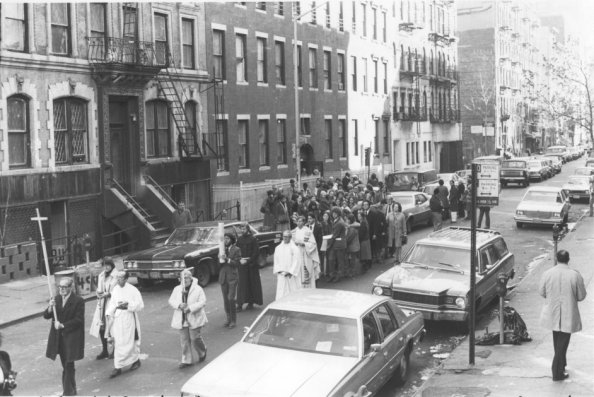
As it happened, Cardinal Terrance Cooke of New York wanted her funeral held in St. Patrick’s Cathedral, where the congregation would certainly have included many bishops, but the Catholic Worker community insisted that the funeral held in the neighborhood where Dorothy had lived so the poor could attend. Few actually did. At the church door each mourner was greeted by Cooke himself, not dressed in a cardinal’s finery but in a simple black cassock. Cooke did not stay for the mass because he did not want his presence to draw attention away from the woman for whose sake we mourners had gathered. Later, he held a memorial mass for Dorothy at the cathedral.
Cooke was a conservative churchman. So was Cardinal John O’Connor who formally initiated the cause on behalf of Dorothy Day’s canonization. Paradoxically, it was Father Daniel Berrigan and other members of the “Catholic Left” who opposed the effort to canonize Dorothy Day. Details can be found in my book, “Making Saints,” first published in 1996. Berrigan feared that in the canonization process the narrative of Day’s life would be stripped of its radical Christian elements. Those fears would indeed be realized if “Saint Dorothy” were to be venerated solely for her remorse for having had an abortion in the years prior to her conversion to Catholicism.
Kenneth L. Woodward
You also be interested to read the Eulogy given by the former Dominican Friar Geoffrey B. Gneuhs on December 2, 1980.
Benedictine Father Michael Zielinski appointed Head of Office for the Pope’s Worship Office
The Pope appointed Benedictine Abbot Christopher Michael John Zielinski to the be the Head of the Office (office manager) of the Congregation for Divine Worship and the Discipline of the Sacraments on Saturday, 24 November 2012. He is the number 3 person in the Congregation serving with Antonio Cardinal Cañizares, Archbishop Arthur Roche and Father Anthony Ward, SM.
The “man from the Veneto” who was John Paul I
Many of us only know the name Albino Luciani. He was the one who became Pope John Paul I in 1978 and lived only 33 days as the Supreme Pontiff. That was 34 years ago; I was only 9 when the smiling pope appeared and then departed. I often think of what the face of the Church would’ve been like had he lived longer.
Dorothy Day not the patron saint of the “left” nor an agenda item of the “right”
Dorothy Day is not a pawn in political camps. She is the darling of a political camp for either the seculars or the ecclesials. To apply political monikers of liberal and conservative, left or right is grossly inaccurate and a rather reductionistic manner to understand a person and her vocation, the vocation defined by love and happiness. True to an authentic follower of Christ, Dorothy Day’s vocation was to be a saint, that is singularly focussed on her Lord and Savior; her vocation was to adore and follow Jesus Christ. Day’s vocation was not to feed the the poor and argue for a change in governmental policy. As a friend said, Day’s life is too easily “framed in political terms by people who anachronistically use words like ‘liberal’ and ‘conservative’ to describe a life that was never about that fight.” Additionally, I fully agree with Martha Hennessy, 57, the granddaughter of Day who said she was uncomfortable about her grandmother’s abortion. Let’s pay attention to Martha Hennessy, “I wish we would focus on the birth of her child more than on her abortion because that’s what really played a role in her conversion.” Indeed. This is the pro-life position of the Church.
Feast of the Miraculous Medal
The feast of the Miraculous Medal may be surprising to a few. Catholics honor buildings, theological ideas, people and medals. The Miraculous Medal is known as the Medal of the Immaculate Conception, the medal that Our Lady on this date in 1830 instructed Saint Catherine Labouré to have struck. There is nothing miraculous about the medal. What is miraculous is the fact that it is a sign that God does miraculous things in our lives. In a boring world there are events that turn reality on end.
Schools of Theology: A 2012 Review
First Things editor RR Reno published his “A 2012 Ranking of Graduate Programs in Theology” yesterday, the annual romp through what’s out there for theological formation. A somewhat helpful review but it doesn’t really cover some important data. Nevertheless, it is good to see a review that advances a good perspective. What is that perspective? In my humble opinion: that in all things God may be glorified AND thinking with the Church.
- The five areas a good school of theology needs to be attentive to: sacred Scripture, sacred Liturgy, patristic study, dogmatic study and ethics. I fully believe that Prosper of Aquataine is correct, and ought to orient all study of theology: legem credendi lex statuat supplicandi. In shorthand, the law of prayer is the law of belief.
The end times are indeed near at hand…
The end times are indeed near at hand. That is not to say that the “12/12/2012” Mayan prediction of the end of the world is true –it is not– or that the rapture approach is insightful. But if you really believe that Jesus Christ is Lord and Savior then an acknowledgement of our living in the end times is the right way to live. The Scripture readings in these final weeks of the liturgical year, but especially this week, prepare the believer to face the fact of the final things, sometimes called the Four Last Things: death, judgement, heaven, and hell. We can’t get away from these things. If we could, then there would be no need of a Messiah, of the Cross and Resurrection, the Eucharist, the sacraments, the Church, and a spiritual life; no need for salvation. If there is no probability of hell, then there is no need of salvation.
- heaven “is not an abstraction nor a physical place amid the clouds, but a living and personal relationship with the Holy Trinity;
- When this world has passed away, those who accepted God in their lives and were sincerely open to his love, at least at the moment of death, will enjoy that fullness of communion with God, which is the goal of human existence”;
- the hell some will enjoy is not the result of God willing the death of the person but the result of the person not desiring the love and mercy God has offered, that he has freely given;
- the Pope spoke of the danger of rigidly holding a literal interpretation of the Scriptural images of hell: for John Paul, and therefore us, “the inextinguishable fire” and “burning oven” in the biblical narrative points the hearer to “indicate the complete frustration and vacuity of a life without God”;
- we know that hell exists; we don’t know the population of hell; Cf. Cardinal Avery Dulles’ famous First Things article, “The Population of Hell”; John Paul says that hell is not something that we can know but that real damnation “remains a possibility”;
- On purgatory the Pope said, is the state of being “before we enter into God’s kingdom, every trace of sin within us must be eliminated, every imperfection in our soul must be corrected. This is exactly what takes place in purgatory”;
- Purgatory is “the process of purification for those who die in the love of God but are not completely imbued with that love”;
- even though Christ holds His hand in friendship, that is, in love, the extension of our hand “does not exclude they duty to present ourselves pure and whole before God.”
- Read the Catechism at paragraph 1861.
So how can we honestly and proactively approach today’s feast, and this holiday season in a way that will get us past the public façade of wise-guy banter and beyond the disconnect between hard realities and sincere beliefs and honest ideals? How might we bravely allow our deeper humanity to shine forth in the midst of some extreme assaults on such things as tenderness, hope, and compassion?
Today’s readings, along with monastic wisdom and psychological insight suggest the following: Daily if not hourly slow down the frantic pace of our media interaction, verbosity, and endless tasks: daily if not hourly return to the temple of our own person and the holy and fertile ground of our interior life. Daily if not continually express appreciation for whatever someone does that makes my life richer today: Daily or at least once in a while do something simple but concrete and different, for the express purpose of nurturing the human spirit, within yourself, for someone else, and for the future.
In these days in the post Christ the King observance and before Advent, let’s pray for the grace to know ourselves more deeply so as to accept more fully “divine work” in our lives with the gift of discernment showing us the way to the Father.
3 unavoidable questions for Christian faith’s reasonability
In recent years, we have seen a significant interest in teaching the faith more authentically, but also we’ve become more attentive to answering the real questions believers and unbelievers have. With the Year of Faith fully engaged now, I think we need to attend to three unavoidable questions whether we are teaching teens, adults, or expanding the horizons of our faith and understanding of the cosmos we live in.
Continue reading 3 unavoidable questions for Christian faith’s reasonability
Pope to the faithful: bear witness to the kingdom of God, to the truth
Conversion advances the Kingdom of God. There is no possibility of entering the Kingdom prepared and promised to us without turning away from sin and truly walking on the path given by the Lord. AND this Kingdom is totally other than what we known and expect. And because of our baptism our vocation is to build the Kingdom according to a plan that is not our own. At the Mass offered by the Pope on the
Solemnity of Our Lord Jesus Christ, King of the Universe, he did so with the six cardinals and their friends and family. The homily follows.
Today’s Solemnity of
Christ, King of the Universe, the crowning of the liturgical year, is enriched
by our reception into the College of Cardinals of six new members whom,
following tradition, I have invited to celebrate the Eucharist with me this
morning. I greet each of them most cordially and I thank Cardinal James Michael
Harvey for the gracious words which he addressed to me in the name of all. I
greet the other Cardinals and Bishops present, as well as the distinguished
civil Authorities, Ambassadors, priests, religious and all the faithful,
especially those coming from the Dioceses entrusted to the pastoral care of the
new Cardinals.
In this final Sunday of the liturgical year, the Church invites
us to celebrate the Lord Jesus as King of the Universe. She calls us to look to
the future, or more properly into the depths, to the ultimate goal of history,
which will be the definitive and eternal kingdom of Christ. He was with the
Father in the beginning, when the world was created, and he will fully manifest
his lordship at the end of time, when he will judge all mankind. Today’s three
readings speak to us of this kingdom. In the Gospel passage which we have just
heard, drawn from the account of Saint John, Jesus appears in humiliating
circumstances – he stands accused – before the might of Rome. He had been
arrested, insulted, mocked, and now his enemies hope to obtain his condemnation
to death by crucifixion. They had presented him to Pilate as one who sought
political power, as the self-proclaimed King of the Jews. The Roman procurator
conducts his enquiry and asks Jesus: “Are you the King of the Jews?” (Jn
18:33). In reply to this question, Jesus clarifies the nature of his kingship
and his messiahship itself, which is no worldly power but a love which serves.
He states that his kingdom is in no way to be confused with a political reign:
“My kingship is not of this world … is not from the world” (v. 36).
Continue reading Pope to the faithful: bear witness to the kingdom of God, to the truth