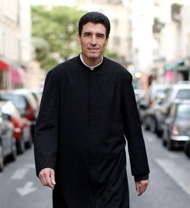
Pray for men to respond to priesthood and consecrated life.
Author: Paul Zalonski
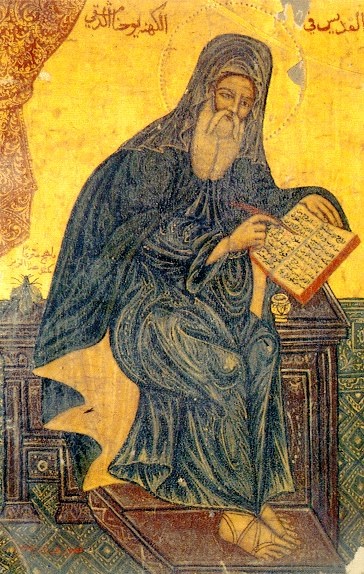
Saint John Damascene
Grant, we pray, O Lord, that we may be helped by the prayers of the Priest Saint John Damascene, so that the true faith, which he excelled in teaching, may always be our light and our strength.
Saint John of Damascus (c. 676-749) is a pretty amazing man, priest, and Father of the Church; noted as the last of the Greek Fathers. He’s known as the “golden speaker” and while he was not an original or brilliant theologian, his gift is his ability to compile what the Church believed in his era. In many ways Avery Dulles was the same.
Much of his preaching and teaching was a defense of the faith in the face of severe opposition, particularly with the rise of Islam.
The Damascene is revered as a saint by the Churches of East and West.
From The Statement of Faith by Saint John Damascene:
O Lord, you led me from my father’s loins and formed me in my mother’s womb. You brought me, a naked babe, into the light of day, for nature’s laws always obey your commands.
By the blessing of the Holy Spirit, you prepared my creation and my existence, not because man willed it or flesh desired it, but by your ineffable grace. The birth you prepared for me was such that it surpassed the laws of our nature. You sent me forth into the light by adopting me as your son and you enrolled me among the children of your holy and spotless Church.
You nursed me with the spiritual milk of your divine utterances. You kept me alive with the solid food of the body of Jesus Christ, your only-begotten Son for our redemption. And he undertook the task willingly and did not shrink from it. Indeed, he applied himself to it as though destined for sacrifice, like an innocent lamb. Although he was God, he became man, and in his human will, became obedient to you, God his Father, unto death, even death on a cross.
In this way you have humbled yourself, Christ my God, so that you might carry me, your stray sheep, on your shoulders. You let me graze in green pastures, refreshing me with the waters of orthodox teaching at the hands of your shepherds. You pastured these shepherds, and now they in turn tend your chosen and special flock. Now you have called me, Lord, by the hand of your bishop to minister to your people. I do not know why you have done so, for you alone know that. Lord, lighten the heavy burden of the sins through which I have seriously transgressed. Purify my mind and heart. Like a shining lamp, lead me along the straight path. When I open my mouth, tell me what I should say. By the fiery tongue of your Spirit make my own tongue ready. Stay with me always and keep me in your sight.
Lead me to pastures, Lord, and graze there with me. Do not let my heart lean either to the right or to the left, but let your good Spirit guide me along the straight path. Whatever I do, let it be in accordance with your will, now until the end.
And you, O Church, are a most excellent assembly, the noble summit of perfect purity, whose assistance comes from God. You in whom God lives, receive from us an exposition of the faith that is free from error, to strengthen the Church, just as our Fathers handed it down to us.
Tweeting. Are you? Join me.
Ecclesia in America at 15, Carl Anderson reflects
Hard to believe that 15 years have passed since John Paul’s post synodal exhortation Ecclesia in America. It is a remarkable document in my opinion, even though it touches on many very serious problems that we need to face from Alaska to Argentina. We hear nothing of this document these days. Every so often we hear a reference to it when a hierarch wants to say something intelligent about the situation at hand in America. Perhaps we could go back to EA with fresh eyes. What is clear is to work on ways for greater communion and solidarity with the Christians across the boarders.
We need to continue to answer the thematic of the “Encounter with the living Jesus Christ: The way to conversion, communion and solidarity in America.” We can’t set tight with only what John Paul gave us to think on, and to work on. The strength of the Church in America rests not merely on our own solution to the matters at hand but also to our persistent call to holiness.
To honor the publication’s anniversary events have been scheduled in Rome from 9-12 December. Among the presentations/dialogue we have:
- the event in Guadalupe as the origin of evangelization in the New World
- the post-Synodal Exhortation: prophecy, teaching and commitment
- the Apostolic Exhortation Ecclesia in America with the intercession of Our Lady of Guadalupe, star of the new evangelization and mother of the civilization of love
- the meaning of the Year of Faith
- Scenarios and proposals for communion and co-operation between Churches of the Americas and for solidarity among their peoples.
Happy to see that Carl Anderson, supreme knights of the Knights of Columbus was chosen as one the presenters for today’s conference. He gives gravitas coupled with reasonableness. You may want to listen to Carl Anderson’s interview with Vatican Radio it is here.
Mr Anderson’s remarks:
honor for the Knights of Columbus to have the opportunity to help organize this
conference on Ecclesia in America – together with the Pontifical Commission for
Latin America – under the patronage of Our Lady of Guadalupe.
As a lay
organization that has been in the United States, Canada, Mexico – and other
parts of Latin America – for more than a century, we are particularly aligned
with the vision presented in Ecclesia in America, and are working with the
Church in our hemisphere on the project of the New Evangelization.
In
re-reading Ecclesia in America 15 years after the close of the Synod for
America held here in Rome in November and December 1997, three things stand out
to me as particularly important to our discussion here and at the conference
next week.
Continue reading Ecclesia in America at 15, Carl Anderson reflects
Benedict XVI to tweet… join in
You heard yesterday that Pope Benedict XVI is now tweeting. Terrific!
The Papal Twitter account is up and running: @Pontifex
As of right now, the English page has 381K followers, the German has 9.5K, the Spanish 88K, the Italian has 36K, the French has 7k and the Arabic has 3,000.
The Press Office of the Holy See said the following about the Papal presence in the digital media.
The The Pope’s presence on Twitter
is a concrete expression of his conviction that the Church must be present in
the digital arena. This initiative is best understood in the context of his
reflections on the importance of the cultural space that has been brought into
being by the new technologies. In his Message for World Communications Day
2009, which was published on the same day as the Vatican’s Youtube channel was
opened, Pope Benedict spoke of the necessity of evangelizing the ‘digital
continent’ and he invited young believers, in particular, to introduce
into the culture of this new environment of communications and information
technology the values on which you have built your lives.
Martin Luther King, Jr and Saint Francis Xavier with the Church
Connecting people is a dangerous thing. It is even more perilous if you connect people from different centuries, places, ethnicities, religions and politics. I read this quote from Dr Martin Luther King, Jr (1929-1968) that made me think of those like Saint Francis Xavier had some difficulty convincing the “powers that be” that their behaviors, policies and attitudes are incoherent with the Gospel and Christ’s Church. I am thinking of Bartholomew de las Casas, OP, Blessed John Paul II, Blessed Mother Teresa of Calcutta, Blessed Franz Jägerstätter, OFS, Saint Katharine Drexel, Saint Frances Xavier Cabrini, Saint Thomas More, Venerable Servant of God Father Michael J. McGivney, Servant of God Dorothy Day, Obl SB, Father Alexander Men and countless others.
The Church must be reminded that it is not the master or the servant of the state, but rather the conscience of the state. It must be the guide and the critic of the state and never its tool. If the Church does not recapture it prophetic zeal it will become an irrelevant social club without morals or spiritual authority.
Continue reading Martin Luther King, Jr and Saint Francis Xavier with the Church
Saint Francis Xavier
O God, who through the preaching of Saint Francis
Xavier won many peoples to yourself, grant that the hearts of the faithful may
burn with the same zeal for the faith and that Holy Church may everywhere
rejoice in an abundance of offspring.
It was love…
This article by Rebecca Hoeffner about the ordination to the episcopacy of Joseph Strickland for service as the bishop of the Diocese of Tyler, Texas, is a terrific testimony to grace at work. The whole article is worth reading for the last sentence. The whole of the ecclesiology is summed up in that one sentence, with that one word… You can follow Bishop Strickland on his blog, FatherRunFather. Blessings on Bishop Joseph Strickland.
Prophet Habakkuk
The Byzantine liturgical calendar includes the prophets in its commemorations because they foretell the coming of the Messiah, as the Kontakion states for today. (The Latin Church has the prophets in the Martyrology but does often feasts.) As a liturgical note, kontakion is a poetic text tied to the celebration at hand, or of a particular saint recalled during the Liturgy, most often sung by the deacon or some designated person following the proclamation of the gospel.
the world the coming forth of God from the south, from the Virgin. Standing on
the divine watch, you received a report from the radiant angel: “You proclaimed
the Resurrection of Christ to the world!” Therefore in gladness we cry out to
you: “Rejoice, splendid adornment of the prophets!”
Advent’s First Sunday
At the Sunday Angelus today, the Holy Father notes some crucial points about our Christian faith that can’t go unheard and need to be savored deeply in the heart. Notice, please, that Benedict doesn’t talk about expectation but he does speak of the Lord’s coming and presence; his death and resurrection and our final destiny (that is, love) and doesn’t mention the Christ Child as the exclusive image of Advent. The Cross, resurrection and ascension is our only Hope. Pope Benedict addressed the faithful with the following:
Today the Church begins a new liturgical year, a path that is further enriched by the Year of Faith, 50 years since the opening of the Second Vatican Council. The first Time of this journey is Advent, composed, in the Roman Rite, of the four weeks that precede the Birth of the Lord, that is, the mystery of the Incarnation. The word “Advent” means “coming” or “presence.” In the ancient world, it signified the coming of the king or the emperor into one of the provinces; in the language of Christians, it referred to the coming of God, to His presence in the world; a mystery that involves the whole of the cosmos and of history, but that recognises two culminating moments: the first and the second coming of Jesus Christ. The first is the Incarnation itself; the second is the glorious return at the end of time. These two moments, chronologically distant – and it is not given to us to know how far apart they are – touch us deeply, because by His death and resurrection Jesus has already accomplished that transformation of humanity and of the cosmos that is the final goal of creation. But before that end, it is necessary that the Gospel be proclaimed to all nations, as Jesus says in the Gospel of Saint Mark. The coming of Christ is continuous; the world must be infused by His presence. This permanent coming of the Lord in the proclamation of the Gospel requires our continual collaboration; and the Church, which is like the Betrothed, the promised Bride of the crucified and risen Lamb of God (cfr. Rev. 21,9), in communion with her Lord collaborates in this coming of the Lord, in which His glorious return is already begun.
It is to this that the Word of God recalls us today, tracing out a line of conduct to pursue in order to be ready for the coming of the Lord. In the Gospel of Luke, Jesus says to the disciples: “Beware that your hearts do not become drowsy from carousing and drunkenness and the anxieties of daily life . . . Be vigilant at all times and pray.” So: simplicity and prayer. And the apostle Paul adds the invitation to “increase and abound in love” among ourselves and towards everyone, to strengthen our hearts and to be blameless in holiness (cfr. 1 Thess 3, 12-13). In the midst of the turmoil of the world, or the desert of indifference and materialism, Christians accept the salvation of God and witness to it by a different way of life, as a city set on a hill. “In those days,” the prophet Jeremiah proclaims, “Jerusalem shall dwell safely; this is the name they shall call her: ‘The Lord our justice'” (Jer 33,16). The community of believers is a sign of the love of God, of His justice that is already present and working in history, but not yet fully realised, and that therefore should always be awaited, invoked, and sought after with patience and courage.
The Virgin Mary perfectly embodies the spirit of Advent, which consists of listening to God, a profound desire to do His will, and joyful service to others. Let us be guided by her, so that God who is coming may not find us closed or distracted, but might extend to each of us a small part of His kingdom of love, of justice, and of peace.