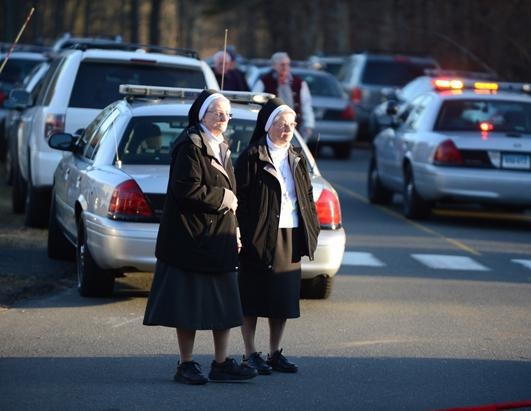
In the days following the Newtown tragedy many people are applying the concept of hero to those who lived and died with dignity offering themselves for the good of others. The adults at the Sandy Hook School can certainly be labeled as a heros. We can also bestow the title of hero on those who responded: police and fire personnel, healthcare professionals and social workers, and members of the clergy and consecrated religious.
Author: Paul Zalonski
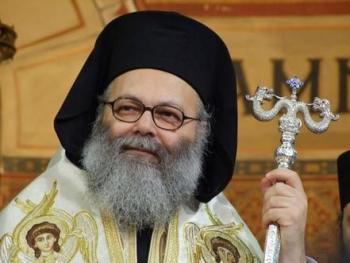
New Orthodox Patriarch of Antioch elected
The Greek Orthodox Church of Antioch elected a new patriarch, His Eminence, Metropolitan Archbishop of Europe, John Yazigi, 57. He will be known as John X.
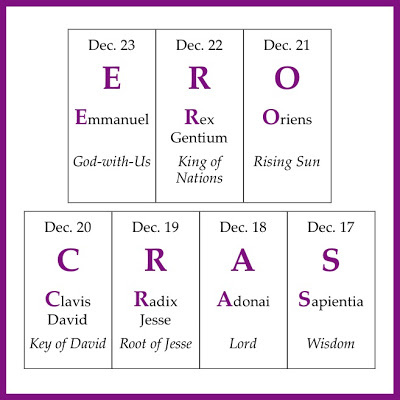
The Greater Antiphons, the Church’s prophetic utterances…
The tradition of the “O Antiphons” is now upon us. We will hear them beginning tonight at Vespers.
night, a biblical verse from the Advent Prophets Isaiah and Micah (that is, an “antiphon”)
that is known to be prophetic of the birth of Jesus; each notes a title of the
Messiah. Each offers us a key to understand the gift of the Messiah promised through the use of typology.
Seven different antiphons are traditionally sung prior to and following the
Magnificat during Vespers as part of the Divine Office (the Liturgy of the
Hours). The eighth day of the octave is Christmas Eve, so Vespers for that
evening is the Christmas Vigil. Each antiphon begins with the word, “O” in the
incipit. Hence, “O Antiphons.”
Most of us are familiar with the Advent hymn, “O Come, O Come,
Emmanuel,” the content of which the O Antiphons form the structure Vespers at
this time of the liturgical year.
says and since in our theology we derive our belief from the manner in which we
pray, the O Antiphons give ample food for what we belief the Messiah to be, who
he is. Secularism gives the world an emasculated Santa Claus but the Church
gives us a Messiah. He is known through his titles, that is, his activities. In
the final stretch before Christmas use this time to pray with the O Antiphons:
they provide a beautiful framework for reflection before the Nativity.
Advent Three, Gaudete
Our worship of God began today with the Church quoting Saint Paul who wrote, “Rejoice in the Lord always; again I say rejoice. Indeed, the Lord is near” (Phil. 4:4-5).
Hard to hear these words today following the tragic events of Friday the 14th where the citizens in Newtown, Connecticut, indeed, the nation, faced horrific acts of evil. As we “faithfully await the feast of the Lord’s Nativity” our affect, our prayer, our humanity has a new orientation, a new recognition: a cry of anguish and a cry of joy. That’s the Christian paradox. We are sad (troubled and grieved) to have young people gunned down. Lives cut short. The living who are searching for ways to go on with meaning and peace. The somber joy of the Third Sunday of Advent is an invitation, a recognition, a way being, to a life of joy found only in God no matter the circumstance.
Advent, like every day of our liturgical lives is call to be aware of God; to be reawakened to the movements of grace in the depths of our being.
The Liturgy concludes with the petition that the divine gifts received in the Eucharist “cleanse us of our faults and prepare us for the coming feasts.” That’s the challenge we all face together: to begin our conversion with the awareness that sin can have deleterious effects in each of us if not attended to. What can be said of Adam Lanza with his crime, personal sin and affective disorder can happen to each of us. There is that line that’s sometimes helpful to remember: There I go but for Christ’s grace. The measure of life is not our passion but the Mystery of Christ.
The anxiety of these days is mitigated by what the Lord does in our hearts: He loves us.
I noticed in the first Scripture reading for today’s Mass the phrase: the Lord is near. It ought to echo for you where you hear the Great O Antiphon, O Emmanuel, God with us. Is that our belief? Is there a true awareness that the Lord is near in the way we live our lives in the particular circumstances in which we find ourselves? Are there concrete ways that we recognize the nearness of the Lord in His gift of the Holy Eucharist, in the proclamation of the Word, in lectio divina, in the community of faith that worships and does works of charity?
The New Evangelization and St Benedict
Some Year of Faith initiatives
The monks, nuns and oblates of Saint Mary’s Monastery and Saint Scholastica Priory in Petersham, MA, had a day of reflection on October 20th that covered the New Evangelization and the Benedictine charism. Dr. Philip Zaleski, an Oblate of the monastery and Father Christophe Vuillaume, OSB, a monk at Saint Mary’s gave the two presentations.
Audio files
The Year of Faith and the New Evangelization
Saint Benedict and the Life of Faith
Dr Zaleski is a professor at Smith College and a published author, and Dom Vuilaume is a priest and monk who as served at the request of the Subiaco Congregation in various locations,as of now he’s serving at Saint Mary’s.
The Monastery is celebrating 25 years of foundation this year. The monks belong to the Subiaco Congregation which is one of the largest groupings of monks and nuns in the world. Most often monasteries in the Subiaco Congregation do not engage in outside works and rely on the generosity of others. At Saint Mary’s. the Divine Office is prayed according to the traditional form of the Antiphonale Monasticum; Holy Mass is celebrated according to the Novus Ordo with the ordinary of the Mass prayed in Latin.
The nuns of Saint Scholastica Priory follow a traditional monastic life. They share the monastic church with the monks for some of the prayer times and Mass but have their own work. They were blessed recently to have two novices profess simple vows.
Saint Lucy
May the glorious intercession of the Virgin and Martyr Saint Lucy give us a heart, we pray, O Lord, so that we may celebrate her heavenly birthday in this present age.
Saint Lucy’s life is rather obscure now with the passage of time and the lack of accurate records from her period in history. She died c. 304 during the time of Diocletius. Since Saint Gregory the Great added Lucy’s name to the Roman Canon in the 6th century we hear her name with other virgin martyrs.
Remembering liturgical history, the liturgical memorial of Saint Lucy was commemorated on the shortest day of the year on the Julian calendar. The meaning of “Lucy” is drawn from the Latin word “lux,” light, hence Lucy illumines our path to Christ; her light shines in the darkness.
Today, December 13, is no longer the shortest day of the year with the least amount of light but we retain the memorial of Lucy, a woman linking us to the Lord through the light of her life of virtue.
Hagiography points us in a direction:
Light is beautiful to look upon; for as Ambrose says: it is the nature of light that all graciousness is in its appearance. Light also radiates without being soiled; no matter how unclean may be the place where its beams penetrate, it is still clean. It goes in straight line, without curvature, and traverses the greatest distances without losing its speed. Thus we are shown that the blessed virgin Lucy possessed the beauty of virginity without trace of corruption; that she radiated charity without any impure love; her progress toward God was straight and without deviation, and went far in God’s works without neglect or delay.
Blessed James of Voragine
The Golden Legend
Lucy’s courage, like that of Saint Agatha’s (to whom she prayed for her mother’s conversion), Saint Barbara and the other virgin-martyrs is a key reminder that we ought to focus our attention on the Lord in a single-minded manner.
I’d like to remember those who live with physical blindness, particularly my late maternal great aunt Bea and uncle Walter. They were such good examples of courage. Just as it is said that Saint Lucy’s eyesight was restored before her death, may those who lived in blindness see clearly the beauty of the Lord.
And, prayers ought to rise up for the Xavier Society for the Blind in NYC.
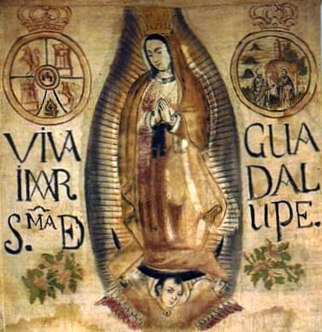
Our Lady of Guadalupe
O God, Father of mercies, who placed your people under the singular protection of your Son’s most holy Mother, grant that all who invoke the Blessed Virgin of Guadalupe may seek with ever more lively faith the progress of peoples in the ways of justice and of peace.
Papal twittering has a history
Millions tweet, even the Pope
We now have a Pope that tweets. It’s big news. Now there seems to be close to a million people following Pope Benedict’s Twitter account @pontifex in a variety of languages.
Massimo Camisasca, FSCB, ordained bishop
This is the fundamental reason for my episcopate: to
announce Christ, the Son of God made man, who underwent the Passion and the
Cross for love of us, is risen and so is living, and acts in the history of
mankind with the attractive force of his divine humanity through his Body in
history, which is the Christian people, his Church.
Communion
and Liberation, therefore, has chosen and chooses to indicate not a road, but
the road toward a solution to this existential drama. The road, as you have
affirmed so many times, is Christ. He is the Way, the Truth, and the Life, who
reaches the person in his day-to-day existence.