Today is the anniversary of death in 1991 of the famed Archbishop Marcel François Marie Joseph Lefebvre founder of the Society of St Pius X (SSPX).
Author: Paul Zalonski
Passover 2013, Francis united in prayer with the Jewish people
Tonight, 15th of Nissan, begins the annual days prayer remembering the liberation of the captive Jews in Egypt by God. The theological reality of the Passover is not merely relating to events of 3000 years ago, but an active remembrance (liturgically called anamnesis) that God leads us to freedom today: from slavery of sin to the grace of freedom; from being chained to unfaithfulness to the freedom of love and mercy. Christians will hear echoes in what is believed about Jesus and Holy Week. All leavened foods will be destroyed, needed cleaning done, and time for prayer and fasting. Read the Book of Exodus. The ritual mean of the sedar is a mix of biblical narrative, song and friendship. Passover ends on April 2 (in Israel the observance is 7 days, other places it’s 8).
The Holy Father unites himself, and us, with our Jewish brethren:
A few days on from our meeting, and with renewed gratitude for your having desired to honour the celebration of the beginning of my ministry with your presence and that of other distinguished members of the Jewish community, I take great pleasure in extending my warmest best wishes to you and Rome’s entire Jewish community on the occasion of the Great Feast of Pesach. May the Almighty, who freed His people from slavery in Egypt to guide them to the Promised Land continue to deliver you from all evil and to accompany you with His blessing. I ask you to pray for me, as I assure you of my prayers for you, confident that we can deepen [our] ties of mutual esteem and friendship.
Francis
Pope Francis’ books draw on Ignatian spirituality
Have you been wondering what the Pope has published? Well, look no further. L’Osservatore Romano is publishing an article in tomorrow’s edition on Francis’ books. With Pope Francis leading the Church I think there will be a resurgence of Ignatian spirituality –as distinct from “Jesuit spirituality”, inhabiting our Christian lives. I am sure these books will be published in various languages before long.
The first two books in Italian by Jorge Mario Bergoglio were presented on Tuesday, 26 March in the offices of Civiltà Cattolica. They are published by Editrice Missionaria Italiana (Emi): Umiltà, la strada verso Dio (Bologna, 2013, 64 pages, € 6.90, with an afterword by Enzo Bianchi) and Guarire dalla corruzione (Bologna 2013, 64 pages, € 6.90, with an afterword by Pietro Grasso) and are collections of addresses that the Cardinal Archbishop of Buenos Aires gave in 2005 to the faithful of the archdiocese.
Both books draw on the spirituality of St Ignatius of Loyola to describe its deep inner workings and offer solutions to extremely pertinent phenomena such as corruption in both society and the Church, as well as the urgent need for an ecclesial life distinguished by brotherly holiness.
Speakers at the meeting chaired by Fr Antonio Spadaro, editor-in-chief of the Jesuit journal, were Lucetta Scaraffia, an Italian historian, Fr Luigi Ciotti and Lorenzo FazzinI, director of Editrice Missionaria Italiana.
Bergoglio stated:
“Factions fighting to impose the hegemony of their own viewpoint and preferences are fairly common in religious communities, both local and provincial. This occurs when charitable openness to neighbour is replaced by each individual’s own ideas. It is no longer the religious family as a whole which the religious defends, but only the part of it that concerns him. People no longer adhere to the unity that contributes to configuring the Body of Christ, but rather to the divisive, distorting, and debilitating conflict. For formation teachers and superiors it is not always easy to inculcate a sense of belonging to the family spirit, especially when it is necessary to shape inner attitudes, even small ones, but which have repercussions at this level of the institutional body. One of the effective attitudes that must acquire substance in the hearts of young religious is that of ‘self-accusation’, for it is in the absence of this practice that the spirit of separation and division is rooted. It is therefore essential first of all to ban every reference, even an unconscious one, and every kind of pharisaic attitude that presents self-accusation as something puerile or characteristic of the cowardly. Self-accusation, rather, presupposes a rare courage in order to open the door to unknown realities and let others see beyond my appearance. It means removing all our make-up so that the truth may shine through.
The accusation of ourselves (which is only a means) is the basis in which the fundamental option puts down roots: for anti-individualism and for a family and Church spirit which brings us to relate as good children and good siblings, so as to succeed later in being good parents. Accusing ourselves implies a fundamentally communitarian attitude.”
The Annunciation: the beginning of salvation
Today is the beginning of our salvation,
The revelation of the eternal mystery!
The Son of God becomes the Son of the Virgin.
As Gabriel announces the coming of Grace.
Together with him let us cry to the Theotokos:
Rejoice, O Full of Grace,
The Lord is with You!
(Troparion, Tone 4)
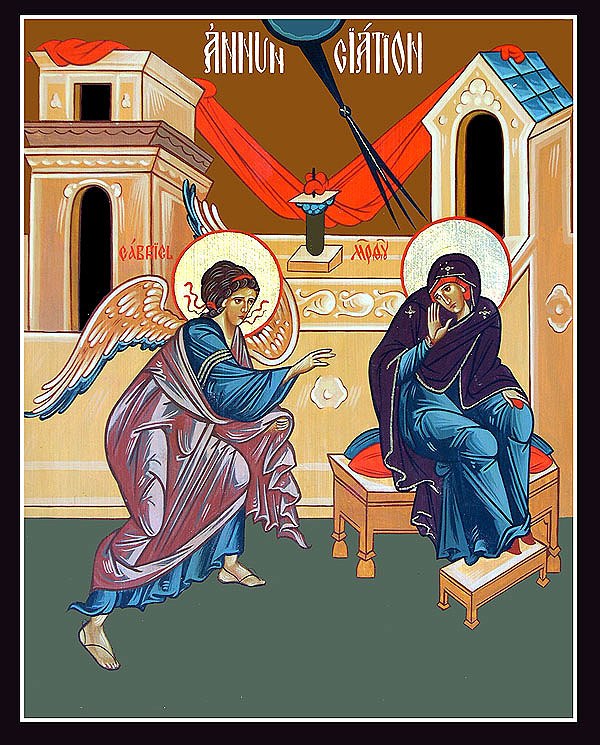
Indeed, today is the beginning of salvation history. As St Luke’s gospel (1:26-38) reveals, and as other languages portray the Incarnation, we’ve received “good tidings.” From the moment the angel’s message was received positively by Mary cosmic history has never been the same. March 25 is the solemnity of the Annunciation to the Mary that she’s be the Mother of God (the most Holy Theotokos). And it’s Holy Week followed by Eastertide, the Church will observe this solemn occasion on April 8. Nevertheless, a word or two need to be said about the Annunciation.
Liturgical history tells us that there exists a 2nd century painting of the Annunciation in the catacomb of Priscilla. And more widely celebrated since the 4th century, the Christian community has observed the Annunciation as a solemn day of grace.
Ecclesiastical history bears witness to the Council of Toledo in 656 mentioning the Feast in Spain and then at the Council in Trullo in 692 indicating the Church there having a celebration of the Annunciation even though it was Lent. The Fathers of the Second Vatican Council spoke about the Marian principle of the Church as being fundamental to the life of the Church (see the conclusion of Lumen Gentium), even more important that the Petrine principles because what we believe to be true about the Incarnation.
On the Annunciation, the Knights of Columbus pray for the unborn children and the work of being pro Life.
The feast testifies that God fulfills His promise to send a Redeemer (Genesis 3:15): “I will put enmity between you and the woman, between your seed and her seed; he shall crush your head, and you shall lie in wait for his heel.” What the prophets and teachers of the Law believed and taught the people of Israel, was given by Gabriel’s announcement; and in the Christian dispensation the Fathers of the Church have taught that what is called “her seed” to refer to Jesus. Here is an unmistakable theological view that Jesus is the new Adam, the new tree of life, the new Law, the new Lawgiver, the new face of God.
Continue reading The Annunciation: the beginning of salvation
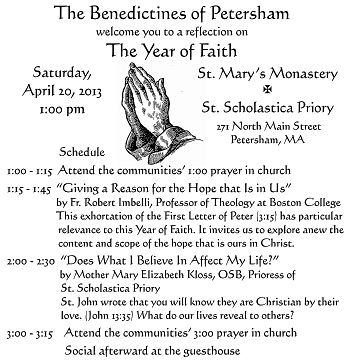
St Mary’s Monastery (Petersham) hosts Fr Robert Imbelli for a Year of Faith presentation on Hope
Pacem in Terris after 50 years
A Public Symposium in Celebration of the 50th Anniversary of Pope John XXIII’s Encyclical on Establishing Universal Peace on Earth
Thursday, April 4, 2013, 5:00PM – 7:00PM
5 – 7 p.m. EST
4 – 6 p.m. CST
Max Palevsky Cinema, Ida Noyes Hall
University of Chicago
1212 East 59th Street, Chicago, IL 60637
Keynote
Roland Minnerath, Archbishop of Dijon
Respondents
Mary Ann Glendon, Harvard Law School
Joseph Weiler, New York University Law School
Russell Hittinger, University of Tulsa Thursday, April 4, 2013
Presented by
The Lumen Christi Institute for Catholic Faith, Thought, and Culture, the Committee on Social Thought at the University of Chicago, and the Center for Civil and Human Rights at the University of Notre Dame Law School
For more information on other presentations, visit this site.
Jesus made an ass of Himself
Bishop Hugh Gilbert, OSB, bishop of Aberdeen, Scotland, tells us about Christ, the donkey and our willingness to become useful for Christ.
Pope Francis: we accompany, we follow Jesus
Pope Francis’ first celebration of the Holy Week liturgies. His homily for Palm Sunday follows:
1. Jesus enters Jerusalem. The crowd of disciples accompanies him in festive mood, their garments are stretched out before him, there is talk of the miracles he has accomplished, and loud praises are heard: “Blessed is the King who comes in the name of the Lord. Peace in heaven and glory in the highest!” (Lk 19:38).
Crowds, celebrating, praise, blessing, peace: joy fills the air. Jesus has awakened great hopes, especially in the hearts of the simple, the humble, the poor, the forgotten, those who do not matter in the eyes of the world. He understands human sufferings, he has shown the face of God’s mercy, he has bent down to heal body and soul. Now he enters the Holy City! This is Jesus.This is the heart that looks on all of us, watching our illnesses, our sins. The love of Jesus is great. He enters Jerusalem with this love and watches all of us.
It is a beautiful scene, the light of the love of Jesus, that light of his heart, joy, celebration.
We accompany, we follow Jesus, but above all we know that he accompanies us and carries us on his shoulders. This is our joy, this is the hope that we must bring to this world of ours. Let us bring the joy of the faith to everyone! Let us not be robbed of hope! Let us not be robbed of hope! The hope that Jesus gives us!
2. A second word: why does Jesus enter Jerusalem? Or better: how does Jesus enter Jerusalem? The crowds acclaim him as King. And he does not deny it, he does not tell them to be silent (cf. Lk 19:39-40). But what kind of a King is Jesus? Let us take a look at him: he is riding on a donkey, he is not accompanied by a court, he is not surrounded by an army as a symbol of power. He is received by humble people, simple folk, who sense that there is more to Jesus, who have the sense of faith that says, “This is the Savior.”
Jesus does not enter the Holy City to receive the honors reserved to earthly kings, to the powerful, to rulers; he enters to be scourged, insulted and abused, as Isaiah foretold in the First Reading (cf. Is 50:6). He enters to receive a crown of thorns, a staff, a purple robe: his kingship becomes an object of derision. He enters to climb Calvary, carrying his burden of wood. And this brings us to the second word: Cross. Jesus enters Jerusalem in order to die on the Cross. And it is here that his kingship shines forth in godly fashion: his royal throne is the wood of the Cross! I think of what Benedict XVI said to the cardinals: “You are princes but of a Crucified King” that is, Christ’s throne. Jesus takes it upon himself..why? Why the Cross? Jesus takes upon himself the evil, the filth, the sin of the world, including our own sin, and he cleanses it, he cleanses it with his blood, with the mercy and the love of God. Let us look around: how many wounds are inflicted upon humanity by evil! Wars, violence, economic conflicts that hit the weakest, greed for money, which no-one can bring with him. My grandmother would say to us children, no shroud has pockets! Greed for money, power, corruption, divisions, crimes against human life and against creation! And – each of us knows well – our personal sins: our failures in love and respect towards God, towards our neighbor and towards the whole of creation. Jesus on the Cross feels the whole weight of the evil, and with the force of God’s love he conquers it, he defeats it with his resurrection. This is the good that Christ brings to all of us from the Cross, his throne. Christ’s Cross embraced with love does not lead to sadness, but to joy! The joy of being saved and doing a little bit what he did that day of his death.
3. Today in this Square, there are many young people: for 28 years Palm Sunday has been World Youth Day! This is our third word: youth! Dear young people, I think of you celebrating around Jesus, waving your olive branches. I think of you crying out his name and expressing your joy at being with him! You have an important part in the celebration of faith! You bring us the joy of faith and you tell us that we must live the faith with a young heart, always, even at the age of seventy or eighty! A young heart! With Christ, the heart never grows old! Yet all of us, all of you know very well that the King whom we follow and who accompanies us is very special: he is a King who loves even to the Cross and who teaches us to serve and to love. And you are not ashamed of his Cross! On the contrary, you embrace it, because you have understood that it is in giving ourselves that we have true joy and that God has conquered evil through love. You carry the pilgrim Cross through all the Continents, along the highways of the world! You carry it in response to Jesus’ call: “Go, make disciples of all nations” (Mt 28:19), which is the theme of World Youth Day this year. You carry it so as to tell everyone that on the Cross Jesus knocked down the wall of enmity that divides people and nations, and he brought reconciliation and peace. Dear friends, I too am setting out on a journey with you, from today, in the footsteps of Blessed John Paul II and Benedict XVI. We are already close to the next stage of this great pilgrimage of Christ’s Cross. I look forward joyfully to next July in Rio de Janeiro! I will see you in that great city in Brazil! Prepare well – prepare spiritually above all – in your communities, so that our gathering in Rio may be a sign of faith for the whole world. Young people need to tell the world: “It is good to follow Jesus, it is good to go with Jesus, the message of Jesus is good, it is good to come out of ourselves, from the edges of existence of the world and to bring Jesus to others!”
Three words: Joy, Cross and Youth.
Let us ask the intercession of the Virgin Mary. She teaches us the joy of meeting Christ, the love with which we must look to the foot of the Cross, the enthusiasm of the young heart with which we must follow him during this Holy Week and throughout our lives. Amen.
Oscar Romero’s 33rd anniversary
The Lord will show his justice to the nations of the world.
Archbishop Oscar Romero, assassinated 33 years ago today, offering Mass in San Salvador.
Archbishop Romero is remembered as a Church leader of hope in a country that was ravaged by poverty, injustice and oppression.
In the face of incredible injustice, the Archbishop knew the Church to be a beacon of faith, hope and charity, recognized his responsibility to be a witness to these virtues and to challenge the oppressors, especially those who claimed to be Catholic. Romero’s cause for canonization is being studied.
Palm Sunday: Keep your eyes on the Lord
In the procession the people meet Jesus with palm branches, in the passion they slap him in the face and strike his head with a rod. In the one they extol him with praises, in the other they heap insults upon him. In the one they compete to lay their clothes in his path, in the other he is stripped of his own clothes. In the one he is welcomed to Jerusalem as just king and savior, in the other he is thrown out of the city as a criminal…If, then, we want to follow our leader without stumbling through prosperity and through adversity, let us keep our eyes upon him, honored in the procession, undergoing ignominy and suffering in the passion, yet unshakably steadfast in all such changes of fortune.
Blessed Guerric of Igny