These weeks we are hearing the narrative of the very early followers of The Way, that is, those who adhere to the Good News taught by Jesus, the crucified and risen one.
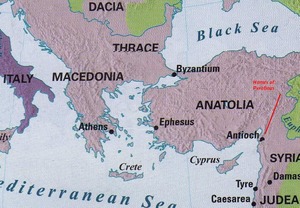
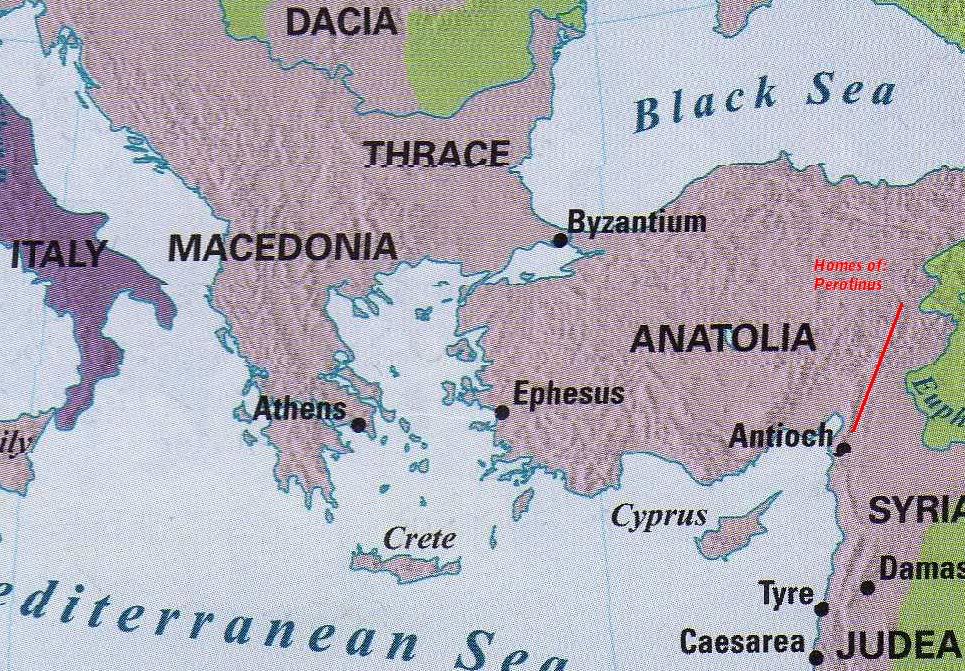
With the killing of the deacon while kidnapping the two bishops in Syria has me concerned about Christians losing the sensitivity to the importance of Syria as a key Christian center. Most Western Christians forget that our Christians origins in the West was first formed in the East. Recall from Acts that “it was in Antioch that the disciples were first called Christians.” It was in Antioch, not in Rome, not in Moscow, not in Constantinople, that the disciples of Jesus of Nazareth were first generated by the Holy Spirit, they were called by name. It’s not West OR East, but West AND East when comes to Christian faith. Does Antioch have any resonance with you Christians? Do you have any concern for our Christian heritage in Syria? What’s our concern for those being killed for being Christian today? Do we even care? Remember: God has created each of us to do Him some definite service; let us live and work in charity for our neighbor.
A famous Antiochian saint, the bishop Ignatius said this in his letter to the Magnesians, “It is right, therefore, that we not just be called Christians, but that we actually be Christians” (4.1).
Too often do I hear that it was much easier to be a Christian of the early years following the Ascension of the Lord and the Pentecost than today. That’s a crazy idea! First of all, no one who knows history can hold that idea as valid. Those who really and truly followed Jesus Christ as Lord and Savior, Messiah and Word made flesh, were harassed and/or killed. The Acts of the Apostles testifies to the fact that Jesus’ followers were killed. There is little difference with state of Christianity in AD 13 than in 2013. So what happened to the Christians in the 1st century is no different than what the dictatorship in Syria is doing now.
So, we can’t allow Syria to further unravel and act contrary to faith and reason. We need to remember that Antioch is crucial to our Christian identity today because our faith in the Lord is no less real, no less beautiful, no less controversial today than in previous eras. It is in Antioch (Syria) that we our Christian identity (belief, liturgy, church tradition, music, science and culture) was formed. Antioch (that is, Syria in general) and the people who live there is the place where and the community where we’ve learned the horizons of our Hope in what Jesus promised.
A preacher whom I like very much is the Very Reverend Denis Robinson, OSB, the president-rector of Saint Meinrad School of Theology. Dom Denis is a Benedictine monk and priest who teaches systematic theology. In 2007, he earned a doctorate in theology specially in the work of Blessed John Henry Newman from the Catholic University of Louvain, Belgium. Recently, he said,
As long as we keep stored up in ourselves the well-rehearsed scripts of indifference, ineptitude, pain, doubt, self-loathing. As long as we think we know the answers, after all that’s what mamma said, until we see that the world is more complicated than the truth we learned at our mother’s knee Brothers and sisters, there is one thing and one thing only that we need. We need Antioch. We need that identity. We need Antioch because we must learn to call ourselves something other than forsaken. We need Antioch. We need to learn to love rather than judge, to give rather than take, to provide for one another rather than constantly seeking the self, the damn self that will be truly damned if we cannot give ourselves over to Christ, all to Christ, fully to Christ, forever to Christ. Where will it be? Where will it be then? If not in Antioch, where will it be? Brothers and sisters we continue to revel in this Easter season knowing I hope full well that the complex completeness of Easter did not come on that solemn night of proclamation. Antioch beckons us in the name of towns and places as yet unseen, unknown, unexplored. And we respond full of hope that the fullness of Easter is still rushing in.
 Antonio Ghislieri (1504-72) was born near Alexandria, a town in Lombardy on the Adriatic. His vocation was with the Dominicans who educated him, had him ordained and missioned him to teach theology. He was elected bishop having served in several places where and he sought to reform the moral and theological, canonical and liturgical laxity of the clergy and laity alike; his concern was the coherence of the Catholic Faith. Sound familiar? Among his many responsibilities was taking up the work of Inquisitor in the Italian region. He was elected to the See of Rome in 1566. As Pope he strenuously promoted the Catholic Reformation outlined by the Council Fathers of Trent (doing of the same work as pope as he did as bishop), oversaw the excommunication of Queen Elizabeth I of England, encouraged missionary work and reformed the brieviary,the sacred Liturgy and the Catechism.