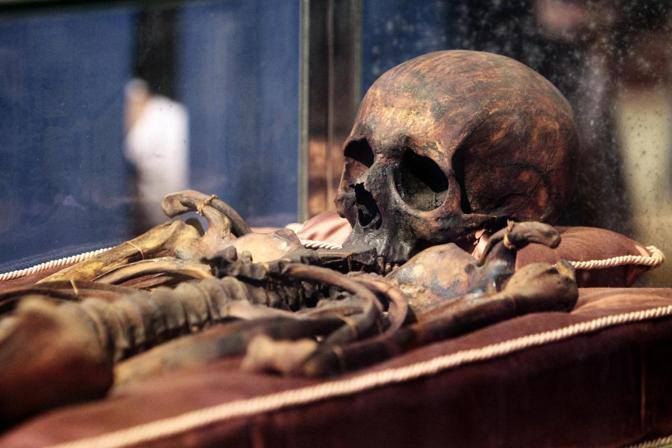
A nun dies at 105 years old. Likely to be the oldest. She was the nun of 10 popes.
Author: Paul Zalonski
Pietro Vittorelli, OSB, resigns abbacy of Montecassino
It’s finally been decided: Abbot Pietro Vittorelli has resigned the abbacy and his ministry of Ordinary of Cassino. Pope Francis invoked the Code of Canon Law 401.2 regarding matters of health.
Last year I asked readers of Communio to pray for Abbot Pietro here.
He now needs to pay more attention to his health for his own good, that of the monastic community that he intensely loves but also for the diocesan community.
Until the monastic community of Montecassino can be called together to elect a new abbot, the Prior of Sacro Speco at the Abbey of Saint Scholastica (on Subiaco) and the Director of the Library in the City there, Dom Augusto Ricci will serve as the Apostolic Administrator.
Dom Pietro was born on 30 June 1962, professed of vows in 1991, ordained priest in 1994, elected and confirmed in the abbatial office and Diocesan Ordinary of Montecassino in 2007. The great abbey of Montecassino is a territorial abbey. The stats of the diocese in 2004 state that there were 79,000 souls, with 68 priests (secular and religious) serving in 53 parishes.
From the Italian media.
Through the intercession of Blessed Columba Marmion we pray,
O God, Almighty Father, who, having called the blessed abbot Columba to the priesthood and to the monastic way of life, wonderfully opened to him the secrets of the mysteries of Christ, grant, in Thy goodness, that, strengthened by his teachings in the spirit of our adoption as Thy sons, we may pray to Thee with a boundless confidence, and so obtain, through his intercession, the full restoration to health of Dom Pietro Vittorelli, Abbot of Monte Cassino. We ask this grace for the joy of Thy Church, for the consolation of the community of Monte Cassino, and for the praise of Thy glory, through our Lord Jesus Christ, Thy Son, who liveth and reigneth with Thee, in the unity of the Holy Spirit, one God forever and ever. Amen.
Saint Barnabas
With the Church we pray
O God, who decreed that Saint Barnabas, a man filled with faith and the Holy Spirit, should be set apart to convert nations, grant that the Gospel of Christ, which he strenuously preached, may be faithfully proclaimed by word and by deed.
Saint Barnabas died in AD 61. What we know of Barnabas comes most from the Acts of the Apostles, which we heard in today’s Mass readings but he also shows in several of Saint Paul’s Letters.
Who was Barnabas? Some scholars say that Barnabas was the cousin of Saint Mark on the basis of Colossians 4. We know he was of the tribe of Levi (making him a member of the priestly class), a native of Cyprus and a landowner there before selling the land to support the Church in Jerusalem, Moreover, he was trained in the Christian faith and a teacher of the same (see Acts 13).
11th Anniversary of a tragedy at Conception Abbey
“When brutal deeds are enacted, it calls for heroic and radical forgiveness. Such acts of violence as happened here on Monday, could only have come from someone in desperate need of help. Hatred, anger, and an unwillingness to forgive only keep us crippled and bound by the evils that surround us. If we endure evil and do not allow it to conquer us, we will share in the victory of Jesus Christ, in the hidden life of the resurrection of Jesus.”
Continue reading 11th Anniversary of a tragedy at Conception Abbey
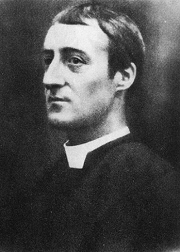
Remembering Gerard Manley Hopkins, priest
On this date in 1889, Jesuit Father Gerard Manley Hopkins died. He was a convert and a poet. Hopkins struggled with having good physical and mental health.
Hopkins’ poetry is extraordinary and innovative in the use of language and form. It is said the was influence more by the Franciscan school than the Thomists.
O God, You did raise Your servant, Gerard Manley Hopkins, to the sacred priesthood of Jesus Christ, according to the Order of Melchisedech, giving him the sublime power to offer the Eternal Sacrifice, to bring the Body and Blood of Your Son Jesus Christ down upon the altar, and to absolve the sins of men in Your own Holy Name. We beseech You to reward his faithfulness and to forget his faults, admitting him speedily into Your Holy Presence, there to enjoy forever the recompense of his labors. This we ask through Jesus Christ Your Son, our Lord. Amen.
The vocation to be a priest relies on a daily dialogue with Jesus, living with the Church
Seminarians get a letter from Mauro Cardinal Piacenza, Prefect of Congregation for the Clergy for the feast of the Sacred Heart of Jesus, advocating the need for the daily dialogue –the salvific meeting (an encounter)– with the Lord which builds a beautiful edifice of life and love.
The cardinal highlights Pope Francis’ idea that in the priestly life there is a primacy of grace: a joy of bearing the cross of Jesus Christ, without which the priest is a mere functionary, not a disciple following a path cut out by the Lord –and, today, the Church– that is certain and life-giving. Only in the cross do we see the self-giving nature of God the Son; the lack of an embrace of the cross contributes to worldliness, secularism, the primacy of the self as the measure of all things.
Highlighted, too, is the faithfulness and thus dependence upon the proven tools of the spiritual life: silence, discernment, sacraments, spiritual direction, human and theological formation. Of course, all this demands that the formators in seminaries aren’t dysfunctional and ideological.
For more about the formation of men to be priests is a book written by the Most Reverend Massimo Camisasca, FSCB, The Challenge of Fatherhood (Human Adventure Books).
On the solemnity of the Most Sacred Heart of Jesus, we celebrate most significantly the day for the sanctification of priests and, as you are in the Seminary to respond in the most fitting way possible to your vocation, it is important for me to send you this letter, with great affection, so that you may feel involved and, as such, remember this important occasion.
The Spirit of the Liturgy from Benedict to Francis
Abbot Michael C. Zielinski OSB, undersecretary of the Congregation for Divine Worship, discusses what is being taught by the most recent pontiffs. Abbot Michael notes the continuity and distinctions in celebrating of the sacred Liturgy by Popes Benedict and Pope Francis. But there are some things that Abbot Michael notes that are not liturgical per se, “the spirit” can be a bit vague some ways. Moreover, there are things that are already expected as the result of the theology and upheld by the rubrics. More reflection on what the synthesis and art of celebrating means, teaches and how it sanctifies. Here is a beginning… The Catholic News Service provides the video feed.
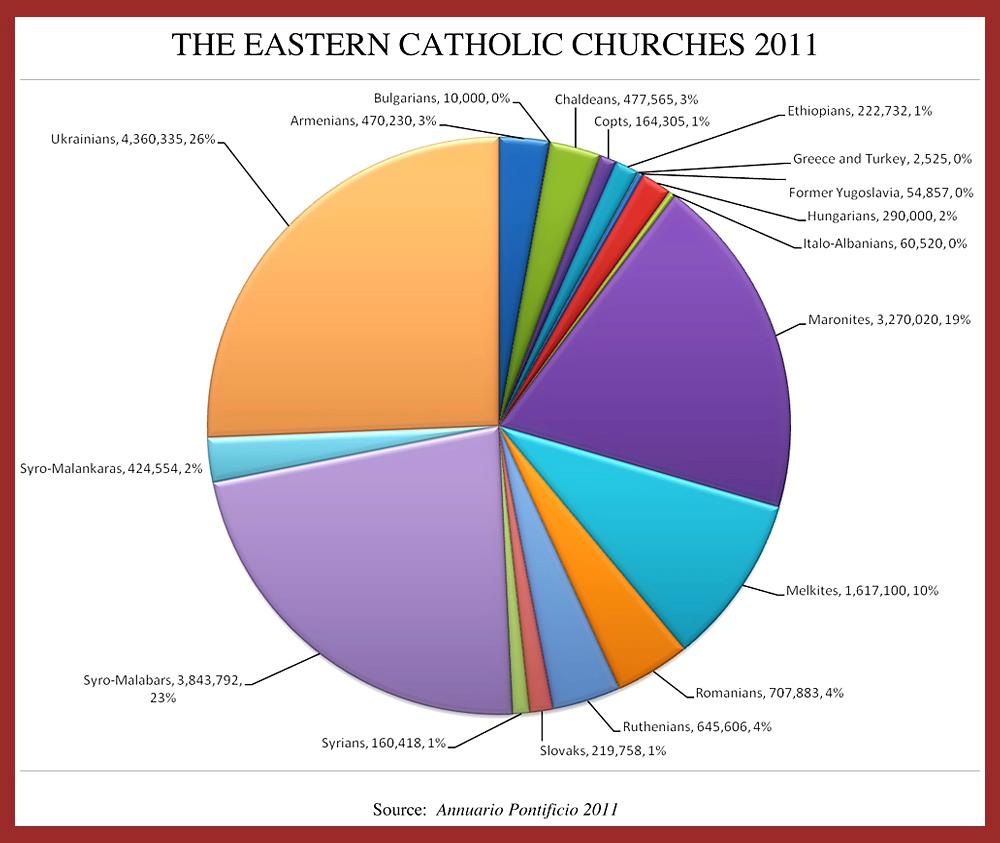
Eastern Catholic Churches by the numbers, 2011
The Feast of the Sacred Heart of Jesus
With the Church we pray…
Grant, we pray, almighty God, that we, who glory in the Heart of your beloved Son and recall the wonders of his love for us, may be made worthy to receive an overflowing measure of grace from that fount of heavenly gifts.
At the period of Jesus’ coming upon this earth, man had forgotten how to love, for he had forgotten what true beauty was. His heart of flesh seemed to him as a sort of excuse for his false love of false goods: his heart was but an outlet, whereby his soul could stray from heavenly things to the husks of earth, there to waste his power and his substance. To this material world, which the soul of man was to render subservient to its Maker’s glory–to this world, which, by a sad perversion, kept man’s soul a slave to his senses and passions–the Holy Ghost sent a marvelous power, which, like a resistless lever, would replace the world in its right position: it was the sacred Heart of Jesus; a Heart of flesh, like that of other human beings, from whose created throbbings there would ascend to the eternal Father an expression of love, which would be a homage infinitely pleasing to the infinite Majesty, because of the union of the Word with that human Heart. It is a harp of sweetest melody, that is ever vibrating under the touch of the Spirit of love; it gathers up into its own music the music of all creation, whose imperfections it corrects, whose deficiencies it supplies, tuning all discordant voices into unity, and so offering to the glorious Trinity a hymn of perfect praise. The Trinity finds its delight in this Heart. It is the one only organum, as St. Gertrude calls it, the one only instrument which finds acceptance with the Most High. Through it must pass all the inflamed praises of the burning Seraphim, just as must the humble homage paid to its God by inanimate creation. By it alone are to come upon this world the favors of heaven. It is the mystic ladder between man and God, the channel of all graces, the way whereby man ascends to God, and God descends to man.
Dom Prosper Guéranger, OSB
The Liturgical Year
The unexpected grace of Matushka Magdalena
We need witnesses. This is an idea that I am echoing from the teaching of Paul VI. Who are the witnesses that lead you to a deeper relationship with the Other, with friends, and with oneself?