A catechist is a Christian who keeps the memory of God alive, Pope Francis tells

Mass offered today by Pope Francis marked an International Day for Catechists organized by the Pontifical Council for the Promotion of the New Evangelization for the Year of Faith. Patriarch John X of the Syrian Greek Orthodox Church was present.

It is a day to remember what teaching the faith to others means. Indeed, we can focus on the gifts of the Catechism of the Catholic Church and Catechesis of the Good Shepherd. Key to any method of teaching is knowing what the role of the teacher has. In the Church, we say that Catechists are not the focus of our attention in passing on the Tradition of the faith, Christ the teacher is. We who teach the faith to others, especially the young, don’t replace the parents as the first teachers of the faith, nor do we, when it comes to adults, obscure the fact that each person makes the decision to freely follow Jesus doing the hard work to know what Jesus said and did.

As Pope Francis said, catechists reflect the memory of God in concrete ways; a line of thinking that Pope Benedict also taught us. Attend to what Francis says. Keeping the memory of God is an intriguing idea: the gift of being able to give clear witness to the Creator, indeed the work of the Holy Trinity. In Ignatian terms, we know God to labor for us but do we recognize this fact? This is one of the reasons we are to be familiar with narrative of divine revelation. There are many patron saints for catechists but we ought to consider important to go to are Saint Robert Bellarmine, Saint Thérèse of Lisieux, Saint John Bosco and Saint John Baptist de la Salle, among others. Go to the saints help you to remember God.

Pope Francis’ homily follows:

1. “Woe to the complacent in Zion, to those who feel secure … lying upon beds of ivory!” (Am 6:1,4). They eat, they drink, they sing, they play and they care nothing about other people’s troubles.

These are harsh words which the prophet Amos speaks, yet they warn us about a danger that all of us face. What is it that this messenger of God denounces; what does he want his contemporaries, and ourselves, to realize? The danger of complacency, comfort, worldliness in our lifestyles and in our hearts, of making our well-being the most important thing in our lives. This was the case of the rich man in the Gospel, who dressed in fine garments and daily indulged in sumptuous banquets; this was what was important for him. And the poor man at his doorstep who had nothing to relieve his hunger? That was none of his business, it didn’t concern him. Whenever material things, money, worldliness, become the centre of our lives, they take hold of us, they possess us; we lose our very identity as human beings. The rich man in the Gospel has no name, he is simply “a rich man”. Material things, his possessions, are his face; he has nothing else.

Let’s try to think: How does something like this happen? How do some people, perhaps ourselves included, end up becoming self-absorbed and finding security in material things which ultimately rob us of our face, our human face? This is what happens when we no longer remember God. If we don’t think about God, everything ends up being about “me” and my own comfort. Life, the world, other people, all of these become unreal, they no longer matter, everything boils down to one thing: having. When we no longer remember God, we too become unreal, we too become empty; like the rich man in the Gospel, we no longer have a face! Those who run after nothing become nothing – as another great prophet Jeremiah, observed (cf. Jer 2:5). We are made in God’s image and likeness, not that of material objects, not that of idols!

2. So, as I look out at you, I think: Who are catechists? They are people who keep the memory of God alive; they keep it alive in themselves and they are able to revive it in others. This is something beautiful: to remember God, like the Virgin Mary, who sees God’s wondrous works in her life but doesn’t think about honor, prestige or wealth; she doesn’t become self-absorbed. Instead, after receiving the message of the angel and conceiving the Son of God, what does she do? She sets out, she goes to assist her elderly kinswoman Elizabeth, who was also pregnant. And the first thing she does upon meeting Elizabeth is to recall God’s work, God’s fidelity, in her own life, in the history of her people, in our history: “My soul magnifies the Lord … For he has looked on the lowliness of his servant … His mercy is from generation to generation” (Lk 1:46, 48, 50).

This canticle of Mary also contains the remembrance of her personal history, God’s history with her, her own experience of faith. And this is true too for each one of us and for every Christian: faith contains our own memory of God’s history with us, the memory of our encountering God who always takes the first step, who creates, saves and transforms us. Faith is remembrance of his word which warms our heart, and of his saving work which gives life, purifies us, cares for and nourishes us. A catechist is a Christian who puts this remembrance at the service of proclamation, not to be important, not to talk about himself or herself, but to talk about God, about his love and his fidelity.

Saint Paul recommends one thing in particular to his disciple and co-worker Timothy: Remember Jesus Christ, raised from the dead, whom I proclaim and for whom I suffer (cf. 2 Tim 2:8-9). The Apostle can say this because he too remembered Christ, who called him when he was persecuting Christians, who touched him and transformed him by his grace.

The catechist, then, is a Christian who is mindful of God, who is guided by the memory of God in his or her entire life and who is able to awaken that memory in the hearts of others. This is not easy! It engages our entire existence! What is the Catechism itself, if not the memory of God, the memory of his works in history and his drawing near to us in Christ present in his word, in the sacraments, in his Church, in his love? Dear catechists, I ask you: Are we in fact the memory of God? Are we really like sentinels who awaken in others the memory of God which warms the heart?

3. “Woe to the complacent in Zion!”. What must we do in order not to be “complacent” – people who find their security in themselves and in material things – but men and woman of the memory of God? In the second reading, Saint Paul, once more writing to Timothy, gives some indications which can also be guideposts for us in our work as catechists: pursue righteousness, godliness, faith, love, endurance, gentleness (cf. 1 Tim 6:11).

Catechists are men and women of the memory of God if they have a constant, living relationship with him and with their neighbor; if they are men and women of faith who truly trust in God and put their security in him; if they are men and women of charity, love, who see others as brothers and sisters; if they are men and women of “hypomoné”, endurance and perseverance, able to face difficulties, trials and failures with serenity and hope in the Lord; if they are gentle, capable of understanding and mercy.

Let us ask the Lord that we may all be men and women who keep the memory of God alive in ourselves, and are able to awaken it in the hearts of others. Amen.
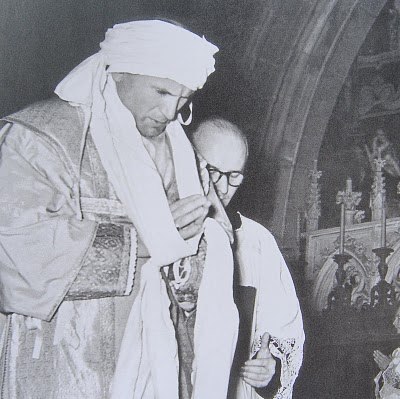
That Karol Wojtyła became a bishop

On this day 55 years ago…

“On 4 July 1958, while Wojtyła was on a kayaking holiday in the lakes region of northern Poland, Pope Pius XII appointed him as the Auxiliary Bishop of Kraków. He was then summoned to Warsaw to meet the Primate of Poland, Stefan Cardinal Wyszyński, who informed him of his appointment. He agreed to serve as Auxiliary Bishop to Kraków’s Archbishop Eugeniusz Baziak, and he was ordained to the Episcopate (as Titular Bishop of Ombi) on 28 September 1958.”

Thanks to Artur Sebastian Rosman for bringing this fact to the table.

Saint Lorenzo Ruiz

Today is the feast of Saint Lorenzo Ruiz, the first Filipino saint.

With the Church we pray,

Grant us, we pray, Lord God, the same perseverance shown by your Martyrs Saint Lawrence Ruiz and his companions in serving you and their neighbor, since those persecuted for the sake of righteousness are blessed in your Kingdom.

Lorenzo was a layman, a husband and a father; he was educated by the Dominican friars and a member of the Third Order. He was especially devoted, as you’d expect for someone connected to the Order of Preachers, to the rosary. Because he was unwilling to renounce his faith in Christ, he tortured and later suffered martyred with 14 others for the faith. Lorenzo Ruiz was canonized by John Paul in 1987.

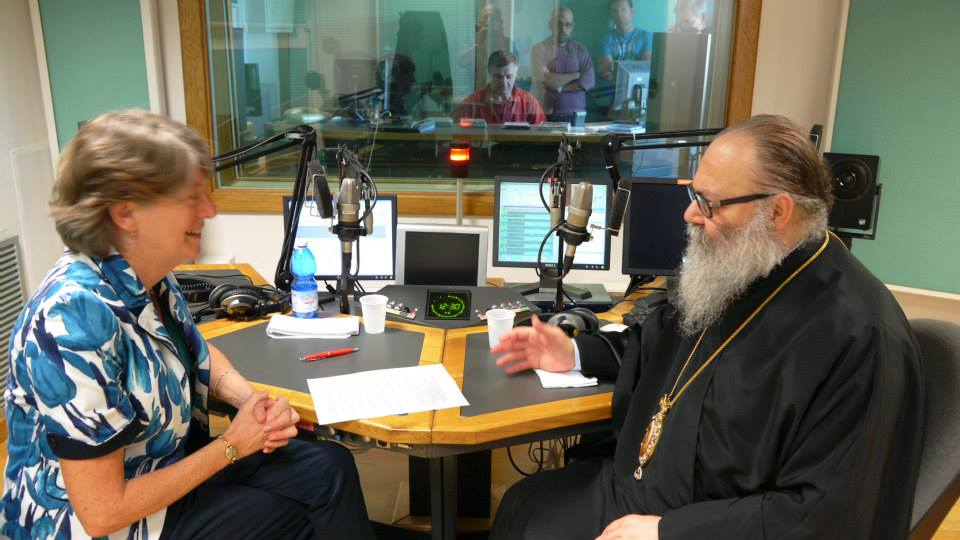
Syrian Patriarch John X Yazigi interview

Pope Francis and Patriarch John X Yazigi, the spiritual father of the Greek Orthodox Church of Antioch and All the East met today. It was a time to discuss the pain and suffering that Syrian Christians face daily and to express his love to Pope Francis.


It’s expected that Patriarch John will attend Mass offered by Pope Francis. Sunday is a day dedicated in the Year of Faith as a day for catechists. The Patriarch will also be meeting the foreign minister of the Italian Republic, and with the people of the ecclesial movement of Sant’Egidio at an interface conference. Sant’Egidio is on the front lines of peace making.

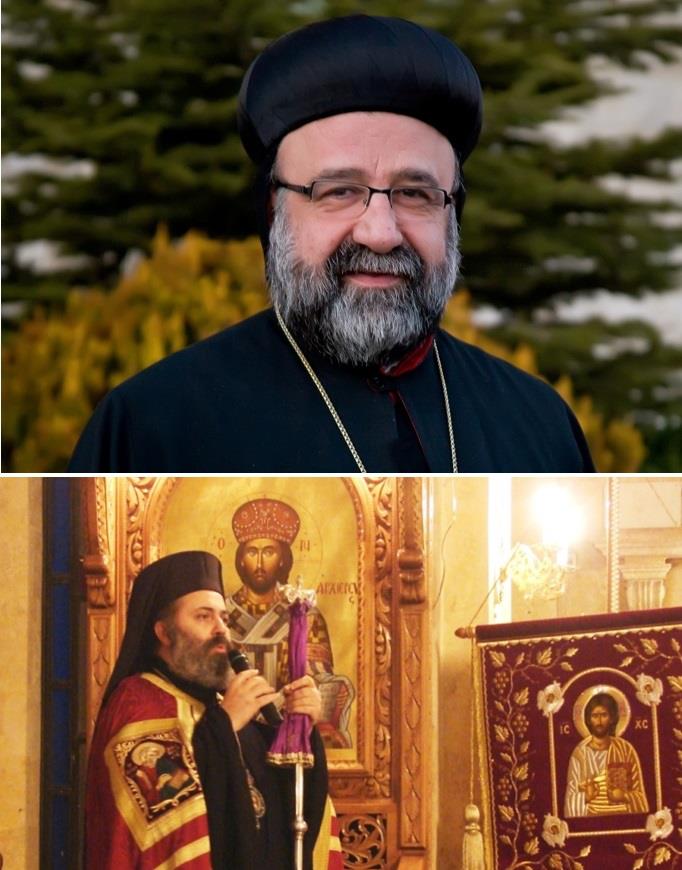
Patriarch John is, as you know, the blood brother of one of the kidnapped Syrian bishops this past April. So he knows first hand not only the crisis his people live with but also deeply because his brother’s freedom (and life) is hanging in the balance.

Striking is the openness of Patriarch John for collaborating with others to bring peace and be with the people; his desire to walk the journey (a procession as the Patriarch said) to full, visible unity among Christians is evident.

Vatican Radio’s Philippa Hichen interviewed Patriarch John X and you can listen to it here.

And, an informative video on the meeting by Rome Reports.

Pope Francis: Keys to His Thought

Many of thee books I read or glanced at over the recent six months have not been too helpful in understanding the newly elected Pope, Francis. A recent publication, Pope Francis: Key to His Thought, has promise. Penned by Monsignor Mariano Fazio, Vicar of the Prelature of Opus Dei in Argentina since 2010, begins the substance of his narrative when he first met Jorge Mario Cardinal Bergoglio in Rome in 2000. Fazio was then working at the Pontifical University of the Holy Cross; he was rector there from 2002-2008.

The author’s thesis is based on many friendly meetings with Francis and thus sketches in a lively manner some of the key ideas that are fundamental in knowing who the Pope is as a person and as a shepherd. I think this perspective opens wider the door of our opinion of the new pope and hopefully engenders in us a spirit of greater collaboration based on something concrete versus the media hype that is prevalent these days.

Monsignor Fazio’s text covers Francis’ “urgency to defend human life and marriage, and the need to ‘go out to the periphery’ to meet people where they are. The latter concern is reflected in the strong encouragement given by Cardinal Bergoglio to the so-called “shantytown priests” for the envangelization of the poorest neighborhoods in Buenos Aires. This effort was grounded on sacramental catechesis and educational projects that foster human dignity, and was never to be confused, Bergoglio always insisted, with an overly political ‘liberation theology.'”

As Fazio says, “I have three letters he sent me in recent years. Whenever I sent him anything, he would respond in writing, in his own hand. The format was always the same: a large card with an image of La Virgen Desatanudos (Our Lady Undoer of Knots), a title originating in Augsburg, Germany (Maria  Knotenlöserin) that he had made known in Buenos Aires . . . In the blank space he writes in small letters, much like Benedict XVI, a few personal and affectionate lines. Here are some: ‘I wish you a holy and happy Christmas. May Jesus bless you and our Lady take care of you. And, please, I ask that you pray and have others pray for me’ . . . These notecards were always accompanied by two holy pictures: one of St. Joseph and the other of St. Therese of the Child Jesus, saints to whom he had great devotion . . . On the back of the picture of St. Joseph is the famous text of St. Teresa of Jesus about the efficacy of devotion to the Holy Patriarch. On various occasions when, having spoken with him, I asked for his blessing, he always invoked these saints and in addition placed me under the protection of St. Josemaria.”

Pope Francis: Keys to His Thought is available from  Scepter Publishers.

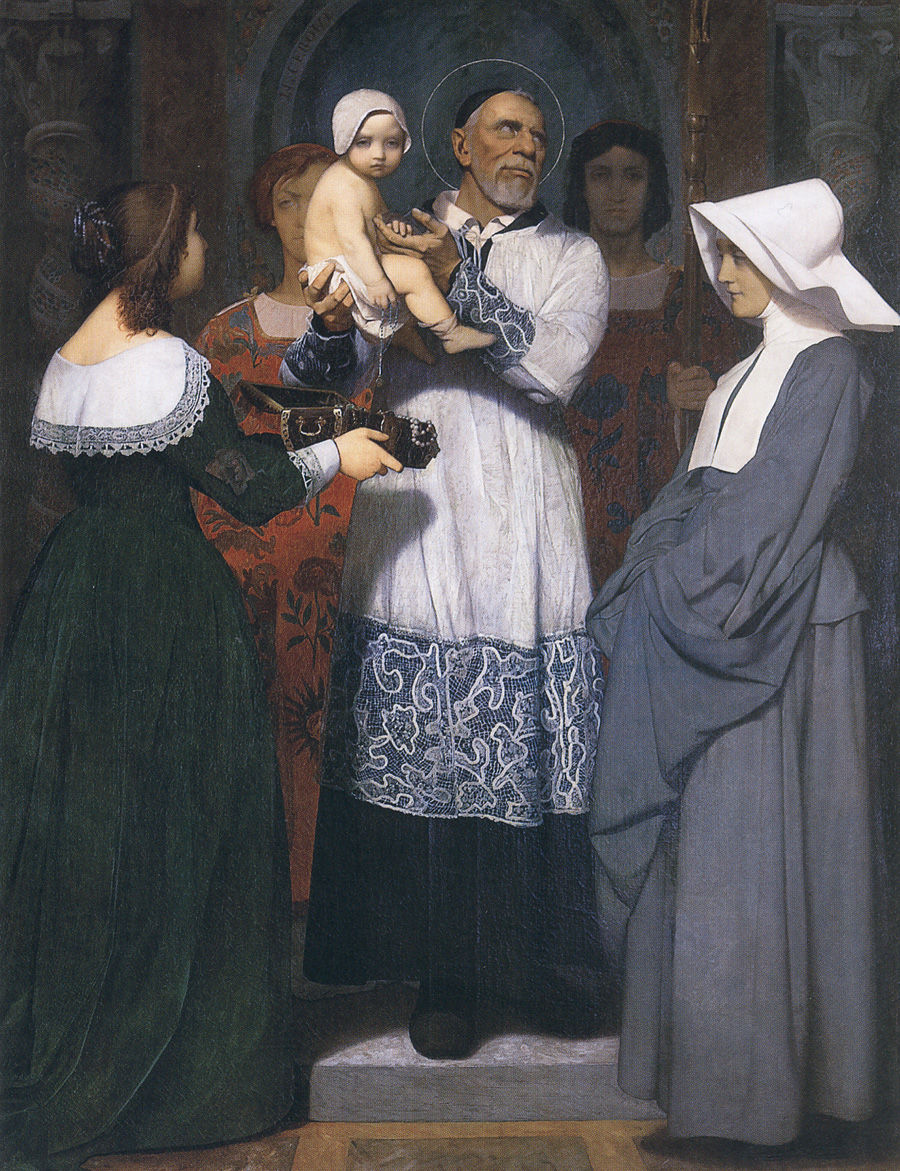
Saint Vincent de Paul

The prayers for the Mass of Saint Vincent de Paul today have us focus on “the relief of the poor and the formation of the clergy” imitating what Vincent loved and  did in following the Savior. The Church’s mission is one of service and education. Baptized into the company of saints, all Christians ought to have concern for the least in society; likewise, the baptized are to be concerned for their own education in the faith aiming to be as Saint Paul said, mature Christians. In Vincent’s world, education of the faithful came through the formation of healthy and holy clergy. An uneducated, that is, an untrained clergyman can lead others to perdition.

“Charity is the cement which binds communities to God and persons to one another in such a way that whoever contributes to union of hearts in a Company binds it indissolubly to God.” (Coste II, Letter 651, p. 413)

Saint Vincent said in his common rules as noted by Vincentian Father José María Román:

Charitable behaviour towards the neighbor should al­ways be characteristic of us. We should try, then: 1) to behave towards others in the way we might reasonably expect to be treated by them; 2) to agree with others, and to accept everything in the Lord; 3) to put up with one another without grumbling; 4) to weep with those who weep; 5) to rejoice with those who rejoice; 6) to yield precedence to one another; 7) to be kind and helpful to one another in all sincerity.

Hence, Vincent stressed three attitudes for his companions in the Congregation of the Mission and the Daughters of Charity, but they are also applicable to us who are not Vincentians, namely: mutual respect, condescension (humility) and bearing with the weaknesses of our neighbors.

Our prayer today ought to note how we engage in concrete works of charity, spiritual and corporal, and how we attend to our education in the faith while supporting those preparing to serve the world as Catholic priests.

The Vincentians need our prayers, so, I’d like to remember the Fathers of the Congregation of the Mission who serve in the Archdiocese of Hartford, especially those at St Stanislaus Church, New Haven, CT.

I’d recommend reading St Vincent de Paul: A Biography by Father José María Román, CM (London, 1999), but the same author has published various aspects of Saint Vincent’s life and work online.

Religious life 2013: Profession of vows, entrances and ordinations

Suscipe me secundum eloquium tuum, et vivam, et non confundas me ab exspectatione mea. (Psalm 118)

abbot & monkEach year at about this time I have published a list of those who have risked everything to follow Jesus Christ more closely as a priest, deacon, monk, friars, nun, or sister. I think it is a good thing to keep this information in front of us, especially as it concerns how each of prays, fasts and financially support  vocations in the Church. Our Christian life helps us to see the need for such witnesses and each of us participates through our good example, by inviting others (even ourselves?) to consider serving the Lord and the Church in this “more excellent” way and by assisting by of the good works.

Let us pray with the psalmist, “The just grow tall like palm trees, majestic like the cedars of Lebanon. They flourish in God’s house, green and heavy with fruit” (Ps 92).

“What counts is to be permeated by the love of Christ, to let oneself be led by the Holy Spirit and to graft one’s own life onto the tree of life,” the Lord’s cross, Pope Francis said on July 7.

What follows is an imperfect collection of information; if there are updates, please zap me an email.

PAX!

Monastic life

monks

English Congregation

Swiss-American Congregation
Subiaco Congregation
American Cassinese Congregation
Other monastic foundations

nuns

The active life

men

  • Daylesford Abbey (the Norbertines): 1 professed simple vows, 1 entered the novitiate;
  • Dominican friars, Province of St Joseph: 6 friars ordained priests; 9 friars profess solemn vows; 8 professed simple vows and  18 entered the novitiate
  • Capuchin friars, Province of St Mary: 2 professed final vows, 4 professed simple vows, 4 invested as novices; 1 ordained to the Order of Deacon and 2 ordained for the Order of Priest
  • Opus Dei: ordained 31 to the priesthood
  • Fraternity of St Charles Borromeo: 1 ordained deacon, 8 ordained priests; -in Chile: 3 received the cassock at entrance
  • Conventual Franciscan friars (of several provinces): 7 professed simple vows; 5 entered the novitiate
  • Friars of the Atonement: 1 entered the novitiate
  • Franciscan Missionaries of the Eternal Word: 2 professed simple vows, 1 entered the novitiate.
  • Order of Friars Minor, Immaculate Conception Province: 2 friars profess simple vows; 1 professed solemn vows; 2 ordained priests; 5 postulants entered
  • Franciscans of the Holy Name Province: 4 profess first vows; 1 novice entered; 1 ordained to the priesthood
  • The Society of Jesuit ordained 16 men to the priesthood for service in the whole USA; the NY-NEN-MD provinces professed 5 in simple perpetual vows; 5 men entered the novitiate.
women

Russian Patriarch gives interview on Orthodox presence in England

Pontifical characters are giving interviews and responding to personal questions these days: Pope Francis, Pope Benedict, the Ukrainian Major Archbishop and now the Russian Patriarch, Kirill of Moscow.

Patriarch Kirill answers questions about the Orthodoxy in Great Britain, Christian life after the Great Schism of 1054, the sainthood of Edward the Confessor, the presences of Russians in England today, and the supposed interest of Prince Charles in Orthodoxy.

Indeed, an interesting interview. The Patriarch was far more neutral than I would’ve thought, especially around history and the question of conversion to Orthodoxy. His Holiness washes over how Catholics and Protestants come into communion with Orthodox Church.

As a point of fact, the “conversion” of Catholics to Orthodoxy is unique to each Orthodox diocese; some bishops handle the situation as the early Church handled schismatics (e.g., Donatists), and others look to the way Peter Mogila handled various denominations in 16th century Russia. As friend said, generally speaking, Oriental Orthodox come in through confession, Catholics come in through a profession of faith, Trinitarian professing Protestants come in through chrismation, and everyone else comes in through baptism and Chrismation. Plus, it is noted, some liturgical books have different formulas of things people have to renounce and accept for different types of Christians converting. So, for example, a Catholic would have to renounce the authority of the Pope, but a Methodist would not.

The interview is in Russian with English subtitles. At least one era is noted: Christians don’t worship saints, they venerate (honor) them.

Watch the 18 minute video.


Pope Benedict defends record

Our emeritus pope Benedict broke a self imposed silence to defend his record against false accusations the he did little to correct the misconduct, particularly sexual abuse behavior of clergy. He did this in Italy’s La Repubblica and it was also picked up by Daily Telegraph in the form of a letter a well-known atheist, Piergiorgio Odifreddi, about this issue (and others) that he originally published in a 2011 book, Dear Pope.

You read the article here and here. The letter is in Italian at the moment.

Here in the USA, the Catholic Church once again has had to deal with the craziness –immorality and criminal behavior– of her priests.

We know from the press several weeks ago a Boston priest was taken out of ministry for constant contact with a prostitute, there’s Scranton priest charged with molesting a teenaged boy he met on Craigslist, a Benedictine monk in Wisconsin who stalks young girls looking for a “quicky” and then we have Curtis Wehmeyer a Minnesota priest who simply is a creep and a criminal. Plus you can call to mind the NJ priests Michael Fugee and Robert Chabak, among others.

Who wouldn’t feel, after reading about pedophile clergy, that the Church has not done enough? That the Church is not too serious about this issue. After all, it is said that the Church has cleaned up her game. Or, so the church and civil authorities claim. In fact, the Catholic Church is a benchmark for cleaning up clergy sex abuse and other misbehavior. The Church record today is vastly different than 10 years ago while civil institutions have yet to address the problem. Nevertheless, you hear that the Vicar General of Wehmeyer’s archdiocese is portrayed as an unfaithful, ignorant, arrogant, incompetent churchman. You can read the story here.

The critics are right to question. Catholics have not left their mind at the door. But the questions of the critics are misplaced if they think that going after Benedict is the right thing to do. He was the pope, not the universal police chief. A pope can only do so much. The local authorities in the Catholic Church are most directly responsible for the faithful and they are to be held accountable. Look at the bishops and various vicars before pointing fingers at the Pope. That’s how the Church has worked for the last 2000 years.

Barbara Dorris of Survivors Network of those Abused by Priests (SNAP) sheds no light for the path nor does she adequately convey with exactitude what, in fact, Benedict tried to do in his previous work the CDF, or as the Roman Pontiff. Dorris is good at complaining and stirring the emotions of victims and antagonists but does not speak the truth. Some of SNAP’s tactics lack charity for both victim and victimizer. Remember the Lord does have concern all the sheep and goats of the Kingdom. And yet, SNAP does attempt to keep the toes of some clerics over the fire and honest).

Within his area of pastoral authority Benedict did everything he could to root out the evil, but the bishops and their close collaborators have obstructed the truth and justice from all. Benedict strengthened church law, spoke out against misconduct, removed clergy, heard the stories of victims and responded according to law of charity.

In one address to the Church, the emeritus pope noted that the spiritual decay has happened, and that it unfortunately continues, and we all have to be vigilant. Supervision is not easy. AND, unfortunately, there are lots of priests, bishops and religious superiors who are neither honest nor holy. In time their malfeasance will be dealt with. But the matter of supervising priests and other church ministers is the obligation of all people, even non-believers, not merely the pope.

Pope wants a Church that brings the world to Christ: this is the task of Social Communications

On a yearly basis the Pope meets with the full assembly of the various departments at the Holy See that assist him in his ministry. This past Saturday (21 September 2013) Pope Francis spoke to the participants of the Plenary Assembly of the Pontifical Council for Social Communications. This Council’s head is Archbishop Claudio Maria Celli, 72, and the Secretary is Monsignor Paul Tighe, 55, a priest of the archdiocese of Dublin. There are several cardinals, bishops, priests, religious and laity who serve as a advisors to the Council.

I’ve been noticing nowadays how often Francis uses the words “discernment,” “journey,” “dialogue,” “understanding,” “encounter” –words that contribute to the building of relationships in Jesus Christ. For me, the notion of relationships is key: it is more than mere social networking, or having a familiarity with technology, or a keeping a Facebook community entertained. Being in relationship means being with another in the Christian sense is caring for the destiny of the other, of sharing life, being human, of telling the other the reasons for our hope, having the capacity to be concretely present to another person who may be difficult. Being relational is not the same as engineering a meeting; it is the fundamental posture of openness to someone greater, an openness to everyone.

The controlling ideas of the Pope are thus: meeting Christ today, really, and faithfully, so that we make a journey of faith by building the Kingdom and confessing Jesus as Savior, without fracture, sans fantasy. The concern of Pope Francis ought to be our concern, too: do we communicate that the Church is a home to all people, or a museum of plastic saints???

The address, like the Pope’s recent interview, needs to be read in continuity with the tradition of the Church and in dialogue with each other. Hence, the the following is not meant only for the advisors and other interested parties, but for all the baptized: cleric, religious and lay person. No exception.

Here’s the Pope address with emphasis added.

Dear Brothers and Sisters, good morning!

I greet you and I thank you for your work and commitment to the important sector of social communications – but having spoken to Archbishop Celli, I must change “sector” to the important “dimension of life” which is that of social communications. I wish to thank Archbishop Claudio Maria Celli for the greeting that he extended to me on your behalf. I would like to share some thoughts with you.

social communicationsFirst of all: the importance of social communications for the Church. This year is the fiftieth anniversary of the Conciliar Decree Inter Mirifica. This anniversary is more than a commemoration; the Decree expresses the Church’s attentiveness towards communication and all its instruments, which are also important in the work of evangelisation. But towards its instruments – communication is not an instrument! It’s something else. In the last few decades, the various means of communication have evolved significantly, but the Church’s concern remains the same, taking on new forms and expressions. The world of social communications, more and more, has become a “living environment” for many, a web where people communicate with each other, expanding the boundaries of their knowledge and relationships (cf. Benedict XVI, Message for the 2013 World Communications Day). I wish to underline these positive aspects, although we are all aware of the limitations and harmful factors which also exist.

In this context – and this is the second reflection – we must ask ourselves: what role should the Church have in terms of its own practical means of communication? In every situation, beyond technological considerations, I believe that the goal is to understand how to enter into dialogue with the men and women of today, in order to appreciate their desires, their doubts, and their hopes. They are men and women who sometimes feel let down by a Christianity that to them appears sterile, struggling precisely to communicate the depth of meaning that faith gives. We do in fact witness today, in the age of globalisation, a growing sense of disorientation and isolation; we see, increasingly, a loss of meaning to life, an inability to connect with a “home”, and a struggle to build meaningful relationships. It is therefore important to know how to dialogue, and how to enter, with discernment, into the environments created by new technologies, into social networks, in such a way as to reveal a presence that listens, converses, and encourages. Do not be afraid to be this presence, expressing your Christian identity as you become citizens of this environment. A Church that follows this path learns how to walk with everybody! And there’s also an ancient rule of the pilgrims, that Saint Ignatius includes, and that’s why I know it! In one of his rules, he says that anyone accompanying a pilgrim must walk at the same pace as the pilgrim, not ahead and not lagging behind. And this is what I mean: a Church that accompanies the journey, that knows how to walk as people walk today. This rule of the pilgrim will help us to inspire things.

last supperThe third: it’s a challenge that we all face together in this environment of social communications, and the problem is not principally technological. We must ask ourselves: are we capable of bringing Christ into this area, or rather, of bringing about the encounter with Christ? To walk with the pilgrim through life, but as Jesus walked with the pilgrims of Emmaus, warming their hearts and leading them to the Lord? Are we capable of communicating the face of a Church which can be a “home” to everyone? We talk about the Church behind closed doors. But this is more than a Church with open doors, it’s more! Finding “home” together, building “home”, building the Church. It’s this: building the Church as we walk. A challenge! To lead to the rediscovery, through means of social communication as well as by personal contact, of the beauty which is at the heart of our existence and our journey, the beauty of faith, the beauty of the encounter with Christ. Even in the context of social communications, the Church is required to bring warmth, to warm hearts. Does our presence and plans measure up to this requirement, or do we remain mired in technicalities? We hold a precious treasure that is to be passed on, a treasure that brings light and hope. They are greatly needed. All this, however, requires a careful and thorough formation in this area for priests, for religious men and women, for laity. The great digital continent does not only involve technology, but is made up of real men and women who bring with them what they carry inside, their hopes, their suffering, their concerns, their pursuit of truth, beauty, and good. We need to show and bring Christ to others, sharing these joys and hopes, like Mary, who brought Christ to the hearts of men and women; we need to pass through the clouds of indifference without losing our way; we need to descend into the darkest night without being overcome and disorientated; we need to listen to the illusions of many, without being seduced; we need to share their disappointments, without becoming despondent; to sympathise with those whose lives are falling apart, without losing our own strength and identity (cf. Pope Francis, Address to the Bishops of Brazil, 27 July 2013, n. 4). This is the walk. This is the challenge.

Dear friends, the concern and the presence of the Church in the world of social communications is important in order to dialogue with the men and women of today and bring them to meet Christ, but the encounter with Christ is personal. It cannot be manipulated. In these times we see a great temptation within the Church, which is spiritual harassment: the manipulation of conscience; a theological brainwashing which in the end leads to an encounter with Christ which is purely nominal, not with the Live Person of Christ. In a person’s encounter with Christ, both Christ and the person need to be involved! Not what’s wanted by the “spiritual engineer”, who wants to manipulate people. This is the challenge. To bring about the encounter with Christ in the full knowledge, though, that we ourselves are means of communication, and that the fundamental problem is not the acquisition of the latest technologies, although these are necessary to a valid, contemporary presence. It is necessary to be absolutely clear that the God in whom we believe, who loves all men and women intensely, wants to reveal himself through the means at our disposal, however poor they are, because it is he who is at work, he who transforms, and he who saves us.

Let us all pray that the Lord may warm our hearts and sustain us in the engaging mission of bringing him to the world. I ask you for your prayers, because this is my mission too, and I assure you of my blessing.