
Author: Paul Zalonski
What is an Apostolic Exhortation?
There are several levels of papal teaching: sacred, ordinary and general. Not all teaching documents that come from “Rome” or from “the Pope” have the same weight or the same required degree of personal adherence of the faithful. The Church in her experience distinguishes types of teaching. So, what are the differences between a bull, an encyclical and an exhortation issued under the name of the pope?
The following –in the order of importance– gives a sense of what I am talking about:
- Papal Bull is a generally a legal document covering any topic.
- Apostolic Constitution (often given as Papal Bulls) are used typically to make a change in a church law or to define something as definitive with regard to faith and morals, or changes in ecclesiastical circumscriptions, and the like…
- The Motu Proprio are legal acts not covered in the Code of Canon Law; the document is given to the Church by the Pope on his own initiative (without a special request of others) and is in conformity of Church Law but doesn’t change the Law unless expressly stated.
- An Encyclical (originally circular letters by bishops) is an exposition on a topic that regards a pastoral concern and giving insight into the Faith and ministry of the Roman Pontiff shared by the bishops, but only the papal version (vs. a translation) published in the Acta can be authoritative to resolve a particular issue or to advance matter of faith. This in the category of being of the ordinary magisterium of the pope and bishops.
- An Apostolic Letter is addressed to particular groups for a jubilee or a clear up a matter of concern under the notion of general teaching authority; the Letter does not have a solemn responsibility to make changes in doctrine but it may be used to communicate a matter of concern.
- An Apostolic Exhortation is published to encourage the faithful to live in a particular manner (greater conversion to Christ) or to do something of virtue. An Exhortation does not have the ability to change Church teaching de fide. The dogmatic teachings of the Immaculate Conception and the Assumption could not be communicated to the Church as de fide in this form. For example, a post-synodal document offered to the Church which is typically a summary of a previous synod and hoping the faithful will do something helpful for the life of the church (e.g., the new evangelization, go to confession, rely on St Joseph, the moral life, preparation for a special event in the Christian life). This level is of ordinary teaching authority.
- Papal Addresses are given to groups like the Knights of Columbus, the plenary meeting of the Pontifical Academy of Science, the Congregation of Worship or some such significant gathering; papal addresses have a point to make.
- Papal Rescript answers a question or a request for dispensation.
- Apostolic Brief is a matter of minor importance but nonetheless there is a need among the faithful for a decision from authority.
Each document has a particular formula for addressing the recipient and authority of teaching.
Not every document listed above requires a complete agreement on our part. Some of what is given to us is the prudential judgement of the Holy Father (the Magisterial part of his office) while other documents are to be accepted de fide, that is, on faith and adhered to with one’s intellect and will: needed for salvation. The bulls and constitutions and the elements of faith and morals contained in the encyclicals are to be closely followed and accepted as needed for salvation. These documents, however, are not the same as defining dogma. For that we have the tool of papal infallibility and this tool is seldom exercised. Since the definition of infallibility was made at Vatican I, the Church has only defined two dogmas using the ex cathedra formulation. Both were Marian teachings in the Immaculate Conception and Mary’s Assumption.
With regard to the documents noted above from the Apostolic Letters down, we are not required to give our complete consent intellect and will; we are, however, asked to sincerely and significantly consider what is being offered to live the Christian life with greater openness, integrity and holiness.
Theologians will speak of the teachings of the Church as part of the consistent teaching of the Church, based on biblical revelation which Catholics must receive as the ordinary papal teaching with the “religious submission of intellect and will” (Vatican II, Lumen Gentium, 25). What does this mean? Essentially, it means that faith and reason are united so as to form and to inform the way we live as disciples of the Lord and faithful members of the Church. The posture we hold is to have an open mind to what is proposed for our salvation and to allow our views and lives to be shaped by the teaching (this is receptivity). It is not an easy task and we understand that the religious submission of intellect and will is always a journey, and gradual conforming ourselves to what Jesus Christ expects of us: to be a person fully alive in God’s glory.
Blessed Giacomo Alberione
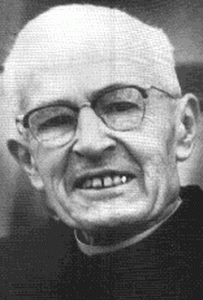 A fascinating priest and zealous missionary of the twentieth century is today’s blessed, Giacomo Alberione (1884-1971). His call to do something striking for the Lord came while he was adoring the eucharistic Lord during the night of the change of year 1900 to 1901. He may be most known in the USA for the foundation of the Daughters of St Paul in 1915 but there are several other congregations forming the Pauline Family. Alberione founded a family devoted to the great evangelizer, Saint Paul, that has active and contemplative sisters, priests and brothers, the laity, and various other institutes. All of the various Pauline congregations collaborate in some way, according to a divine gift given, to spread the message of the gospel and to assist in the devotional life of the Christian.
On 27 April 2003, Blessed John Paul beatified Father Giacomo Alberione We look forward to his definitive place at the altar.
In all ways, Blessed Alberione is a keen example of work of the new evangelization and the formation of Christians.
Blessed Giacomo Alberione, pray for us.
Pope to canonize Jesuit without second miracle
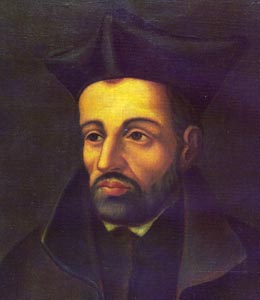 When Pope Francis spoke with Jesuit Father Antonio Spadaro of La Civiltà Cattolica he spoke in a definite manner of his admiration for the person and charism of Blessed Peter Faber, a 16th century Jesuit and close collaborator of Saint Ignatius of Loyola. This was likely the first time many heard of Peter Faber.
Blessed Peter was an early companion of Loyola and was the first of the early founders to be ordained a priest. Moreover, it ought to be recalled that Faber was a master in giving the Spiritual Exercises.
It is expected that Pope Francis will canonize Faber (1505-1546) in December. This papal act is clearly more important for the Society of Jesus than for others in the Church unless they have a devotion to the Spiritual Exercises. I welcome this canonization for the same reasons that others speculate that move Pope Francis.
The procedure of canonization is an act of infallibly of the Pope. The decision has been made. He has deemed the canonization will happen without a certified second miracle is not without precedent. Pope Benedict did the equivalent canonization for Hildegard of Bingen while making her a Doctor of the Church at the same time. Pope Francis waived the second miracle for Blessed John XXIII. Other examples are cited in the article below. The papal pen writes many things, even bulls of canonization.
Andrea Tornielli writes,
French Jesuit priest Peter Faber to be made a saint in December
ANDREA TORNIELLI
VATICAN CITY
Pierre Faber, a “Reformed” Jesuit priest whom Francis sees as a model figure, is to be proclaimed as saint before Christmas, Stefania Falasca reports in an article for Italian Catholic newspaper Avvenire. The process for his cause in the Congregation for the Causes of Saints is complete and now all that remains is for Francis to issue the Bull of Canonization that will proclaim the first companion of St. Ignatius a saint, extending the cult of the soon-to-be-saint to the Universal Church.Faber was born in the Upper Savoy region of France in 1506 and died in Rome in 1547 just a few weeks before he was due to attend the Council of Trent. He was beatified in September 1872 with a Papal Rescript issued by the Sacred Congregation of Rites and ratified by the Society of Jesus. Now Francis is extending the liturgical cult to the Universal Church.
The process followed for Faber’s canonization is called “equivalent canonization”. This is when the Pope omits the judicial process and ceremonies involved and orders a servant of God to be venerated in the Universal Church, when such a saint has been from a remote period the object of veneration, when his heroic virtues (or martyrdom) and miracles are related by reliable historians, and the fame of his miraculous intercession is uninterrupted. “Examples of this in recent history include John Paul II, who decreed 3 such canonizations, Benedict XVI who decreed 1, the last of which was that of Angela da Foligno, confirmed last 9 October by Pope Francis,” Avvenire writes.
But Faber’s canonization takes on a whole new meaning as the Jesuit is “a model of spirituality and priestly life for the current successor of Peter. At the same time, he is an important reference point for understanding the Pope’s leadership style.” Faber lived on the cusp of an era when the unity of the Church was being threatened. He mostly kept out of doctrinal disputes and steered his apostolate towards a reform of the Church, becoming a pioneer of ecumenism.”
Francis spoke about Faber in his famous interview with Jesuit journal Civiltà Cattolica, revealing some key aspects of the priest as a figure: “[His] dialogue with all, even the most remote and even with his opponents; his simple piety, a certain naïveté perhaps, his being available straightaway, his careful interior discernment, the fact that he was a man capable of great and strong decisions but also capable of being so gentle and loving.”
“The picture of Faber that emerges from the texts is that of a thinker in action, a man who was profoundly attracted by the figure of Christ and was understanding of people. The cause of separated siblings was one he held close to his heart and he was good at discerning spirits. He lived an exemplary priestly life and the unconditional nature of his ministry was reflected in his patience and gentleness. He gave himself without asking others for anything in return. Faber distinguished himself for his “affective magisterium”, in other words, his gift for spiritual communication with people and his ability to put himself in other people’s shoes,” Falasca writes
Evangelii Gaudium: Pope Francis gives his vision for the Church
What is Pope Francis encouraging us to do now? His “apostolic exhortation”–called Evangelii Gaudium (The Joy of the Gospel) is a new document (c. 48, 000 words) in which he outlines a bold, new vision of how to be disciples of the Lord, how to be living members of the Catholic Church. The joy here indicates the encounter (the meeting) with the living God, especially in the person of Jesus. Evangelii Gaudium is not an easy document to boil down to a few key points. Therefore, you will need to spend time reading, studying and praying with the document. This is principally true because what is proposed in this document is a new discernment in the truest way possible: according to the Gospel, tradition and the received wisdom of the saints. The papal invitation to each of us is to “recover the original freshness of the Gospel,” finding “new avenues” and “new paths of creativity,” without boxing God in “dull categories.” What is exactly true is that Francis gives us a work that is thought-provoking, surprising and challenging. Evangelii Gaudium is nothing if not very interesting. The status quo is not part of the pastoral plan of any Church guided by the Paraclete.
I go back to what I consider to be the three key ideas proposed by the newly elected Roman Pontiff when he preached at the Mass with the Cardinals: the Christian is to journey, to build and to confess the Body of Christ. His other homilies and addresses have had some form of this triad all aiming at truly living our new humanity given to us in baptism, confirmed in the Holy Spirit and nourished by the Eucharist.
Recently, Father Julián Carrón gave to the members of Communion and Liberation a mini retreat in which he spoke of the new knowledge, the wisdom of the Spirit given to us. For him, it is a new way of living and thinking as a friend of Jesus. But our friendship is not limited to exchanging pious platitudes, it is a true companionship, a way of seeing life, a communio. This way of living with the eyes of faith, it is a faith born of the gaze Jesus had for Andrew and James, Mary Magdalen or Zacchaeus, it is the very same gaze Jesus has for us and that we ought to have for others. Too often have forgotten what it is to live in the freshness of the Good News and hence we now need to first to work our problems of faith by addressing the problem what it means to be living this faith as a knowledge of who Jesus Christ is, and what it means to follow Him.
So, what does the Pope propose as his vision for the Church?
Francis wants a Church that is a joyful community of faith ready to face the world as it is, not through the lens of nihilism or fearfulness of what may or may not be. There is always a bit of trepidation of the unknown or one’s meeting head-on of one’s opponents, and therefore, Evangelii Gaudium may be too challenging for some people. Remember the exhortation of Blessed John Paul and Pope Benedict at the very start of their pontificates: be not afraid! For the Pope blows open a perspective that looks the other way: “Pastoral ministry in a missionary key seeks to abandon the complacent attitude that says: ‘We have always done it this way.’” Traditionalism is killing Christian life. Just because we have done thus-and-such for 1000 years does not mean that it is good and healthy thing to do today.
One description of what it means to live anew…
Evangelization with joy becomes beauty in the liturgy, as part of our daily concern to spread goodness. The Church evangelizes and is herself evangelized through the beauty of the liturgy, which is both a celebration of the task of evangelization and the source of her renewed self-giving.
What Evangelii Gaudium conveys is that Catholics ought to be unafraid of new ways of proclaiming (the kerygma) the Gospel and new ways of thinking about the work of the Church in a way that is a total gift of self. Francis is not changing Church teaching but asking us to explore new forms of pastoral practice based on traditional teaching. We can cite as one example Francis affirming the Church’s inability to ordain women as Catholic priests, but he invites the Church to think about the place of women in the Church in new ways: “the possible role of women in decision-making in different areas of the Church’s life.” Ecclesial renewal and reform at any level is not going to be easy. Yet we have to strive to be renewed and reformed. The bishops with the priests, deacons and religious, for example, will have to ask the hard question of their personal conversion and their manner of living. Perhaps the episcopate in the USA will have to reassess the manner in which the bishops live. I think we are at the point that says, if the Jesuits and Dominicans do not start living their charism with mind of the Church and bishops and secular priests do not stop living like little princes, the laity will start voicing their opposition to the contraception of the vocation before the Church will be even more dismissed as irrelevant. We need for today a NEW St Charles Borromeo, a NEW Sts Benedict and Scholastica, a NEW Sts Ignatius and Sophie Barat, a NEW Sts Dominic and Catherine of Siena and a NEW Sts Francis and Clare.
We have already heard throughout the centuries of the deadly sins of preaching, catechesis, pastoral care, and liturgical praxis: “complacency,” “excessive clericalism,” and Catholics who act like “sourpusses”: it is described by the Pope as Christians whose lives are like “Lent without Easter.” (“Sourpusses” is in the official English-language translation.) All of these attitudes are considered roadblocks. Moreover, the Pontiff has little patience for people who “tempted to find excuses and complain.”
Clearly, there will be no alteration of the Catechism, dogmatic and liturgical and moral theology. Rather, Francis wants a new way of proposing the faith in Jesus as the Way, the Truth and the Life. Orthodoxy is not the big NO as some one want to say; it is about the beauty of living in a completely new way so as be saints on earth and in heaven. As such I am thinking of the groundbreaking work of Jospeh Ratzinger, Introduction to Christianity.
I have to ask myself, Do I have a fundamental and tender joy of living a life centered in Jesus Christ and focused on the hope of the resurrection? My experience tells me that in different periods of personal history I have lost a great deal of hope and joy in the resurrection, and the centrality of Jesus Christ in all of creation (cf. the papal homily closing the Year of Faith on 24 Nov.). But I have choice to live differently where the measure of life and faith is not me but the Lord.
Evangelii Gaudium is a discussion on joy as a requirement for evangelization and a treatise on the value and necessity of “personal dialogue,” a personal meeting of the other, and encounter with the Lord,; the personal approach is needed in extending an invitation to live differently; the faith is a way of knowing, a way of seeing, a way of loving God, others and ourselves.
The Pope restores to our human awareness the plight of those on the margins: the poor, the children, the elderly, the sick and otherwise neglected. Being formed by the Jesuits I heard about the Church’s “preferential option for the poor.” I was rightly taught that a Christian looks at another person as God sees them: “God’s heart has a special place for the poor.” We are not exhorted to open soup kitchens and social concern centers. We are asked to awaken our hearts and minds. Hence, we are not to give lip service saying that God loves the poor in a special way, and let someone else take care of the “problem.” People, whatever, their social-economic-religious status may be, each person has a God-given dignity. Here solidarity is the lens: how do I care and advocate for the poor, the elderly, the sick, etc.? Who has responsibility for the other person? The Pope tells us: “None of us can think we are exempt from concern for the poor and for social justice.” No bishop, priest, deacon, lay person, rich or poor, educated or uneducated can neglect the needs of another; for in the beggar we see ourselves begging before Christ as Dives did.
The Apostolic Exhortation offers critique of the “idolatry of money” and an “economy of exclusion” as tyranny. For Francis, therefore it ought to be the same for all us, we need to live in an economy of communion (see the work of the Focolare Movement for more on this idea). Francis writes, “The Pope loves everyone, rich and poor alike, but he is obliged in the name of Christ to remind all that the rich must help, respect and promote the poor. I exhort you to generous solidarity and a return of economics and finance to an ethical approach which favors human beings. What’s clear to me, caring for the marginalized means addressing the structures that keep people at arm’ length: “The need to resolve the structural causes of poverty cannot be delayed.” This is a call to arms now. The Church is for and of the poor. Period.
Do not be fooled: the hard work of personal conversion is absolutely necessary before we set out on changing things that are perceived to be broken. We cannot point the fingers at others without doing the hard work of spiritual conversion ourselves. Change for the sake of change is not a Catholic thing to do. You can change the right structures for the wrong reasons. The matter is: “Nobody can go off to battle unless he is fully convinced of victory beforehand.” Is Christ the center of our life? We are looking for a revolution of tenderness.
Evangelii Gaudium will be received by some as boilerplate clap-trap that one would expect in a document on the “New Evangelization,” but that would be too reductionistic, even too pessimistic an evaluation; Pope Francis identifies areas of challenge, a hardening of the arteries, and he desires a healing, he wants to see real, visible change in me, and in structures of the Church and civil society. But how is this possible? Francis tells us that evangelization and the life of the Christian is “constantly renewed experience of savoring Christ’s friendship and his message.”
Follow what the Pope says with this in mind: “embark upon a new chapter of evangelization marked by this joy, while pointing out new paths for the Church’s journey in years to come”: these new paths can only be walked if we meet the Lord. These paths are fruitful if live in communion with others. The companionship of the Church is the place of our true freedom.
May Mary, Mother of the Living Gospel, “Star of the new evangelization, help us to bear radiant witness to communion, service, ardent and generous faith, justice and love of the poor, that the joy of the Gospel may reach to the ends of the earth, illuminating even the fringes of our world” help us on our journey.
Catechesis and Preaching is trinitarian
In catechesis too, we have rediscovered the fundamental role of the first announcement or kerygma, which needs to be the centre of all evangelizing activity and all efforts at Church renewal. The kerygma is trinitarian. The fire of the Spirit is given in the form of tongues and leads us to believe in Jesus Christ who, by his death and resurrection, reveals and communicates to us the Father’s infinite mercy. On the lips of the catechist the first proclamation must ring out over and over: ‘Jesus Christ loves you; he gave his life to save you; and now he is living at your side every day to enlighten, strengthen and free you.’ This first proclamation is called ‘first’ not because it exists at the beginning and can then be forgotten or replaced by other more important things. It is first in a qualitative sense because it is the principal proclamation, the one which we must hear again and again in different ways, the one which we must announce one way or another throughout the process of catechesis, at every level and moment.
Pope Francis
Evangelili Gaudium (2013)
Evangelii Gaudium
Today, the Holy See officially released Pope Francis’ Apostolic Exhortation, Evangelii Gaudium. This is first work that comes from the papal office. The first paragraph of the Exhortation reads,
The joy of the gospel fills the hearts and lives of all who encounter Jesus. Those who accept his offer of salvation are set free from sin, sorrow, inner emptiness and loneliness. With Christ joy is constantly born anew. In this Exhortation I wish to encourage the Christian faithful to embark upon a new chapter of evangelization marked by this joy, while pointing out new paths for the Church’s journey in years to come.
The entire text of Evangelii Gaudium may be read here.
Saint Catherine of Alexandria
 Saint Catherine of Alexandria whom we honor today in our liturgical memory. For centuries the church had listed Catherine on the ordo but with the liturgical renewal and revision following the Second Vatican Council she was removed from calendar; in 2002, John Paul returned her to the ordo. Her importance for us is what tradition says of her, namely, that she climbed Mount Sinai, the place where Torah was given, and an image which prefigures calvary when Jesus died. A journey each disciple of the Lord is called to make. Our more contemporary theological view of Catherine is that she is the bridge for the work of unity among Christians. Saint Catherine is a saint honored by the Eastern Churches and her memory is highly esteemed in the West. Hence, we, the Churches of East and West, are united in Jesus Christ through the person of Saint Catherine.
The reliability of the historical sources on Catherine is questionable, but liturgical legend is not to be dismissed. How the Churches came to know, love and reverence the holy disciples of the Lord is to be honored and studied. Historical accounts are not always that important: the witness, the experience, the faithfulness is what moves our heart. What is meant by legend does not mean fiction and nor is it an idea from a vigorous imagination. Legend in the Church is received wisdom. We consider her to be learned that, once converted to Christian faith, she defeated in debate fifty pagan philosophers working for the Roman emperor. Her defense of the truth of the Gospel and reality of the Church was reasonable enough that opened the door for the philosophers to accept Christianity themselves. Centuries later a famous monastery on Mount Sinai acquired both her relics and her name. Pope John Paul II made a pilgrimage to the Monastery of Saint Catherine on Mount Sinai in Egypt on February 26, 2000.
Saints beget saints. After the year 1000, devotion to Catherine was widely accepted in the West. It is said that Catherine was both honored as one of the Fourteen Holy Helpers to whom the faithful asked to intercede for them before the Throne of Grace; and in the 15th century Catherine was one of the saints who appeared to Saint Joan of Arc, giving her God’s mission. It is a similar mission we receive when we are Baptized, it was the mission of Daniel and his friends seeking to be faithful in a foreign land, the mission of the poor widow and her little coins, the mission to witness to Jesus Christ as Catherine did with the philosophers.
Patriarch Sviatoslav Shevchuk offers Liturgy at St Peter’s
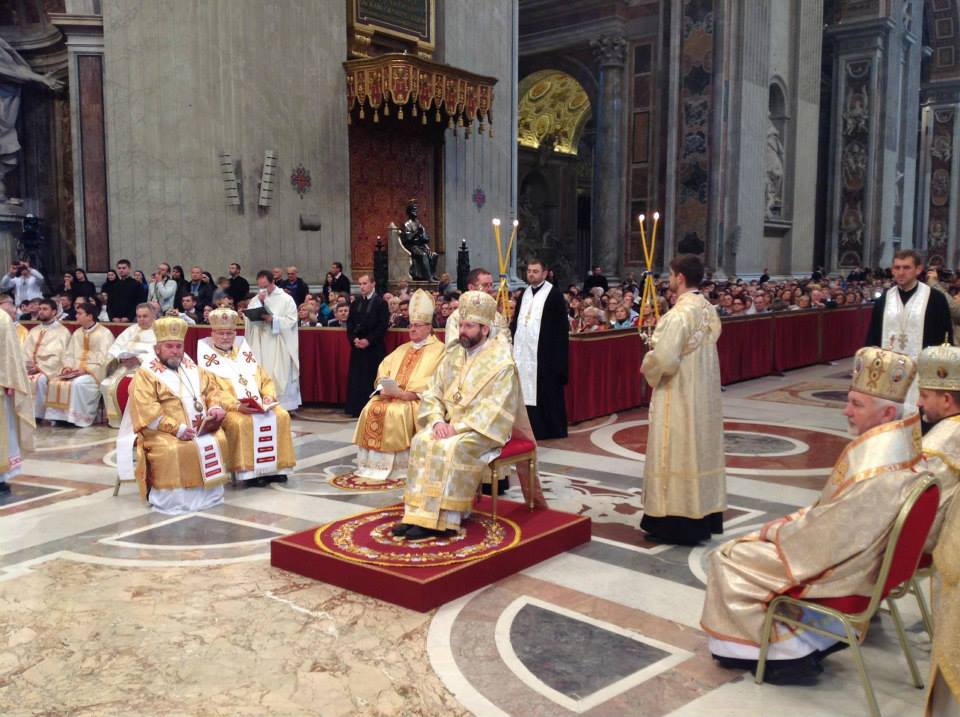 Patriarch Sviatoslav Shevchuk of the Ukrainians offered the Divine Liturgy on 25 November with the special permission of Pope Francis at the altar of the Vatican Basilica. The Ukrainian Church is observing the 50th anniversary of the laying of the relics of Saint Josaphat, martyr for Church unity.
The praying of the Liturgy in Saint Peter’s is a terrific sign of diversity and unity of the Catholic Church. The Byzantine Church exists in Rome, Catholic and Orthodox. The beauty of the faith in all its specificities.
This week another group of Byzantine Catholics are meeting in Rome with their Patriarch and some bishops, that of the Melkites. A delegation from the USA just arrived in Rome today. The eternal city is being overrun with the Eastern Church.
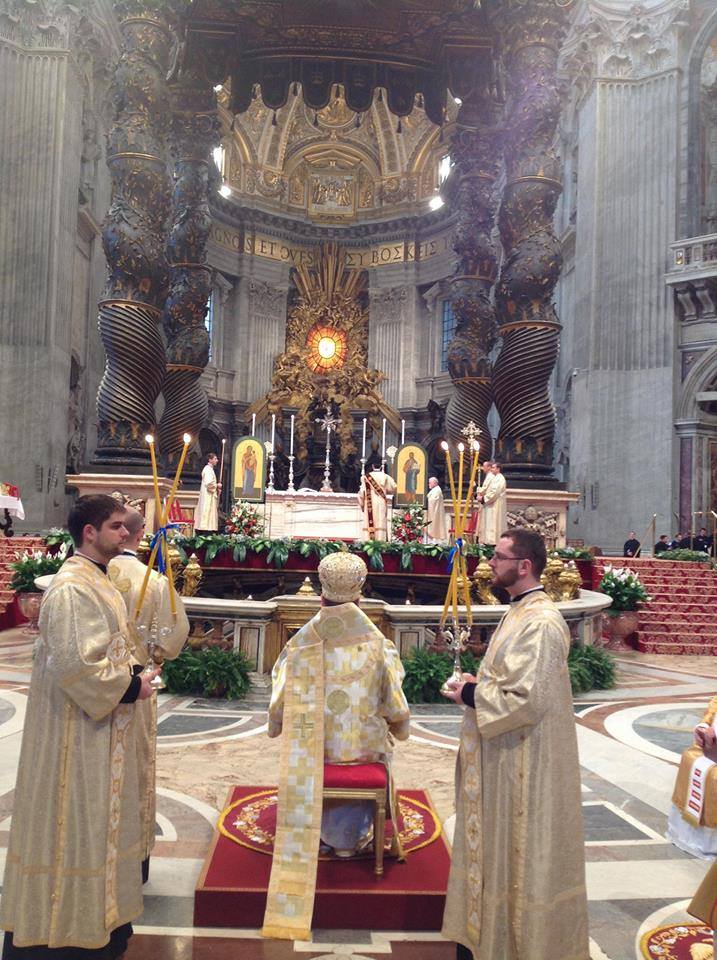 Two notes: 1) it is a rare circumstance that a bishop other than the Bishop of Rome offer Mass on the altar of Saint Peter’s because it is a reserved altar. When John Paul was ailing we saw designated cardinals offering Mass at this altar. Recall that Major Basilicas belong to the Pope and have certain privileges; 2) In Church law and ecclesiastical custom (at the moment) the Ukrainian Church has a leader who does not officially carry the title of “Patriarch”; he holds the title of Major Archbishop —and there is no canonical difference in titles, but…— yet in a variety of places the Ukrainian faithful rightly use the term Patriarch as a few Vatican news agencies did today to relate the event. I hope that Sviatoslav will be granted the official use of the title of Patriarch, as he ought to have.
Saint Josaphat, pray for us.
In Christ, we share we share a single journey, a single destiny, Francis teaches
The Year of Faith closes with the Pope embracing the relics, the bones, of the Apostles who answer their human need, who broke opened their hearts to see the face of God. Peter and Paul shared in the One they loved with the world, and they presented the world with gift of salvation with whom they desired to share an incomparable journey, a destiny, as Christians, desire to share in. Francis closes a year in which we all lived with intensity of living the faith, meeting the Lord and journeying to a new knowledge and new vigor in the promise of the Hundredfold. The following is the homily delivered today in Rome where he speaks about the essentials of the faith: baptism, the Encounter and centrality of the Christ in our life and the desire for heaven.
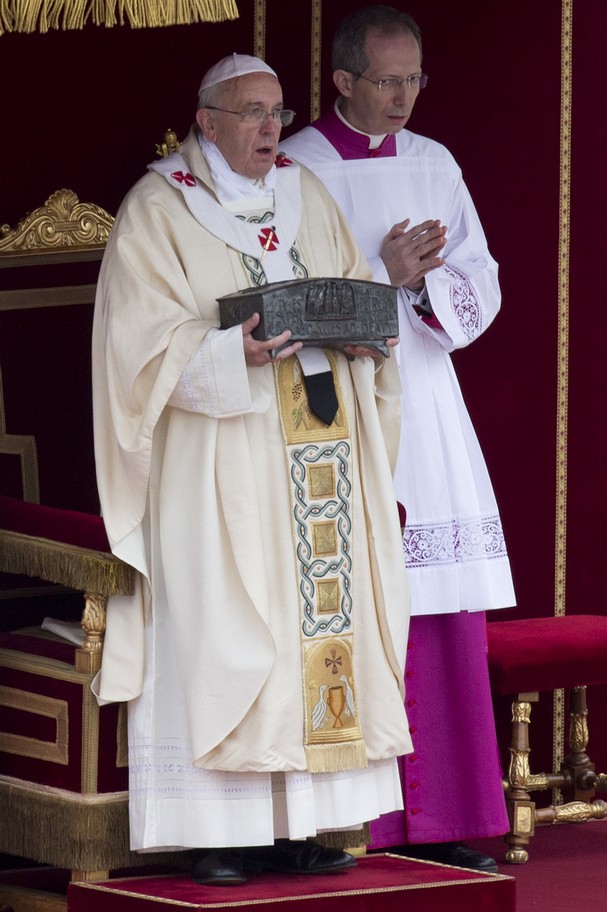 Today’s solemnity of Our Lord Jesus Christ, King of the Universe, the crowning of the liturgical year, also marks the conclusion of the Year of Faith opened by Pope Benedict XVI, to whom our thoughts now turn with affection and gratitude. By this providential initiative, he gave us an opportunity to rediscover the beauty of the journey of faith begun on the day of our Baptism, which made us children of God and brothers and sisters in the Church. A journey which has as its ultimate end our full encounter with God, and throughout which the Holy Spirit purifies us, lifts us up and sanctifies us, so that we may enter into the happiness for which our hearts long.
I offer a cordial greeting to the Patriarchs and Major Archbishops of the Eastern Catholic Churches present. The exchange of peace which I will share with them is above all a sign of the appreciation of the Bishop of Rome for these communities which have confessed the name of Christ with exemplary faithfulness, often at a high price.
With this gesture, through them, I would like to reach all those Christians living in the Holy Land, in Syria and in the entire East, and obtain for them the gift of peace and concord.
The Scripture readings proclaimed to us have as their common theme the centrality of Christ. Christ as the centre of creation, the centre of his people and the centre of history.
1. The apostle Paul, in the second reading, taken from the letter to the Colossians, offers us a profound vision of the centrality of Jesus. He presents Christ to us as the first-born of all creation: in him, through him and for him all things were created. He is the centre of all things, he is the beginning. God has given him the fullness, the totality, so that in him all things might be reconciled (cf. Col 1:12-20).
This image enables to see that Jesus is the centre of creation; and so the attitude demanded of us as true believers is that of recognizing and accepting in our lives the centrality of Jesus Christ, in our thoughts, in our words and in our works. When this centre is lost, when it is replaced by something else, only harm can result for everything around us and for ourselves.
2. Besides being the centre of creation, Christ is the centre of the people of God. We see this in the first reading which describes the time when the tribes of Israel came to look for David and anointed him king of Israel before the Lord (cf. 2 Sam 5:1-3). In searching for an ideal king, the people were seeking God himself: a God who would be close to them, who would accompany them on their journey, who would be a brother to them.
Christ, the descendant of King David, is the “brother” around whom God’s people come together. It is he who cares for his people, for all of us, even at the price of his life. In him we are all one; united with him, we share a single journey, a single destiny.
3. Finally, Christ is the centre of the history of the human race and of every man and woman. To him we can bring the joys and the hopes, the sorrows and troubles which are part of our lives. When Jesus is the centre, light shines even amid the darkest times of our lives; he gives us hope, as he does to the good thief in today’s Gospel.
While all the others treat Jesus with disdain – “If you are the Christ, the Messiah King, save yourself by coming down from the cross!” – the thief who went astray in his life but now repents, clinging to the crucified Jesus, begs him: “Remember me, when you come into your kingdom” (Lk 23:42). And Jesus promises him: “Today you will be with me in paradise” (v. 43). Jesus speaks only a word of forgiveness, not of condemnation; whenever anyone finds the courage to ask for this forgiveness, the Lord does not let such a petition go unheard.
Jesus’ promise to the good thief gives us great hope: it tells us that God’s grace is always greater than the prayer which sought it. The Lord always grants more than what he has been asked: you ask him to remember you, and he brings you into his Kingdom!
Let us ask the Lord to remember us, in the certainty that by his mercy we will be able to share his glory in paradise. Amen!