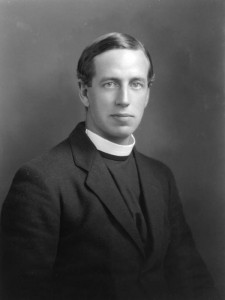
The famed English priest Monsignor Ronald A. Knox wrote a letter about Christmas published in The Tablet in 1937 (this is a British publication). For our purposes here, it is good to consider the theological points the Knox makes about the feast we are living in these days.
Dear When I saw you yesterday, you told me that you did not see any reason why you should have your house turned upside down just because it was Christmas. I have been thinking of your remark ever since, and the more I think of it, the less sense I can find in it. What is Christmas, from start to finish, but things being turned upside down?
The winter solstice, after all—I don’t seem to be able to find a calendar, but I know it happens about now—is just the reversing of a process. The days, instead of getting shorter and shorter till we fall into a perpetual night (and what else does our civilization deserve?) begin to lengthen out again; the hour-glass tips up, as it were, and our credits begin to balance our debits. The heathen obviously noticed that, and decided to hold their Saturnalia about then; was it on the fifteenth? Anyhow, not badly out. The Saturnalia, because Saturn was the god of the golden age, before the nasty, jerry-balt, mass-produced Jove-civilization began: so they liked to think that if the year could turn back in its tracks, there was no reason why history should not do the same; why should not history have its solstices? In that wistful desire for topsy-turvydom, they allowed their slaves to have a holiday, and say exactly what they liked to their masters. I wonder how you would like that? How you would take it if the housemaid started to draw the line at your daughter having followers? Magnus ab integro saeclorum nascitur ordo—Virgil caught the spirit of the solstice idea, and wrote his Messianic eclogue. I am not going to bother about what he meant by it; but you can hardly deny that he made some good shots.
Don’t start arguing about whether Christmas happened. What we are talking about is a mood, and the world remembers the mood, even when it has become doubtful about the story; it would like Christmas to have happened, whether it really happened or not. The Maid-Mother—we could not have invented anything more gracious than that part of the story, even if it had been necessary for us to invent. Jam, edit et Virgo, redeunt Saturnia regna; how is the golden age to return to us, except by some upheaval of nature, the appearance of some uncaused Cause to reverse the pounding of the monotonous wheels which hurry us relentlessly in the same direction? What better answer to Caesar Augustus’ population-bill, than the Child who had to be enrolled, for all there was no father that could be named for him?
That message, reasonably enough, has gone to the head of Christendom ever since ; and we find no better way of doing honour to Christmas than by turning things upside down. Everything went wrong from the first; all the best places going to the wrong people, as it were ; the ox and the ass nearest to the cradle, and the shepherds getting in ahead of the Kings; the Kings having to ask their way, and asking it of the people who never found it; the inn having no room, so that it was left for a stable to contain Him whom the worlds could not contain—all the arrogant topsy-turvydom, in fact, of the Christmas Crib. How it puzzled the Wise Men when they set out to make a calculation in astrology, to discover what child the strange star was going to influence, and found, at the end of their search that it was the Child who influenced the star.
All the modern paraphernalia of Christmas, presents, trees, crackers, turkey, yule-logs, waits and the rest of it, has become over-conventionalized, I grant you, and much overlaid with affectation, big-business, and the cult of the Tudor tea-room. But Christmas retains, under all its trappings, its essential note of unexpectedness. Just when you are expecting burglars to prowl about other people’s houses in disguise and take things away, you instead, the householder, are expected to disguise yourself and prowl about your own house, putting things there. Instead of waking up to find ladders in her stockings, your small daughter wakes up to find that the stocking itself has become a ladder, for Santa Claus to come down the chimney. Just when the boughs should be at their barest, one tree manages to reverse the whole process, miraturque novas frondes et non sua poma, burgeons into leaves of flame and fruits of glittering glass. The pudding which has meant so much more trouble than all the puddings of the year comes to table full of careless oversights, thimbles and sixpences which the most myopic of cooks could hardly have left there by mistake. Everywhere and in all ages head-dress has been the sign of human dignity ; can still be a matter of national importance, or why must Kemal be at pains to replace the fez by the bowler hat?—but not at Christmas; at Christmas it is expected of the solemnest uncle that he should dress up like a fool, and the angels are too discreet to smile at it. You should even admit in the abstract (though it is not so easy to take the right line when you actually come in contact with them) the propriety of those elaborate practical jokes which the shops sell, booby-traps that squirt water at you unexpectedly or black your face when you are not looking ; they all keep up the atmosphere of unexpectedness. Of course your house has got to be turned upside-down if it is to be a fitting symbol of the world turned upside down; and nothing less will do at Christmas.
And if you still complain, remember that the Church, whose dignity is (if you will excuse my mentioning it) much more important than yours, turns things upside down herself in a determined effort to do something about Christmas. Or rather, she has preserved one solitary anachronism in her calendar, to make us all feel properly uncomfortable, not knowing whether we are standing on our heads or our heels—I mean the Midnight Mass. For there is a gracious influence about night as a time of prayer—darkness, and light in darkness, and the day’s memories still warm, not yet severed from us by any interval of sleep. All that is what you cannot get at Mass; for Mass goes with another set of impressions, the cleanness and coldness of early morning, or the prosaic glare of the full sunlight. But on this one day in the year, for a treat, the Church will allow us to have it both ways, to combine the comfortable, almost guilty magic of darkness with the presence of the daily miracle. Supreme instance of topsy-turvydom, to go to a twelve o’clock Mass at twelve midnight!
All this probably won’t impress you; but it will teach you to be more careful what you say. I don’t think it does much good wishing a person like you a happy or a merry Christmas ; but I am doing it, if only to annoy you.
Yours always,
R. A. KNOX
The Tablet, p. 6
December 25 1937