 Dear brothers and sisters, good morning!
I extend to you a warm welcome and I am pleased to meet with you on the occasion of your World Congress.
The Benedictine Oblate, “in his or her own family and social environment, recognizes and accepts the gift of God… inspiring his or her own journey of faith with the values of the Holy Rule and of the monastic spiritual tradition” This is from article 2 of the Statutes of the Italian Benedictine Oblates. Here, I am thinking of your charism which, I believe, can be summarized in a certain way by the very beautiful expression of Saint Benedict, who invited his followers to have a “heart expanded by the unspeakable sweetness of love” (Rule of Saint Benedict, Prologue, n. 49).
How beautiful is that phrase: a heart expanded by the unspeakable sweetness of love! This expanded heart characterizes the Benedictine spirit, which invigorated the spirituality of the Western world and subsequently spread to all continents. This expression, “an expanded heart”, is very important. Throughout the centuries the Benedictine charism has been a charismatic herald of grace, for its roots are so firm that the tree grows well, weathering the ravages of time and bearing the savoury fruits of the Gospel. I believe that this expanded heart is the secret of the great work of evangelization that Benedictine monasticism carries out, and to which you promise yourselves as Oblates, “offered up” in the footsteps of the great Holy Abbot. So I want to reflect briefly with you on three aspects of this “expansion of the heart”: the search for God, enthusiasm for the Gospel and hospitality.
The Benedictine life is marked first of all by a continual search for God, for his will and for the wonders he works. This search takes place principally through his word, with which you are nourished each day by lectio divina. Yet you also do this by contemplating creation, by letting yourselves be challenged by daily events, by experiencing work as prayer, to the point of transforming the very means of your work into instruments of blessing, and finally through people, in those brothers and sisters whom divine Providence leads you to encounter. In all this, you are called to be seekers of God.
A second important characteristic is that of enthusiasm for the Gospel. Following the example of the monks, the lives of those who take their inspiration from Saint Benedict are given as a gift, whole and rich. Like the monks, who make the places where they live fruitful and mark their days with industriousness, you also are called in this way to transform your everyday settings, wherever you live, by acting as a leaven in the dough, with skill and responsibility, and at the same time with gentleness and compassion. The Second Vatican Council outlines this missionary enthusiasm in an eloquent way when, speaking of the role of the laity in the Church, it says that they are called “to seek the kingdom of God by engaging in temporal affairs and directing them according to God’s will… from within, like leaven” (Lumen Gentium, 31). In this sense, we should be mindful of what the presence of monasticism, with its model of evangelical life marked by the motto ora et labora and the peaceful conversion and integration of numerous peoples, was able to build during the transition period from the fall of the Roman Empire to the birth of medieval society! All this zeal was born out of enthusiasm for the Gospel, and this, too, is a very timely matter for you. Indeed, nowadays, in a globalized but fragmented and fast-paced world devoted to consumerism, in settings where family and social roots sometimes almost seem to disappear, there is no need for Christians who point fingers, but for enthusiastic witnesses who radiate the Gospel “in life through life”. This is always a temptation: go from being “Christian witnesses” to “Christian accusers”. There is only one accuser, the devil. We should not assume the role of the devil but of Jesus. We are students of the school of Jesus, of the Beatitudes.
The third characteristic of the Benedictine tradition that I want to reflect on is that of hospitality. In his Rule Saint Benedict devoted an entire chapter to this (cf. Ch. LIII, On the Reception of Guests). The chapter begins with these words: “Let all guests who arrive at the monastery be received as Christ, for he will one day say: ‘I was a stranger and you took me in’ (Mt 25:35)” (n. 1). Venit hospes, venit Christus. And he continued by indicating some concrete attitudes to be taken by the whole community with regard to guests: “let them go forth to meet him, showing him their love in every way;… let them pray together and then let them associate with one another and exchange the kiss of peace” (n. 3), that is, they should share with the guest what they hold most dear. Benedict then spoke of those who are “special” guests, saying: “Let the greatest care be taken, especially in the reception of the poor and pilgrims, because Christ is received more specially in them” (n. 15). As Oblates, your wider monastery is the world, the city and the workplace, for it is there that you are called to be models of welcome with regard to whoever knocks at your door, and models in preferential love for the poor. This is what it means to welcome yet we are confronted with the temptation to close ourselves off. Today in our society, our culture, even a Christian culture, one of the ways of closing ourselves off from others is through gossip. Gossip “dirties” other people. “I close myself off from another person because he or she is a wretch”. Please, as Benedictines, let your tongue be reserved for praising God, and not for gossiping about others. If you are able to change your lives in such a way that you do not speak ill of others, you will have opened the door for your causes of canonization! Move forward in this way. Sometimes it seems that our society is slowly suffocating in the locked vaults of selfishness, individualism and indifference. Gossip locks us into this reality.
Dear brothers and sisters, I want to bless the Lord with you for the great patrimony of holiness and wisdom of which you are custodians, and I invite you to continue to expand your heart and entrust it every day to God’s love, never ceasing to seek it, to bear witness to it with enthusiasm and to welcome it in the poorest whom life leads you to encounter. I offer my heartfelt thanks for your oblation, and ask you, please, to remember to pray for me. Thank you!

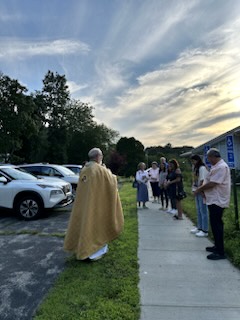
 Super Blue Moon before matins on 9/1 at Portsmouth Abbey, Rhode Island.