Our Lady of Sorrows

Today, Pope Francis delivered this homily for the feast of Our Lady of Sorrows:

“Jesus came into the world to learn how to be a man, and by being a man, walk with men. He came into the world to obey, and He obeyed. But he learned this obedience from suffering. Adam left Paradise with a promise, a promise that lasted for so many centuries. Today, through this obedience, this self-abnegation, this humiliation, through Jesus, that promise becomes hope. And the people of God walk with sure hope. Even the Mother, ‘the New Eve,’ as Paul himself calls her, in order to participate in her Son’s journey, learned, suffered and obeyed. And thus she becomes Mother.”

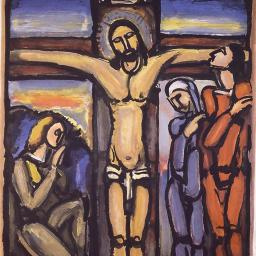
The Gospel shows us Mary at the foot of the Cross. Jesus says to John, “Behold your mother.” Mary – the Pope said – “is anointed Mother”

“And this is our hope. We are not orphans, we have Mothers: Mother Mary. But the Church is Mother and the Mother Church is anointed when it takes the same path of Jesus and Mary: the path of obedience, the path of suffering, and when she has that attitude of continually learning the path of the Lord. These two women – Mary and the Church – carry on the hope that is Christ, they give us Christ, they bring forth Christ in us. Without Mary, there would be no Jesus Christ; without the Church, we cannot go forward.”

“Two women and two mothers” – continued the Pope Francis – and next to them our soul, which in the words of Isaac, the abbot of Stella, is “feminine” and is like “Mary and the Church.”

“Today, looking at this woman by the Cross, steadfast in following her Son in His suffering to learn obedience, looking at her we see the Church and look at our Mother. And also, we look at our little soul that will never be lost, if it continues to be a woman close to these two great women who accompany us in life: Mary and the Church. And just as our fathers left Paradise with a promise, today we can go forward with a hope: the hope that our Mother Mary, steadfast at the Cross, and our Holy Mother, the hierarchical Church, give us.”

Transcription from Vatican Radio

Exaltation of the Holy Cross

triumph of the crossToday’s Solemnity of the Exaltation of the Holy Cross: “We Adore You O Christ, and We Bless You, Because by Your Holy Cross, You have Redeemed the world!”

This feast celebrates two historical events: the discovery of the True Cross by Saint Helen, mother of the Emperor Constantine, in AD 320 under the temple of Venus in Jerusalem. The feast is also memorialized in the basilica of the Holy Cross in Rome, a church constructed by Helen. In the USA, the metropolitan cathedral of Boston honors this feast with the name of Holy Cross. It is also the dedication in AD 335 of the basilica and shrine built on Calvary by Emperor Constantine, which mark the site of the Crucifixion.

The greatness of this feast reminds us that the Cross is the instrument, the vehicle of our salvation; touching our lips to the glorious cross of our redemption, we  take up the crosses in our own lives and accept and reverence them as well.  And by God’s grace we are able to carry our cross to the natural conclusion.

Saint Andrew of Crete tells us: “We are celebrating the feast of the cross which drove away darkness and brought in the light… Had there been no cross, Christ could not have been crucified. Had there been no cross, Life Itself could not have been nailed to the tree. And if Life had not been nailed to it, they would be no streams of immortality pouring from Christ’s side, blood and water for the world’s cleansing. The legal bond of our sin would not be canceled, we should not have obtained our freedom, we should not have enjoyed the fruit of the tree of life, and the gates of paradise would not stand open. Had there been no cross, death would not have been trodden underfoot, nor hell despoiled… The cross is called Christ’s glory; it is saluted as his triumph.”


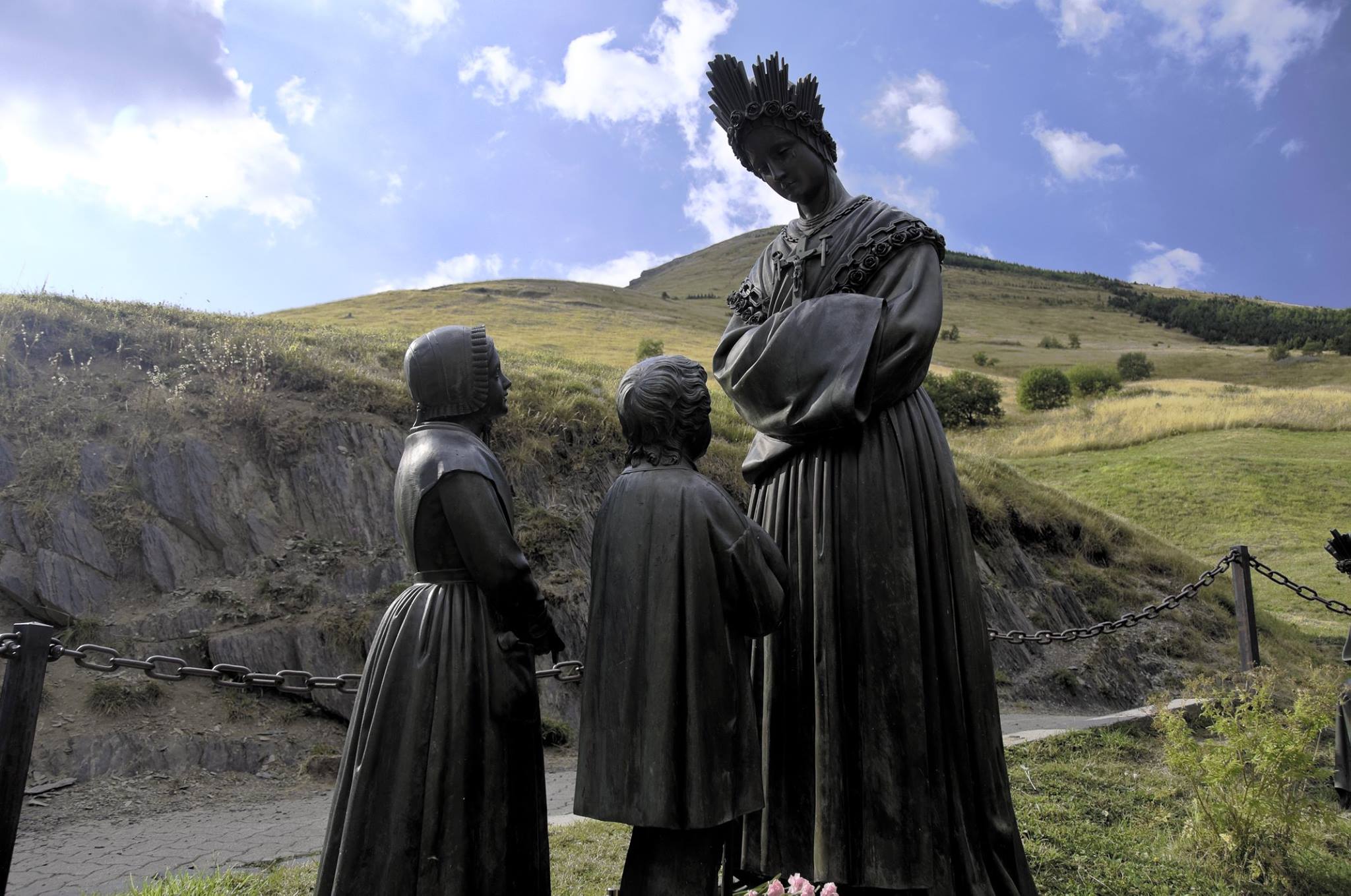
Holy Name of Mary

Holy Name of Mary

With the Church we pray,

Grant, we, pray, almighty God, that your faithful, who are gladdened by the Name and protection of the most holy Virgin Mary, may by her loving intercession be freed from all evils on earth, and merit to attain eternal joys in heaven.

This feast was established by Pope Innocent XI in 1683, that the faithful may in a particular manner recommend to God on this day, through the intercession of the Blessed Virgin, the necessities of His Church, and return Him thanks for His gracious protection and numberless mercies.

What gave occasion to the institution of this feast was the desire of all Christendom for a solemn thanksgiving which would commemorate the deliverance of Vienna, obtained through the intercession of Our Lady, when the city was besieged by the Turks in 1683. An army of 550,000 invaders had reached the city walls and was threatening all of Europe. John Sobieski, King of Poland, came with a much smaller army to assist the besieged city during the octave of the Nativity of the Blessed Virgin, and made ready for a great battle. This religious prince began by having a Mass celebrated, which he himself desired to serve, his arms in a cross. After receiving Communion with fervor, he rose at the close of the sacrifice and cried out: Let us march with confidence under the protection of Heaven and with the aid of the Most Holy Virgin! His hope was not disappointed; the Turks were struck with a sudden panic and fled in disorder. From that time the feast day has been celebrated during the octave of the Nativity of Our Lady.

Reflection: If we, like the Christians of Europe in the 17th century, desire to appease by our prayers the divine anger which our sins have justly provoked, we must join the tears of sincere compunction to a perfect conversion of our habits. The first grace we should beg of God is that He will dispose us to maintain at all times a spirit of worthy penance. And to the invocation of Jesus it is a pious and wholesome practice to join our recourse to the Blessed Virgin, that, through Her intercession, we may more readily obtain the effects of our petitions. For this reason devout souls, with great affection and confidence, honor the Holy Hearts and invoke the Holy Names of Jesus and Mary.

Vie des Saints pour tous les jours de l’année, by Abbé L. Jaud (Mame: Tours, 1950); Little Pictorial Lives of the Saints, a compilation based on Butler’s Lives of the Saints and other sources by John Gilmary Shea (Benziger Brothers: New York, 1894).

Nativity of Mary

Nativity of Mary printExercising a motherly care for us her poor children in all things and through all things, the Virgin Mother calms our trembling fear, enlivens our faith, supports our hope, drives away our distrust, strengthens our timidity.

Surely you are not afraid to approach Jesus? He is your Brother and your flesh, tempted in all things as you are, yet without sin, so that he might have compassion. And this Brother has been given to us by Mary.

And so whatsoever you have a mind to offer to the Lord, be sure to entrust it to Mary, so that your gift shall return to the Giver of all grace through the same channel by which you obtained it.

Saint Bernard of Clairvaulx, Sermon 7 for the Nativity of Our Lady

An everlasting inheritance promised

The Mass Collect prayed by the priest states that by God’s grace we are adopted children and by His grace we ask for a share in the gift of freedom and an everlasting inheritance. What is this inheritance? It is the gifts of the hundredfold in this life and living in His holy Presence in the next. The Church begs the Holy Spirit for these gifts for her children as the sacrament of Christ’s Presence on earth, as the mediator between God and humanity. The sacred Liturgy is the method of our conversion and our Christian identity; the prayer of the Liturgy is about giving glory to God.

The Scripture readings for the 23rd Sunday through the Year has us hearing Matthew 18:15-20. Here is a reflection from St. John Chrysostom:

“You will be doing everything for the glory of God if, when you leave this place, you make yourself responsible for saving your brother or sister, not just by accusing and rebuking him or her, but also by advising and encouraging, and by pointing out the harm done by worldly amusements, and the profit and help that come from our instruction. You’ll also be preparing for yourself a double reward, since as well is greatly furthering your own salvation, you will be endeavoring to heal a fellow member of Christ’s body. It is the Church’s pride, it is the Savior’s command, not to be concerned only about our own welfare, but about our neighbor’s also.”

Blessed Teresa of Calcutta

Blessed Teresa

One of the most recognizable faces on the planet: a woman who pointed to Jesus even when her own questions surfaced. Blessed Teresa’s faithfulness and complete self-sacrifice for Christ and His people is what I follow.

“Go before the Blessed Sacrament- He is there. When we look at the Cross we know how much He loved us; when we look at the tabernacle, we know how much He loves us now. “Loved,” past tense; “Loves,” present tense. Not only past tense, He loves us now. He loves me tenderly.”


–Blessed Mother Teresa, Where There is Love, There is God, page 60)

Sports at the Service of Humanity

We Catholics hold in healthy tension the goods of the act of faith and sport. We know that Pope John Paul II loved the outdoors and sporting activity; we see now that Pope Francis appreciates and advocates healthy competition among people on the field. Yet, few know that for several years the Holy See has had an office dedicated to nature of sport viz. the faith.

The Pontiff said, “Sports in the community can be a great missionary tool, where the Church is close to every person to help them become better and to meet Jesus Christ. Put yourselves in the game, in the search for good, in the Church and in society, without fear, with courage, and enthusiasm. Don’t content yourselves with a mediocre ‘tie.’ Give the best of yourselves, spending your lives for that which is truly valuable and that which lasts forever.”

A recent colloquium worked on the theme of Sports at the Service of Humanity. How does sport facilitate dialogue and encounter and with Christ?

Vatican Radio interviewed Linda Del Rio, who is associated with the Fellowship of Catholic University Students (FOCUS) Varsity Catholic Mission in the United States. The link to the interview is here.

Saint Gregory the Great

Gregory the GreatSaint Gregory the Great (540-604) is a Church father, founder of monasteries, and pastor of souls. The Church benefitted by Gregory’s vision of taking the Gospel to the margins. Gregory’s personal witness to the evangelical vows was demonstrated by his living as a simple monk who showed concern for those on the margins; he had a purity of heart in the midst of his new ministry’s numerous responsibilities as the Roman Pontiff. Pope Gregory set as his first priority the service of those who were considered the last in the diocese. Besides his significant contribution to the organization of sacred music Gregory is remembered for his writings, his commitment to the praying with Scripture in lectio divina and his love of Benedictine monasticism. What we know about Saint Benedict, for instance, comes from Saint Gregory.

Benedetto Calati has this reflection on Gregory who is great:

The community of faith is a hermeneutic criterion of the Word of God. “Often, many things in holy Scripture that I was not able to understand on my own,” Gregory said courageously to his brothers, “I understood when I found myself among my brothers. After I realized this, I also tried to understand by whose merit such knowledge had been given to me.” What is even more surprising is that, for Gregory, every member of God’s people who obeys the Word is “an organ of truth” for his or her brothers and sisters in the faith. “When we who are filled with faith try to make God resound for others, we are organs of truth, and truth has the power to reveal itself to other people through me, or to reach me through other people.” Gregory’s humble discretion with regard to the action of the Spirit, and the Word whom he obeys, generates a model of Church leadership that is expressed in the formula, “Gregory, servant of the servants of God.”