Blessed Elizabeth of the Trinity

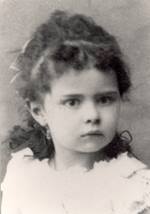
Bl Elizabeth of the Trinity child picBlessed Elizabeth of the Trinity, OCD, is honored on this date by Mother Church but because it is Sunday, her feast is either transferred or not commemorated in the sacred Liturgy today. She lived from 1880-1906 and beatified by Pope John Paul II on November 25, 1984.

Her last words were: “I am going to Light, to Love, to Life!”

As we move through history we come to have real remembrances of our saints like this child photo of Blessed Elizabeth.

Blessed John Scotus

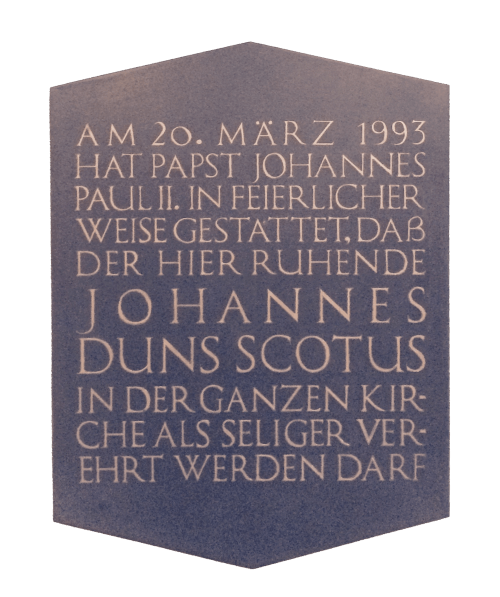
Scotus plate of beatificationBlessed John Duns Scotus is liturgically remembered today but because it is Sunday his memorial is skipped this year. Sad really. As you know, Blessed John was born in Scotland in 1266, studied and taught in London and Paris and spent the end of his life in Cologne having died in 1308. His sarcophagus in the Minoritenkirche. At Scotus’s sarcophagus is the plate showing us that he was declared to be “blessed” when John Paul II visited Cologne.

Blessed John is widely known as the high point of medieval philosophy. Martin Heideggers did his second doctorate  to teach in the university (the “Habilitationsschrift”), on a topic from the philosophy of John Duns Scotus. The modern era of philosophy is credited for being full of errors, especially for the errors of modernity (the univocity of being). Blessed John seems to be at the heart of the controversy.

Philosophically, I remember Scotus for two things: 1.) his exposition on the Blessed Virgin Mary and 2.) haecceitas.

It was his work, the year before his death, on the Virgin Mary that led the Church under Pope Pius IX to define the dogma of the Immaculate Conception.

On this second point develops a theory of haecceitas, or this-ness –the metaphysical cause of individual being. Haecceitas speaks to what makes this rhubarb (or cat or dog or human being) different from that other plant (or car or dog or human being). This metaphysical cause was picked up by Jesuit Father Gerard Manly Hopkins in his poetry.

At any rate, Blessed John’s philosophy is not what he’s liturgically remembered for, it is his holiness of life. Let us pray that Blessed John Duns Scotus mediates for us before the Throne of Grace.
Gratitude for the things God provides

We are moving to the end of the liturgical year quickly: November 22, in the Ordinary Form of the Mass, is the feast of Christ the King and the last Sunday of the year. The readings are all pointing to a deeper question as to whom do we belong and who is the source of our hope. For this 32nd Sunday of of the year we are reading Mark’s gospel (12:38-44) concerning the poor widow and the Temple and God’s faithfulness to us. Jesus notes not the widow’s generosity (responsibility) but her faithfulness to the promises of God because she knows deep-down that all things in life are sustained by God. Hers is a radical sense of gratitude.

Knowing and caring about the poor is a Christian way. How do we live with an attitude of abundance? Abundance, here, is more than material things. The Decree of Gratian taught: “Feed the man dying of hunger, because if you have not fed him, you have killed him.”

A reflection from St. Paulinus of Nola might help us to focus: “Remember the poor widow who forgot herself in her concern for the poor and, thinking only of the life to come, gave away all her means of subsistence…So let us give back to the Lord the gifts he has given us. Let us give to him who receives in the person of every poor man or woman. Let us give gladly, I say, and great joy will be ours when we receive his promised reward.”

Muslims will change the face of Europe

The world is changing very fast in all of the arenas of life: politics, economy, family, education, church, medicine, etc. In fact, the diminishment of Christian faith and culture is gaining speed. This is result of a very true fact that Christians are weak in faith (they don’t have a relationship with Jesus Christ and they don’t know what it means to be a disciple of Christ) and they liberal in their actions, e.g., many have abandoned the desire to have children. Islam on the other hand are serious on both parts: they have big families and they practice their faith.

There was an interesting article was published recently addressing the forthcoming changes in Europe forged by “faith and birthrate.” Ralph Sidway reposts an interview with the Maronite Patriarch Bechara Raï on what we can expect. Read the article here. An Italian publication Familia Cristiana carries a more specific perspective.

Dominicans at 800

OP800Today, the Order of Preachers begin their 800 anniversary of papal approval. Today, also is the All Saints observance of the Order, so, a very good way to begin a year of celebration and reflection on the charism.

Here is Master of the Order, fr Bruno Cadoré giving his greetings for the jubilee year…

The Dominican family –the friars, the cloistered nuns, the active sisters and the laity– are a great gift to the Church universal. I have been privileged to count among friends members of the Order. I recommend that you spend time getting to know the charism that was given to Saint Dominic and his companion.


Indulgence for 800 years of the Dominicans

OP JubileeResponding to God’s generosity is what the Roman Pontiff is calling not only the Order of Preachers –indeed, the entire Dominican family, all those who follow in some way the charism of Saint Dominic, by giving an special of the Indulgence. Pope Francis has granted the privilege of an indulgence for the Order of Preachers who began their year-long 800th Jubilee today.

The Plenary Indulgence is given by the Pope through the Apostolic Penitentiary. This indulgence is given under the usual conditions: sacramental confession, Eucharistic Communion, and prayer for the Supreme Pontiff. But the spiritual program is more plentiful that can be read in the document posted herein. You will note that His Holiness invites the priests of the Order to be available to celebrate the Sacrament of Penance in “all Jubilee places and frequently administer the Holy Communion to the infirm.”

This indulgence document is seen here (to make more readable double click on the image)

Remembering John Carroll’s election

John CarrolToday is the anniversary of the establishment of the Diocese of Baltimore and the anniversary of a rather unique circumstance, the episcopal election of Father John Carroll (January 8, 1735 – December 3, 1815) as the first bishop of the Roman Catholic Church in the United States of America. As bishop of Baltimore he set the stage for Catholicism’s vitality in the new nation.

So, on this date, 6 November 1789, by the pontifical brief Ex hac apostolicae, Baltimore was made the first diocese of the United States. Father John Carrol was elected the first bishop by the clergy in the USA by a vote of 24 out of 26. Pope Pius VI approved the election and he was consecrated to the episcopacy by Bishop Charles Walmesley, in England, on August 15, 1790.

Among his many accomplishments for the Church he was the founder of Georgetown University, held the first diocesan synod in 1791, invited the English Dominicans to serve here and established the Order of the Visitation. By 1804, the Holy Father entrusted the Church in the Danish West Indies and other nearby islands to Carroll; and by 1805 the Louisiana Territory became part of the Baltimore Province. In April 1808, Pope Pius VII established Baltimore as the first US archdiocese with suffragan diocese of Bardstown, Boston, New York and Philadelphia.

Conscience is the window to truth

right wrongIn the 10th grade Confirmation class that I teach the question of Conscience and its formation was the topic of conversation the other day. Most of the students knew nothing about conscience, why it was important to inform and to form and how it functions in making good decisions.

One of the things the ecclesial movement of Communion and Liberation has reminded me that ethics (conscience) never comes before the event of the Incarnation. Conscience is first built on the relationship one has with his or her God (Father, Son, Holy Spirit) lived within the companionship of the Church. More on this subject later.

This article published on LifeSiteNews highlights the Pope’s theologian, Dominican Father Wojciech Giertych, who is addressing the change, or not, of Catholic doctrine by local conferences of bishops, and he gets into the role of conscience. “Many people identify conscience with feelings…Feelings are secondary; conscience is a window to truth. … The conscience has to be formed to see the truth.” AND “You have to perceive the truth of the matter, by reason.” There is more in this article and so I ask that you read the article and think about the facts, not merely what you want to hear.