Edward Pentin, a National Catholic Register journalist and based in Rome, wrote a good article on Christmastide –Vatican style. We are in the middle of Advent and it’s time to think of Gaudete Sunday this coming weekend. Read Pentin’s article.
Month: December 2010
Significance of the Christmas Tree
 My mother and the neighbors have had the Christmas tree up for a week. We’ve got three small trees. In fact, my neighborhood is alighted with Christmas lights. New York’s Rockefeller Center Christmas tree was lit last week with several stars entertaining us with “Christmas songs.” The Vatican put its Christmas tree, a gift from the good people of Bolzano, Italy (a German speaking of Italy where Pope Benedict has vacationed in the past) A little too early for my tastes. SO, it MUST be Christmas time!!! What does it all mean? But what does the Christmas tree stand for? How ought the Christmas tree be interpreted by the Catholic?
The Christmas tree began as a reminder of the tree of life and the life-giving cross of Jesus Christ. When you see the evergreen Christmas tree you will also see the life-giving tree of life on which Jesus hung as our crucified savior.
For those interested, a short history is helpful.
Saint Pio of Pietrelcina: rare video footage
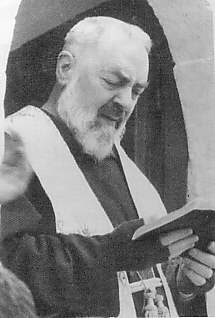
The blogger at “The Hermeneutic of Continuity,” Father Tim
Finigan, posted a YouTube video clip of Saint Pio of Pietrelcina showing some rare footage. It is a very delightful video of the saint with his Capuchin brothers. Padre Pio is a favorite saint who died in 1968; watching him brings to life a new experience.
Father Tim notes that “At the end, they are obviously teasing him about the camera and he hits the cameraman with his cincture. We see him in the refectory and in the Church, and there are scenes
of his brothers dealing with the massive postbag which he generated.” Finigan also notes the footage of Saint Pio celebrating the Mass.
One thing I notice is that the Capuchin priests all cover their hoods when vested for Mass -as they are supposed to do. Too often covering the hood with an amice is not done not only by Franciscans but the Dominicans; the acolyte serves the Mass with a surplice and hood uncovered. A piece of liturgical observance.
Saint Ambrose
The patristic reading in the Office of Readings (in the Divine Office) there is a beautiful letter from Saint Ambrose about governance and the use of words. Wouldn’t be good to heed Ambrose’s exhortation about relying on the guidance of the Church as the surest sign of God’s faithfulness, in keeping our words clean, reflective and full of meaning? Ambrose’s letter bears thinking about today. Let us keep in prayer today the Church in which Ambrose lived and worked, the Archdiocese of Milan.

You have entered upon the office of bishop. Sitting at the helm of the Church, you pilot the ship against the waves. Take firm hold of the rudder of faith so that the severe storms of this world cannot disturb you. The sea is mighty and vast, but do not be afraid, for as Scripture says: he has founded it upon the seas, and established it upon the waters.
The Church of the Lord is built upon the rock of the apostles among so many dangers in the world; it therefore remains unmoved. The Church’s foundation is unshakeable and firm against the assaults of the raging sea. Waves lash at the Church but do not shatter it. Although the elements of this world constantly beat upon the Church with crashing sounds, the Church possesses the safest harbor of salvation for all in distress. Although the Church is tossed about on the sea, it rides easily on rivers, especially those rivers that Scripture speaks of: The rivers have lifted up their voice. These are the rivers flowing from the heart of the man who is given drink by Christ and who receives from the Spirit of God. When these rivers overflow with the grace of the Spirit, they lift up their voice.
There is also a stream which flows down on God’s saints like a torrent. There is also a rushing river giving joy to the heart that is at peace and makes for peace. Whoever has received from the fullness of this river, like John the Evangelist, like Peter and Paul, lifts up his voice. Just as the apostles lifted up their voices and preached the Gospel throughout the world, so those who drink these waters begin to preach the good news of the Lord Jesus.
Drink, then, from Christ, so that your voice may also be heard. Store up in your mind the water that is Christ, the water that praises the Lord. Store up water from many sources, the water that rains down from the clouds of prophecy.
Whoever gathers water from the mountains and leads it to himself or draws it from springs, is himself a source of dew like the clouds. Fill your soul, then, with this water, so that your land may not be dry, but watered by your own springs.
He who reads much and understands much, receives his fill. He who is full, refreshes others. So Scripture says: If the clouds are full, they will pour rain upon the earth.
Therefore, let your words be rivers, clean and limpid, so that in your exhortations you may charm the ears of your people. And by the grace of your words win them over to follow your leadership. Let your sermons be full of understanding. Solomon says: The weapons of the understanding are the lips of the wise; and in another place he says: Let your lips be bound with wisdom. That is, let the meaning of your words shine forth, let understanding blaze out. See that your addresses and expositions do not need to invoke the authority of others, but let your words be their own defense. Let no word escape your lips in vain or be uttered without depth of meaning.
Fernando Rielo, founder of the Idente Missionaries, 6th anniversary Mass December 6


The Liturgical Institute launches

2010 is the 10th anniversary of the Liturgical Institute at Mundelein Seminary. Congrats to Father Douglas Martis, Denis McNamara and Kevin Thornton for the hard work of making the LI a place of prayer, study and research/publication.
The Institute’s publishing venture, Hillenbrand Books, has 33 titles to date, many outstanding in research and writing.
The enrollment has never been higher, the work of the Liturgical Institute has not been more vigorous than it is now and our engagement in the Church’s sacred Liturgy as never been as needed as it is now in the 21st century.
Visit The Liturgical Institute and watch their informational video.
Pope distinguishes St Patrick’s Old Cathedral as “Basilica”
 In solemn rites during second Vespers for the Second Sunday of Advent, Archbishop Timothy Michael Dolan formally inaugurated the Archdiocese of New York’s first minor basilica, Saint Patrick’s Old Cathedral, a community of Catholic faith since 1809. A prior blog post notes the announcement.
Other area churches distinguished with the title of “basilica” are: Saint James Cathedral and Our Lady of Perpetual Help in the Brooklyn Diocese, the Cathedral of the Sacred Heart in the Newark Archdiocese, the Church of the Immaculate Conception (Waterbury, CT) in the Hartford Archdiocese and Saint John the Evangelist (Stamford, CT) in the Bridgeport Diocese.
Congrats to Archbishop Dolan and to Monsignor Donald Sakano, rector of the new basilica.
Here’s the NY Times’ article on the event.
CBS News did a spot…
Saint Nicholas
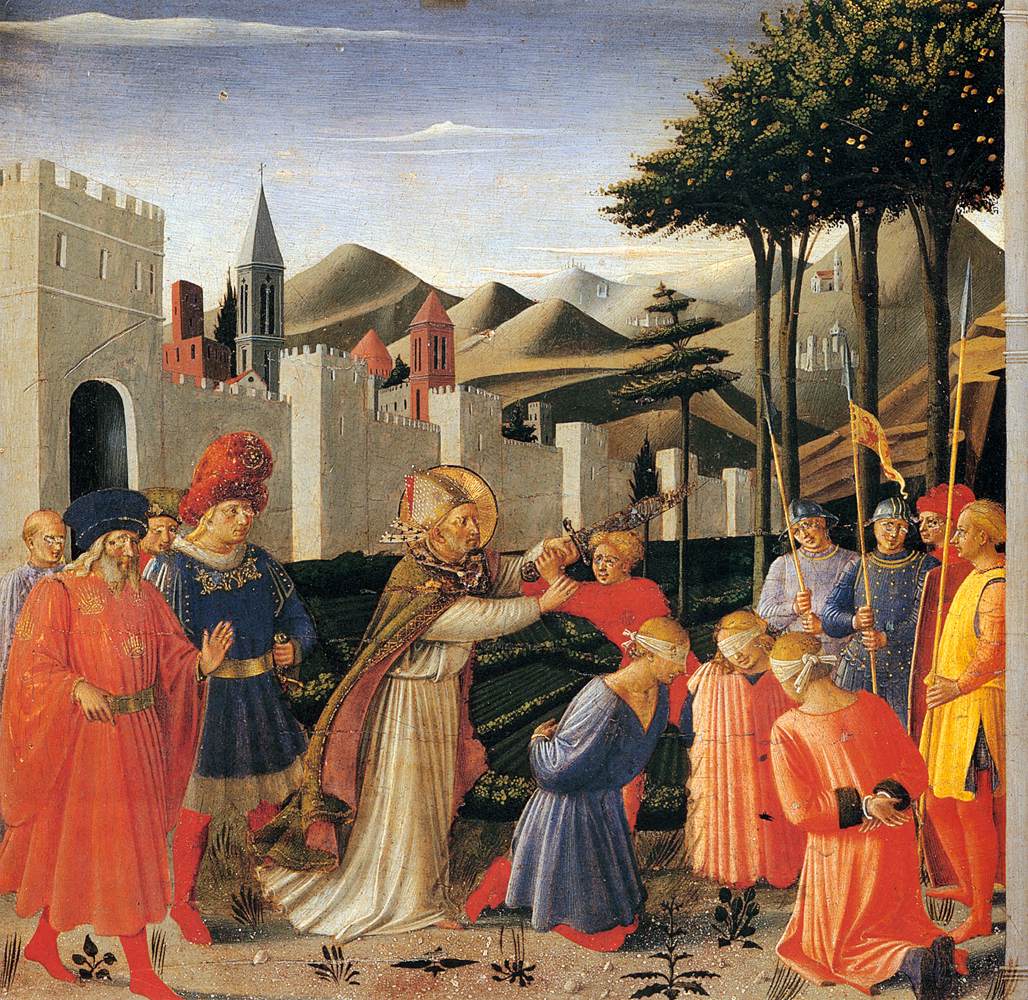
O Holy Father Nicholas, the fruit of your good deeds has enlightened and delighted the hearts of the faithful. Who cannot admire your measureless patience and humility? And who cannot wonder at your graciousness to the poor? At your compassion for the afflicted? O Bishop Nicholas, you have divinely taught all things well. And now wearing your unfading crown, you intercede for our souls with Christ, our God.
(Vesperal antiphon, Byzantine)
The Baptist calls us recognize the voice in desert

Advent is time of hope and expectation, it is also a time of repentance and conversion. Today’s readings in the Liturgy orient our attention to changing our life’s to reflect more and more the Lord’s. And the Baptist is the amazing and stirring Advent proponents to follow Jesus more closely. What is more identifiable than the Baptist’s exhortation: Prepare the way of the Lord?
St. Augustine on the gift of conversion: “What, then?
It is perhaps dependant on you, O man, if converted to God once you have earned
his mercy, while on the contrary those who have not converted have not obtained
mercy but have encountered the wrath of God? But you what resources available
to convert, if you had not been called? Was it not He who called you when you
were the enemy, to grant you the grace of repentance? So do not ascribe to
yourself the merit of your conversion: why, if God had not intervened to call
you when you fled from him, you would not have been able to look back.” St.
Augustine Expositionson the Psalmi, 84, 8-9.
It is perhaps dependant on you, O man, if converted to God once you have earned
his mercy, while on the contrary those who have not converted have not obtained
mercy but have encountered the wrath of God? But you what resources available
to convert, if you had not been called? Was it not He who called you when you
were the enemy, to grant you the grace of repentance? So do not ascribe to
yourself the merit of your conversion: why, if God had not intervened to call
you when you fled from him, you would not have been able to look back.” St.
Augustine Expositionson the Psalmi, 84, 8-9.
The International Theological Commission meets with Pope: God “has gifted us with a reason in harmony with his nature”
The Pope met yesterday with the members of the International Theological Commission in plenary session, a bi-annual meeting, though I think the Pope only meets in a plenary session with the ITC once a year. I am familiar with several members of the group and I can attest to their diligent and honest work in theology for the good of the entire Church. The work of the ITC deals with some of the most interesting theological and philosophical questions these days. The ITC is working on questions of theological methodology, the question of one God for the 3 monotheistic religions and question of the Church’s social doctrine in the context of Christian doctrine. The ITC documentation is published in various languages and useful for one’s own theological reflection. There are several important points the makes about the vocation of a theologian and the nature of theology. He reminds us, namely, that a theologian does not work in a solitary way, that faith and reason are intrinsically linked and that theology is outward thinking and acting. Benedict XVI’s address to the ITC follows:
I receive you with joy at the end of your annual
plenary session. I would like first of all to express my heartfelt gratitude
for the words of homage that, on behalf of all, Your Eminence, in his capacity
of president of the International Theological Commission, addressed to me. The
work of this eighth “quinquennium” of the commission, as you
recalled, addresses the following very weighty topics: theology and its
methodology; the question of the one God in relation to the three monotheistic
religions; the integration of the social doctrine of the Church in the wider
context of Christian doctrine.
plenary session. I would like first of all to express my heartfelt gratitude
for the words of homage that, on behalf of all, Your Eminence, in his capacity
of president of the International Theological Commission, addressed to me. The
work of this eighth “quinquennium” of the commission, as you
recalled, addresses the following very weighty topics: theology and its
methodology; the question of the one God in relation to the three monotheistic
religions; the integration of the social doctrine of the Church in the wider
context of Christian doctrine.
“For the love of Christ impels us, once we
have come to the conviction that one died for all; therefore, all have died. He
indeed died for all, so that those who live might no longer live for themselves
but for him who for their sake died and was raised” (2 Corinthians
5:14-15). How can we not make our own this beautiful reaction of the Apostle
Paul to his encounter with the risen Christ? In fact this experience is at the
root of the three important topics on which you reflected in your plenary
session that has just ended.
have come to the conviction that one died for all; therefore, all have died. He
indeed died for all, so that those who live might no longer live for themselves
but for him who for their sake died and was raised” (2 Corinthians
5:14-15). How can we not make our own this beautiful reaction of the Apostle
Paul to his encounter with the risen Christ? In fact this experience is at the
root of the three important topics on which you reflected in your plenary
session that has just ended.