Adoratio 2011: From Adoration to Evangelization

Dominique Rey.jpgThe Most Reverend Dominique Rey, Bishop of Fréjus-Toulon, announced today that he is sponsoring an international conference on Eucharistic Adoration to be held in Rome, Italy, 20-23 June 2011: Adoratio 2011: From Adoration to Evangelization.

The Missionaries of the Most Holy Eucharist, a community founded in 2007 Bishop Rey is doing the organizing of the conference.

In the words of Bishop Rey: “The first condition for the new evangelization is adoration.” No truer words have been spoken. And as we know so well, Eucharistic Adoration is key in the spiritual life and human flourishing and it figures prominently in the pastoral plan of Pope Benedict XVI.
Bishop Dominique Rey is renown for his pastoral directness and knowing Christ through sacred Scripture and the sacred Liturgy. His background includes earning a doctorate in economics and he worked for the Ministry of Finance of France. He is a priest of the Emmanuel Community and received episcopal ordination in 2000. Since becoming bishop, he’s known to be supportive of the good work of new communities, the lay movements and religious orders. His agenda is the Church’s:  the lex orandi, lex credendi tradition. He’s been an exponent of the new evangelization brought on the world stage by Pope John Paul II and continued by Pope Benedict XVI.
For more information: contact@adoratio2011.com
Media contact: Father Florian Racine: fr@adoperp.com 
The press release with a list of the speakers is found here: Eucharistic congress 2011, Rome.pdf

Friends wed today: Maureen and Andrew Walther

Friends wed today at Saint Mary’s Church (New Haven, CT). What a perfect day to go to a nuptial Mass to pray for friends as they wed each other with other friends. Maureen L. Hough and Andrew T. Walther are now husband and wife.

The Sacrifice of the Mass with the Rite of Marriage was celebrated by Dominican Father Paul J. Keller with the Schola Cantorum of Saint Mary’s. The Mass celebrated by Father Keller was beautiful and prayerful, doctrinal and sacred. Everything was fitting in order that God might be glorified. Maureen and Andrew chose today to wed because it was the closest day they could find to the great feast of Our Lady of Guadalupe (December 12). Both are close to Our Lady under this title. Maureen was beautifully dressed and Andrew wore a smart tux.

Continue reading Friends wed today: Maureen and Andrew Walther

Reading Benedict XVIs “Light of the World”

Much is being made of Peter Seewald’s brilliant interview of Pope Benedict XVI, Light of the World: The Pope, the Church, and the Signs of the Times (2010).

The recent splash of news about this book is rather interesting and pathetic at the same time. Interesting because there are some great things the Pope says theologically about a whole host of things; pathetic because so many people are focussed on what the Pope said about latex. In recent years I’ve not see THAT much interested in the Pope’s ideas on sex, sexuality and salvation through condom use. AND the confusion runs rampant to the point that a Vatican clarification had to be issued on what the Pope said. Catholic News Service ran the Vatican statement and making sure everyone was on the same condom –rather, page.

Card Burke.jpg

On November 22, Cardinal Raymond Leo Burke spoke briefly of the Pope’s recent work when he answered John Burger’s questions. Burke, prefect (head) of the Church’s highest court, the Supreme Tribunal of the Apostolic Signatura, is one of 24 new cardinals created by Benedict XVI on November 21. The cardinal is a native of Wisconsin, trained in Canon Law, and the bishop of La Crosse, WI, and the former archbishop of St Louis, MO.
Popular blogger Jimmy Akin wrote two noteworthy pieces, “The Pope Said WHAT about Condoms???” which can be read here and “New Developments on the Pope and Condoms” can be read here.

Lectio Divina: 9 qualities of doing

At yesterday’s terrific conference on Lectio Divina, the keynote presenter, Trappist Brother Simeon Levia, monk of Saint Joseph’s Abbey, Spencer, MA, gave an incredible talk on doing the work of Lectio Divina at a conference on Lectio sponsored by Mario Paredes and his staff at the American Bible Society. Brother Simeon is an established Catholic thinker.

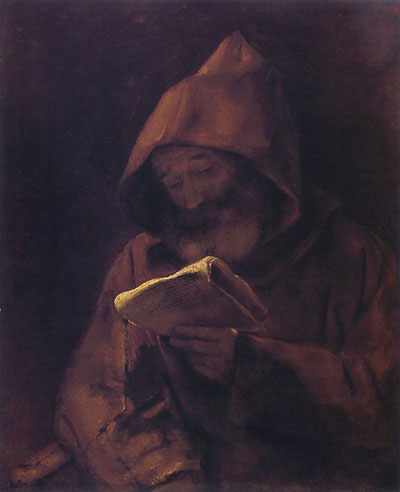
One central aspect of Brother Simeon’s talk was his development of 9 qualities of Lectio Divina. Please note, lectio divina is not the exclusive domain of professional religious, that is, the exclusive use of monks and nuns, even though a lot of artwork often limits itself to portraying monks doing lectio. My notes are an expansion of what he said about doing lectio divina:

monk doing lectio.jpg

1. It’s done leisurely, it is not a rushed process: give at least 30 minutes. There’s an open-endedness of doing lectio; it’s to be done in a slow manner, neither achievement nor goal-oriented. You might want to read Josef Pieper’s seminal book, Leisure: The Basis of Culture. By doing lectio in a leisurely manner one activates the deepest levels of the human heart opening the heart up to its potentiality. Brother Simeon said something crucial for me: doing lectio in a leisurely manner you return to Paradise where there’s an original delight in all things –God, His Presence, ourselves, the Other. Brother noted that in this category we are able to build “islands of leisure for all” in that we cultivate healthy relationships. Remembering that we are made for the other –be it for life in the Trinity and the other person– and not to cultivate healthy relationships we are prone to die. Pertinent, therefore, is to ask the question: How do I spend my free time and take delight in that time? With a style of life that prizes the use of time, how we use our time is a sacrifice. Time is a precious gift from God. If you are inclined to do things out of obligation: forget it. Moralisms don’t work here.
2. It’s ruminative, that is, you turn over and over in mind a word or an image like a cow chews her cud. One’s ruminating on words and images means that you stay close to the text until you deplete for the moment the energy of that word and/or image. Brother Simeon advocates our attention to the language (the grammar) of the text. Here words are important, not just ideas. If  possible you would compare different translations of the Scriptural passage, and if you are really skilled, you’d consult with the Latin and Greek texts. There’s no reductive choice of words for this work.
3. Lectio is cordial. There’s a freedom of the heart to follow its own instincts. The point here is to allow the flourishing of the language of the heart to work over the language of the logic of reasoning. Brother Simeon used the image of a “logic of fire” where it sparks, it ignites flames that illuminate a path. A cordial reading of Scripture doesn’t allow the historical critical method to run one’s prayer (the aims of HCM and Lectio Divina are not same); Lectio is about something that is new, unique and at a deeper of awareness.
4. Lectio is contemplative, that is, lectio is “the listening heart.” “Contemplation” is a much misunderstood and abused word. It is needs to be liberated by so much clutter, let me tell you. When you think of contemplation you ought to think of being receptive to the transcendent. As I tell the students in the Catechesis of the Good Shepherd, the language that God most often uses is silence to express Himself. How much more do we need to remind ourselves that silence needs to be cultivated in order to know, love and serve God. Into greater silence we should walk if we are going to cut sin and falsehood out so as to live (abide) in Christ.
Think of what Saint Paul said: “Now if the ministry of death, carved in letters on stone, was so glorious that the Israelites could not look intently at the face of Moses because of its glory that was going to fade, how much more will the ministry of the Spirit be glorious? For if the ministry of condemnation was glorious, the ministry of righteousness will abound much more in glory. Indeed, what was going to fade was glorious, how much more will what endures be glorious” (2 Cor. 3: 6-8).
5. It’s disinterested: there’s no predetermined goal or skills to be learned or analysis to be made. At this point the there’s no goal that’s not produced in freedom; the fruitfulness of the word is unknown in the apostolate but in prayer. The apostolate for so many is more important than adoring the Word. No apostolic work will be fruitful if not grounded and sustained in lectio and prayer.
6. Lectio is provocative. With the prayerful reading of Scripture we’re not looking for a soothing by-product. The provocative nature of lectio means that our reading ought to take us out of our comfort zone. Scripture should make us a little –perhaps a lot in some cases– uncomfortable. Scripture’s provocative nature makes us sacrifice our preconceptions and ideologies opening us up to new mentality, an new attitude by which we judge reality. As Brother said, “God seeks to call us out of hiding.” Think of God calling Adam from his hiding place where he demurs: I am naked.
7. Lectio is necessarily and crucially ecclesial. Our ability to encounter God through Lectio Divina is an act of gratitude. It is the Church who is the owner and guardian of Scripture. We receive the Scriptures from the sacred Liturgy in its proclaimed and written form and seen in the context of its historical, grace-filled (liturgical) and eschatological planes. The heart and mind of the Church is respected because the Bible is a gift of the Holy Spirit.  When we say that lectio is ecclesial we also mean that it is inherently Christological and Marian. How could one read and pray with the Scriptures without thinking about it being Christo-centric: what converges is the reality of knowing who Christ is and how the Father sees his Son. Lectio is Marian because the Word is conceived in her womb, and Mary pondered the word in her heart. It is through Mary that we learn how to be silent, adoring, and faithful to God coming to humanity. Mary is the first church that lives the word in all its fullness.
8. Lectio is trans-biblical. This is a unique word formed by Brother Simeon by which he indicates that we are to allow the texts breath freely. Since the sacred Scripture reveals the hidden face of God in a unique and definitive manner. Allowing the Scriptures to live on their own, divine revelation is manifested according to the heart of God. Moreover, the sense here is that the Bible interprets itself: every part completes other parts.
9. Finally, lectio is mystagogical. Here is where lectio merits the adjective “divina.” The subjective is transformed by the objectivity and freedom of Grace. It is here that lectio divina realizes itself in its missio, its fruitfulness. The work done at this point can be expressed in this way: we become a living exegesis of the Word. The disciple learns from the Spirit on how to put on the mind of Christ; the Incarnation is born anew today. Recall: the Liturgy reminds us that today the Paschal Mystery has happened, today we are saved; today we are brought into intimacy with the crucified and risen Savior. And where does this happen: in me.
How close am I to Christ? How close is Christ to me? With mystagogy the disciple recognizes the Lord in Word, Sacrament and prayer. Knowledge, therefore, loves to be fruitful. Lectio that lives in this point knows in the deepest parts of the the soul a modest foretaste of heaven.
Brother Simeon was ordained to the priesthood in May of 2013 and he entered the Abbey in April 2003. Those who know him will say that Simeon is an accomplished author, preacher and retreat master, is currently serving as secretary to the Trappist Abbot General in Rome. He continues as editor of the Monastic Wisdom Series for Cistercian Publications.

Lectio Divina conference sponsored by American Bible Society

American Bible Society logo.pngI am exceedingly happy to see the American Bible Society (ABS) responding so quickly to Pope Benedict’s encouragement to delve more deeply into sacred Scripture through the practice of Lectio Divina. The Pope spoke eloquently of Lectio Divina and its need for us to practice in his recent work on Scripture, Verbum Domini.

Mario Paredes who oversees the Roman Catholic section of the ABS has organized for today “a contemporary approach to the ancient method of Lectio Divina as a service both to and through the Catholic Church with a new Lectio Divina Bible and Manuel. ABS will inaugurate the new Lectio Divina program at an official kick-off” today at 11 a.m at the ABS headquarters.
Brother Simeon Leiva, OCSO, a monk of Saint Joseph’s Abbey, Spencer, MA, will deliver a talk titled, “A Contemporary Approach to Lectio Divina.”

With a look full of hope and compassion Mary says: fear not, God loves you personally

Pope Benedict made the annual visit to Spain’s Square, the Spanish Steps as it’s known, to lay a wreathe at the Shrine of the Immaculate Conception of the Blessed Virgin Mary, to offer a prayer of filial devotion and to encourage the faithful in our faith. His address follows:

B16 Dec 8 2010 Spanish Steps.jpg

Also this year
we have made an appointment here, in Piazza di Spagna, to render homage to the
Immaculate Virgin, on the occasion of her solemn feast. To all of you, who have
come in great numbers, as well as all those taking part through radio and
television, I address my cordial greeting. We are gathered around this historic
monument, which today is all surrounded by flowers, sign of the love and
devotion of the Roman people for the Mother of Jesus. And the most beautiful
gift, and most pleasing to her, that we offer is our prayer, the one we bear in
our hearts and which we entrust to her intercession
. They are invocations of
gratitude and supplication: of gratitude for the gift of faith and for all the
good that we receive daily from God; and supplication for our different needs,
for the family, health, work, for every difficulty that life has us encounter.

Continue reading With a look full of hope and compassion Mary says: fear not, God loves you personally

Catherine of Siena: A Passionate Life –book presentation at St Catherine of Siena Church NYC

Catherine of Siena A Passionate Life.jpgOn Thursday, December 9, 2010 at 7:00 PM
in Saint Catherine of Siena Church, 411 East 68th Street, NYC, author Don
Brophy will present his award winning new book, Catherine of Siena: A
Passionate Life
.


Brophy’s book has won the Paulist Press Book of the
Month Award, the same is forthcoming from the Catholic Press Association. Other
Catherine of Siena Scholars hail Don Brophy’s work as a masterpiece that
reveals in a new way the wonder and passion of Catherine of Siena in
medieval Europe and today.

There will be time for questions and answers as well
as meeting the author.

The event is free and open to the public.

Saint Catherine of Siena Church is a ministry of the Dominican Friars of the Province of Saint Joseph. The friars have been present on New York’s East Side since 1896. In addition to the Church, the friars also sponsor the Dominican Friars Healthcare Ministry of New York, providing pastoral care to the four area hospitals.

Consecration of Persons to the Immaculate Heart of the Most Blessed Virgin Mary

This prayer of consecration was written by a friend of mine, Father Mark. As he notes, “and may be helpful when one experiences a need to entrust particular souls in difficulty to the Immaculate Conception. As he notes, when a priest prays it, he may want to don the stole and pray it before a blessed image of the Most Holy Virgin. This intercessory consecration is appropriate for the unbinding and healing of situations marked by habitual sin and moral suffering. The Immaculate Virgin Mary is ever-ready to intervene in the lives of her children. She is the Mother of Mercy and the Mediatrix of All Graces.”

In the name of the Father, + and of the Son, and of the Holy
Spirit. Amen.

Immaculate Conception bw.jpg

Most holy Virgin Mary, — thou whom the FATHER didst preserve
from the first instant of thy conception from all evil and from the least
shadow of sin,
– thou whom the Precious Blood of JESUS didst render immaculate
and all-beautiful, even before that same Blood was formed in thy virginal womb
and poured out upon the altar of the Cross,
– thou whom the HOLY GHOST didst
fill full with every grace in view of the glorious motherhood of the Son of God
for which thou wast created, — thou art she who crusheth the head of the ancient
serpent, thou art she who alone overcometh the evil that is in us and around
us.

To thee, O Mary, thy Son hath entrusted the liberation of souls enchained
by sin, the healing of wounded souls, and the sanctification of souls who have
suffered evil’s worst ravages.

Thou hast only to open thy immaculate hands over
them, and they are shot through with the rays of thy purity. Through thee,
entereth the light to shine in the darkest places. Through thee, souls are washed
in a downpour of graces. Through thee, the Holy Spirit succoureth the weakest
souls and giveth to the sterile a wonderful fecundity.

Continue reading Consecration of Persons to the Immaculate Heart of the Most Blessed Virgin Mary

Catholic reform of priesthood called by Vatican official Mauro Piacenza

MPiacenza.jpegMauro Cardinal Piacenza, Prefect of the Congregation of Clergy, is focusing on the life of the priest and how the Catholic priest lives the vocation given to him by the Holy Spirit. Piacenza is doing all he can to strengthen priesthood in all its vigor and beauty. In the style and content of Benedict XVI, Piacenza is calling for a Catholic reform of the priesthood, a reform that returns to the source. He said, 

I think it’s a big task that I do no hesitate to define reform. But reform in the Catholic sense of the word, which is to get as close as possible to the source, close to the Heart of Jesus, which is the mystery of the priesthood. Therefore, they must take care of the relationship with God.